

By Tejasvi Singh | India Prime Researce Sariska Tiger Model June 28, 2026 marks a historic milestone in India’s wildlife conservation journey. A National Seminar was organized at Sariska Tiger Reserve to commemorate 18 years of the Tiger Reintroduction Project.
The seminar was inaugurated by Union Minister for Environment, Forest and Climate Change Bhupender Yadav and Rajasthan Minister of State for Forest & Environment Sanjay Sharma.
The objective of the seminar was not only to celebrate 18 years of conservation success but also to prepare India’s future Tiger Conservation Roadmap.
Key Dignitaries Participating in the Seminar
- Sushil Awasthi, Director General, National Tiger Conservation Authority (NTCA)
- Sanjay Kumar, Additional Director General (Forests)
- S.P. Yadav, Director General, International Big Cat Alliance (IBCA)
- Chief Wildlife Wardens from 11 Indian States
- Field Directors of more than 20 Tiger Reserves
- Senior Indian Forest Service (IFS) Officers
- Experts from the Wildlife Institute of India (WII)
- Wildlife Scientists, Conservation Biologists and Forest Management Experts
The Real Heroes Behind the Sariska Model
The success of Sariska is the result of collective efforts rather than the work of a single institution.These organizations jointly prepared a scientifically driven tiger recovery strategy.
Policy and Institutional Leadership
- Government of India
- Government of Rajasthan
- National Tiger Conservation Authority (NTCA)
- Rajasthan Forest Department
- Wildlife Institute of India (WII)
- International Big Cat Alliance (IBCA)
Administrative Leadership
The Forest, Environment and Climate Change Department of Rajasthan is led by IAS officers at the policy level, while Indian Forest Service (IFS) officers are responsible for technical forest and wildlife management.
Key Leadership
- Arijit Banerjee (IFS) – Principal Chief Conservator of Forests & Head of Forest Force (PCCF & HoFF)
- Pawan Kumar Upadhyay – Senior Forest Leadership
- Rajesh Kumar Gupta (IFS) – Additional Principal Chief Conservator of Forests (Wildlife) & Chief Wildlife Warden (CWLW)
- Uday Shankar (IFS) – APCCF, CEO CAMPA and Additional Charge of Monitoring, Evaluation & Forest Protection
- Managing Director, Rajasthan State Forest Development Corporation Ltd. (RSFDCL) with additional responsibility for Labour & Legal Affairs
These senior officers played a significant role in strengthening the Sariska Tiger Model through:
- Action against illegal mining
- Village relocation
- Budget and resource management
- Scientific wildlife monitoring
- Strategic tiger translocation planning
Ground-Level Conservation Teams
The greatest contribution came from:
- Forest Guards
- Rangers
- Field Biologists
- Veterinary Teams
- Camera Trap Monitoring Teams
- Local villagers
- Eco-Development Committees
Their continuous field surveillance ensured the long-term protection of Sariska’s tiger population.
What is the Sariska Model?
The Sariska Model is far more than relocating tigers from one forest to another.
It is a four-pillar conservation framework.
Before its revival, Sariska represented one of India’s biggest wildlife crises.
By 2004-05, all tigers had disappeared due to large-scale poaching.
The Government of India, Government of Rajasthan, NTCA, Forest Department and scientific institutions jointly launched an ambitious recovery plan.
June 28, 2008: Tigers Arrived by Helicopter
On June 28, 2008, the first tiger was airlifted by helicopter from Ranthambore Tiger Reserve to Sariska.
Subsequently, additional male and female tigers were translocated.
The project became the world’s first widely recognized successful Tiger Reintroduction Programme, restoring an entirely extinct tiger population.
Sariska Today
After eighteen years, Sariska has achieved remarkable success.
Today it supports:
- Approximately 53 tigers and cubs
- Multiple established territories
- Regular breeding
- Scientific monitoring
- Advanced wildlife protection
making it one of India’s most successful tiger landscapes.
Four Pillars of the Sariska Model
1. Scientific Tiger Reintroduction
Scientific selection of tigers, radio collaring, veterinary screening and helicopter translocation.
2. Habitat Restoration
Revival of forests, water resources, prey base enhancement and reduction of human pressure.
3. Community Participation
Village relocation, employment generation, eco-tourism and local community involvement.
4. Technology Driven Protection
Artificial Intelligence, drones, camera traps, GPS tracking, satellite monitoring and digital patrolling.
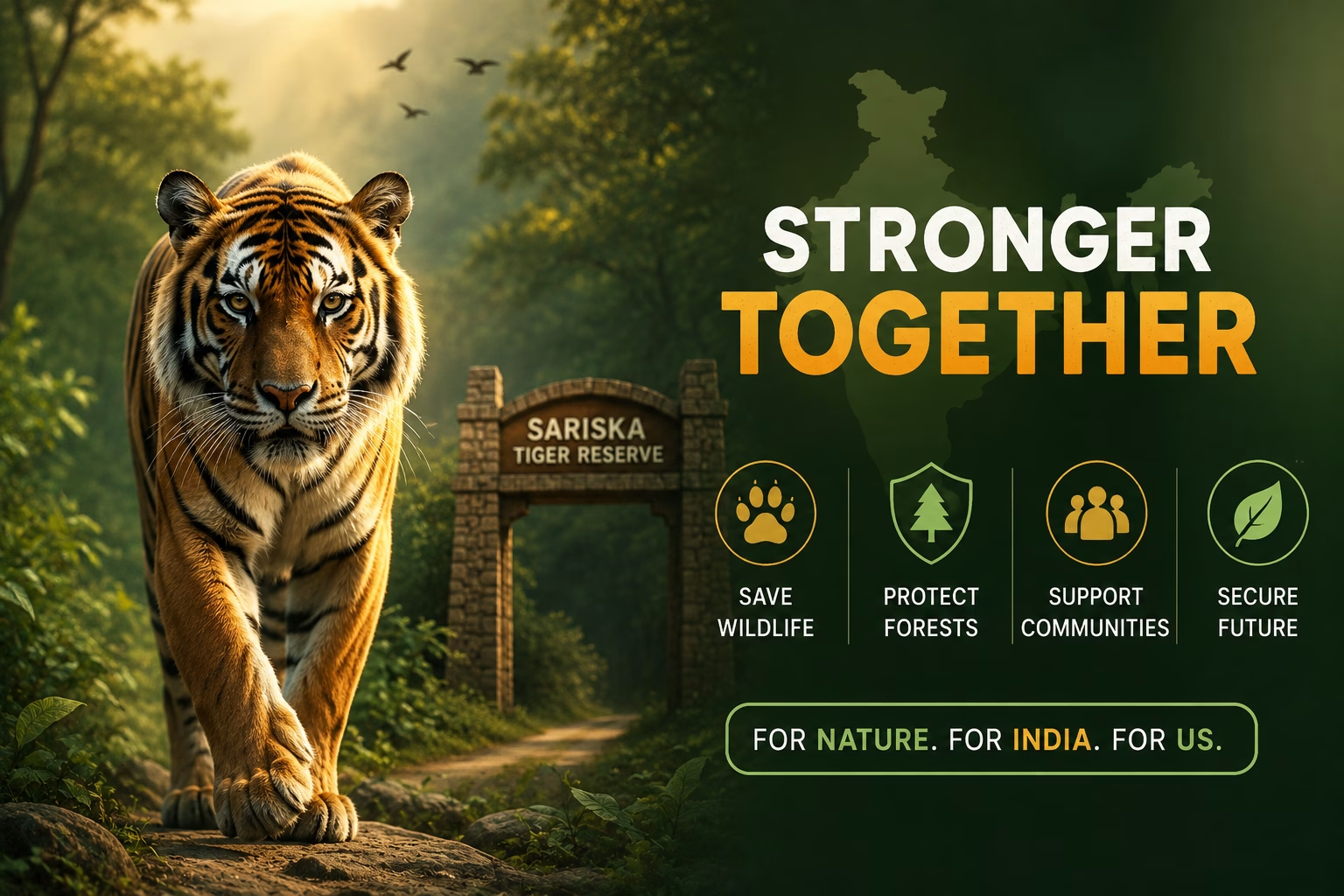
Why Has the Sariska Model Become a Global Example?
By 2005 Sariska had completely lost its tiger population.
Following the first translocation in 2008, the reserve now has:
- Around 53 tigers and cubs
- Third and fourth generation breeding
- Stable population growth
- Continuous scientific management
It is now regarded as one of the world’s most successful tiger reintroduction programmes.
How is Sariska Different from Other Tiger Reserves?
| Conventional Tiger Reserve | Sariska Model |
|---|---|
| Natural forest corridors | Isolated habitat |
| Dense forests | Dry deciduous Aravalli forests |
| Native tiger population | Fully restored population |
| Traditional patrolling | AI-based surveillance |
| Limited technology | Drone, Thermal & Satellite Monitoring |
| Conventional conservation | High-Tech Conservation |
Sariska’s Geographical Challenge
The reserve faces unique conservation challenges:
- Rocky Aravalli terrain
- Dry deciduous forests
- Human settlements
- Religious pilgrimage sites
- Limited natural wildlife corridors
These factors make Sariska one of India’s most complex tiger landscapes.
India’s First High-Tech Tiger Conservation Plan
The new conservation strategy integrates advanced technologies including:
- AI Camera Trap Grid
- Thermal Surveillance
- Drone Monitoring
- GPS & Satellite Tracking
- Real-Time Control Room
- Dedicated Tiger Monitoring Teams
- Smart Patrol System
- Wildlife Corridor Mapping
- Human-Wildlife Conflict Management
“Rajmata ST-2” – The Tigress That Changed Sariska’s Future
If one tiger symbolizes Sariska’s success, it is Tigress ST-2.
After the death of ST-1 in 2010, the project faced serious uncertainty.
ST-2 revived hope by:
- Producing the first successful litter
- Establishing the second generation
- Laying the foundation for the third and fourth generations
She is therefore respectfully known as the “Rajmata of Sariska.”
Future Roadmap
The National Seminar focused on:
- Wildlife Corridors
- Climate-Resilient Conservation
- AI-based Wildlife Monitoring
- Genetic Diversity
- Landscape-Level Management
- Community-Based Conservation
- Eco-Tourism Management
- High-Tech Wildlife Protection
Conclusion
What began eighteen years ago as an ambitious conservation experiment has today evolved into a globally recognized wildlife management model.
The Sariska Model represents far more than the return of tigers. It demonstrates the power of science, technology, political commitment, administrative leadership and dedicated frontline forest staff working together.
Today, the Sariska Model serves as a blueprint for nations seeking to restore endangered wildlife populations.
Frequently Asked Questions (FAQs)
When did Tiger Reintroduction begin in Sariska?
Tiger reintroduction officially began on 28 June 2008, when the first tiger was airlifted from Ranthambore Tiger Reserve.
How many tigers currently live in Sariska?
Sariska currently supports approximately 53 tigers and cubs.
What is the Sariska Model?
It is a scientific conservation framework based on tiger translocation, habitat restoration, community participation and technology-driven monitoring.
Why is Sariska globally significant?
It is among the world’s most successful examples of restoring an entirely extinct tiger population.
How is Sariska different from other tiger reserves?
Its isolated Aravalli landscape, lack of natural corridors and extensive use of AI-driven conservation technologies make it unique.
What is the High-Tech Conservation Plan?
It integrates AI camera traps, drones, thermal surveillance, satellite tracking and real-time monitoring systems.
Why is ST-2 called the “Rajmata of Sariska”?
Because she established the first successful breeding lineage that led to today’s thriving tiger population.
What was the objective of today’s National Seminar?
To review 18 years of tiger reintroduction success and develop future strategies for tiger conservation across India.
SEO Keywords
Sariska Tiger Model, Sariska Tiger Reserve, Tiger Reintroduction India, Tiger Reintroduction 2026, Bhupender Yadav, NTCA, Tiger Conservation India, Rajasthan Forest Department, High Tech Conservation Plan, AI Wildlife Monitoring, Wildlife Conservation India, Sariska Tigers, Ranthambore Tiger Transfer, IBCA, Wildlife Management India
Sariska, Sariska Tiger Reserve, Tiger Reintroduction, Tiger Conservation, NTCA, Bhupender Yadav, Sanjay Sharma, Rajasthan Forest Department, Wildlife India, AI Conservation, High Tech Conservation, Big Cats, Sariska Seminar 2026
Read this full research by India Prime Research in hindi click link
#Sariska #TigerConservation #TigerReintroduction #Wildlife #Rajasthan #NTCA #BhupenderYadav #BigCats #Conservation #IndiaPrimeTV #Environment #Forest #WildlifeIndia #Biodiversity #TigerReserve #AIConservation