
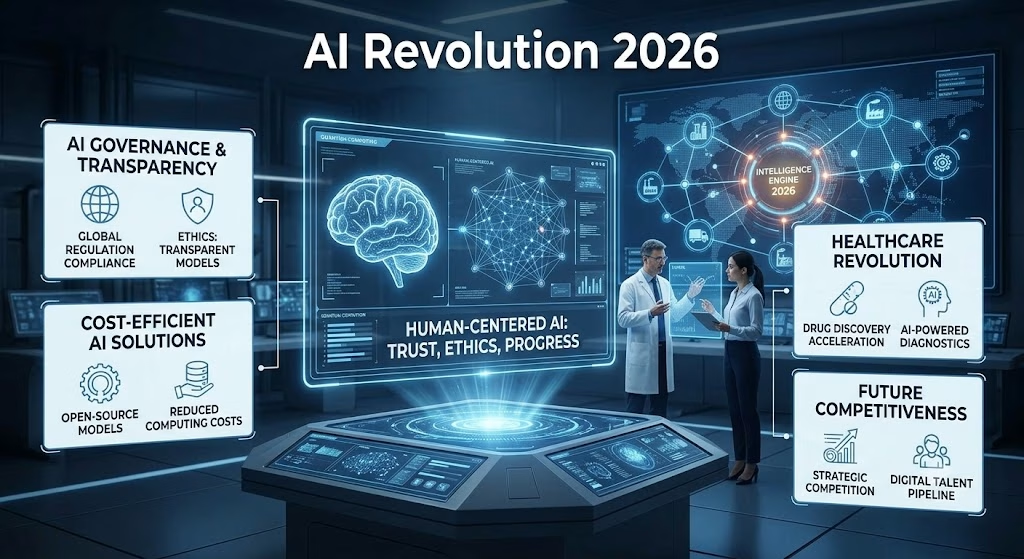
Devender Singh IndiaPrimeTv Artificial Intelligence is no longer confined to research laboratories or Silicon Valley boardrooms. In 2026, AI has become a transformative force shaping economies, healthcare systems, education, advertising, governance, and everyday life across the globe.
From accelerating breakthrough drug discoveries to creating hyper-realistic digital humans for advertising campaigns, AI is rapidly moving from an experimental technology to a foundational pillar of modern society. At the same time, rising AI costs, increasing regulatory scrutiny, and growing concerns about transparency and ethics are forcing governments, businesses, and researchers to rethink the future of intelligent machines.
As the global AI race intensifies, one critical question remains: Are we witnessing the dawn of humanity’s most powerful tool, or the emergence of challenges we are not yet fully prepared to manage?
The Rise of AI Regulation: Transparency Becomes the New Standard
One of the most significant developments in 2026 is the growing demand for AI transparency.
New York has introduced regulations requiring advertisements to clearly disclose when AI-generated or “Synthetic Performers” are being used. The move reflects growing concerns that consumers may struggle to distinguish between real people and digitally generated personalities.
This marks a major turning point in AI governance. Experts believe similar regulations could soon expand across Europe, Asia, and other major markets as governments seek to combat misinformation, deepfakes, and deceptive digital content.
For businesses, transparency is quickly becoming a competitive advantage. Brands that openly disclose AI-generated content may gain greater consumer trust in an era where authenticity is increasingly valuable.
Why This Matters
- Greater protection against AI-generated misinformation.
- Improved consumer trust in digital advertising.
- Stronger safeguards against deepfake fraud.
- New global standards for responsible AI deployment.
The AI Cost Crisis: Why Companies Are Turning to Open-Source Models
While AI adoption continues to accelerate, a growing number of organizations are facing an unexpected challenge: cost.
Throughout 2024 and 2025, businesses rushed to integrate advanced AI systems into their operations. However, expensive subscriptions, rising inference costs, and increasing token consumption have made large-scale deployment difficult for many enterprises.
As a result, companies are increasingly exploring open-source AI models and lower-cost alternatives developed outside traditional Western ecosystems. Chinese large language models (LLMs) and open-source platforms are gaining momentum because they offer greater customization, lower operating costs, and increased control over data.
Industry analysts believe the next stage of AI competition will not be defined solely by which company builds the most powerful model, but by who delivers the most cost-efficient and practical AI solutions.
The future winners may not necessarily be the biggest innovators—but the companies that successfully balance performance, affordability, and accessibility.
Can AI Really Think? The Consciousness Debate Intensifies
As AI systems become increasingly sophisticated, one philosophical and scientific question continues to dominate discussions:
Can Artificial Intelligence become conscious?
Despite remarkable advances in natural language processing and reasoning capabilities, most leading researchers argue that today’s AI systems remain fundamentally different from human minds.
Modern AI can analyze vast datasets, generate human-like conversations, write code, produce artwork, and solve complex problems. Yet experts emphasize that these systems do not possess self-awareness, emotions, subjective experiences, or genuine understanding.
In simple terms, AI can simulate intelligence—but it does not experience reality.
This distinction is becoming increasingly important as AI systems appear more human-like in conversations and decision-making processes. The debate over machine consciousness is expected to remain one of the defining intellectual discussions of the next decade.
AI’s Biggest Opportunity: Revolutionizing Healthcare and Drug Discovery
Perhaps the most promising impact of Artificial Intelligence is emerging in healthcare.
Scientists are now combining AI with multi-omics data—including genomics, proteomics, and molecular biology—to accelerate the discovery of new medicines and treatments.
Traditionally, drug development can take more than a decade and cost billions of dollars. AI is helping researchers identify promising drug candidates in a fraction of the time, potentially reducing costs and accelerating medical breakthroughs.
The technology is also driving advances in precision medicine, where treatments can be tailored to an individual’s unique biological profile.
For patients suffering from cancer, rare diseases, and chronic illnesses, AI-powered healthcare could represent one of the most significant medical revolutions of the 21st century.
AI Expands Across Business, Education, and Government
Artificial Intelligence is no longer a technology industry story—it is becoming a global economic story.
According to industry research, AI adoption is accelerating across:
- Financial services
- Cybersecurity
- Customer support
- Supply chain management
- Education technology
- Public administration
- Scientific research
Nations are also investing heavily in national AI strategies. Countries that successfully develop AI infrastructure, research ecosystems, and digital talent pipelines are expected to gain significant economic advantages in the coming decade.
The emerging AI race is increasingly viewed as a strategic competition that could influence future economic growth, technological leadership, and geopolitical influence.
The Road Ahead: Human-Centered AI
The central challenge facing the AI industry is no longer whether artificial intelligence can become more powerful.
The real challenge is ensuring that AI becomes more trustworthy, transparent, affordable, and aligned with human values.
The most successful AI systems of the future will not simply be those with the largest models or the highest performance benchmarks. They will be the systems that improve human productivity, solve real-world problems, and operate within clear ethical and regulatory frameworks.
As AI continues to reshape the world, 2026 may ultimately be remembered not as the year AI became smarter—but as the year humanity began learning how to govern it responsibly.
Conclusion
Artificial Intelligence stands at a historic crossroads.
It offers unprecedented opportunities in healthcare, science, business, and innovation. At the same time, it raises critical questions about transparency, ethics, economic disruption, and human identity.
The future of AI will be determined not only by technological breakthroughs but by the choices societies make today. The nations, companies, and institutions that successfully balance innovation with responsibility will be best positioned to lead the next era of the digital age.
Sources Referenced: Associated Press (AP), Broadband Breakfast, Tom’s Hardware, The Wall Street Journal (WSJ), The Atlantic, Nature Intelligence, IBM Think, Anadolu Agency, Simplilearn, Windows Central, and global AI industry reports.