The industry coalition highlights data-driven support for the reclassification of expanded polystyrene transport packaging and rigid polystyrene packaging.
Posted by Erin Finan, Managing Editor
The Polystyrene Recycling Alliance (PSRA), a North American coalition working toward innovative polystyrene recycling solutions, released two business cases supporting the reclassification of expanded polystyrene (EPS) transport packaging and rigid polystyrene (PS) packaging under the U.S. Plastics Pact’s materials evaluation framework.
PSRA says the business cases draw on independent analysis by Ann Arbor, Michigan-based Resource Recycling Systems (RRS), third-party research and real-world case studies to demonstrate that both materials are backed by growing infrastructure, expanding end markets and continued industry investment.
“Polystyrene is a valuable, recyclable resource with a clear pathway to circularity and plays a critical role in the emerging circular economy for plastics,” said Polystyrene Recycling Alliance Chair Justin Riney. “The focus should be on scaling solutions and investing in the systems that are already working. That’s exactly what these business cases are designed to support.”
The first business case addresses EPS transport packaging—widely used for appliances, pharmaceuticals and cold-chain logistics—and demonstrates meaningful, existing recycling infrastructure, according to PSRA.
According to a study conducted by the EPS Industry Alliance, EPS transport packaging has achieved a recycling rate of approximately 31 percent in North America and is supported by a growing nationwide network of more than 700 drop-off locations and business-to-business recovery systems. Because it is primarily recovered through commercial and drop-off channels rather than curbside collection, PSRA says EPS transport packaging avoids contaminating mixed recycling streams by operating within a dedicated, functioning circular system.
Independent analysis by RRS identified 81 companies operating 119 facilities across the United States and Canada using recycled EPS as a manufacturing feedstock, producing everything from EPS transport packaging to construction materials. PSRA says the material is compatible with multiple recycling pathways—mechanical, dissolution and chemical—making it a versatile feedstock for circular applications.
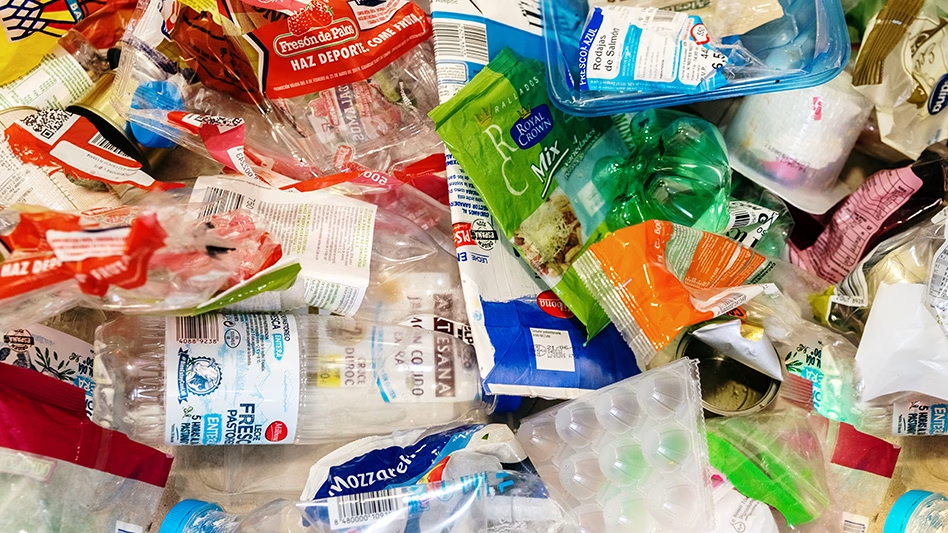
The second business case highlights rigid PS packaging, which is found in yogurt cups, produce containers, bakery clamshells, foodservice items and protective retail packaging that are already collected, sorted and recycled in communities across the United States.
An estimated 25–28 percent of the U.S. population have access to recycling infrastructure covering at least one rigid PS format, according to RRS, placing it within the “check locally” category for recyclability. RRS also identified 45 companies operating 50 facilities across the United States and Canada using recycled rigid PS as feedstock for consumer goods, packaging and building materials.
Like EPS, PSRA says rigid PS is compatible with mechanical, dissolution and chemical recycling technologies, each capable of producing high-quality, food-grade outputs. The business case further notes that rigid PS does not disrupt recycling systems, is easily sortable in modern material recovery facilities and represents a small share of the overall waste stream.
RRS also identified 45 companies operating 50 facilities across the United States and Canada using recycled rigid PS as feedstock for consumer goods, packaging and building materials.
PS has been approved for food-contact use by the U.S. Food and Drug Administration (FDA) for decades, PSRA says, with both the FDA and the European Food Safety Authority concluding that use of PS products poses no risk to consumers. Styrene, the liquid monomer used to produce PS, occurs naturally in foods such as strawberries, cinnamon, coffee, peanuts and beef.
PS or EPS packaging, which is comprised of 95–98 percent air, often has lower lifecycle greenhouse gas emissions than heavier alternatives, especially in transport applications where weight efficiency, product protection and food waste prevention are important climate factors.
PSRA says it supports the U.S. Plastics Pact’s commitment to promoting a circular economy for plastics and sees these business cases as an important contribution. The evidence presented makes a strong case that both materials are ready for reclassification from the “problematic and unnecessary” designation.
PSRA says it looks forward to collaborating with the U.S. Plastics Pact and stakeholders to:
“Rigid polystyrene and EPS transport packaging have the technology, the end markets and the momentum to succeed,” Riney says. “These business cases reflect our commitment to building on that progress.”