By Devender Singh | India Prime TV Jaipur Rajasthan Government Tightens Rules on APO: Accountability Fixed for Officers Kept Without Posting Beyond 30 Days The Rajasthan Government has started taking strict measures against the practice of keeping government employees and officers under Awaiting Posting Orders (APO) for a long period. The objective of the government is to prevent situations where officers continue receiving salaries without assigned responsibilities and to ensure administrative accountability.
APO (Awaiting Posting Orders) means an officer has been removed from his/her previous posting but a new posting order has not yet been issued. Normally, it is considered a temporary administrative arrangement. However, in several states, APO has often remained in discussion due to allegations that it was prolonged because of administrative reasons, departmental disputes, transfers, or other issues.
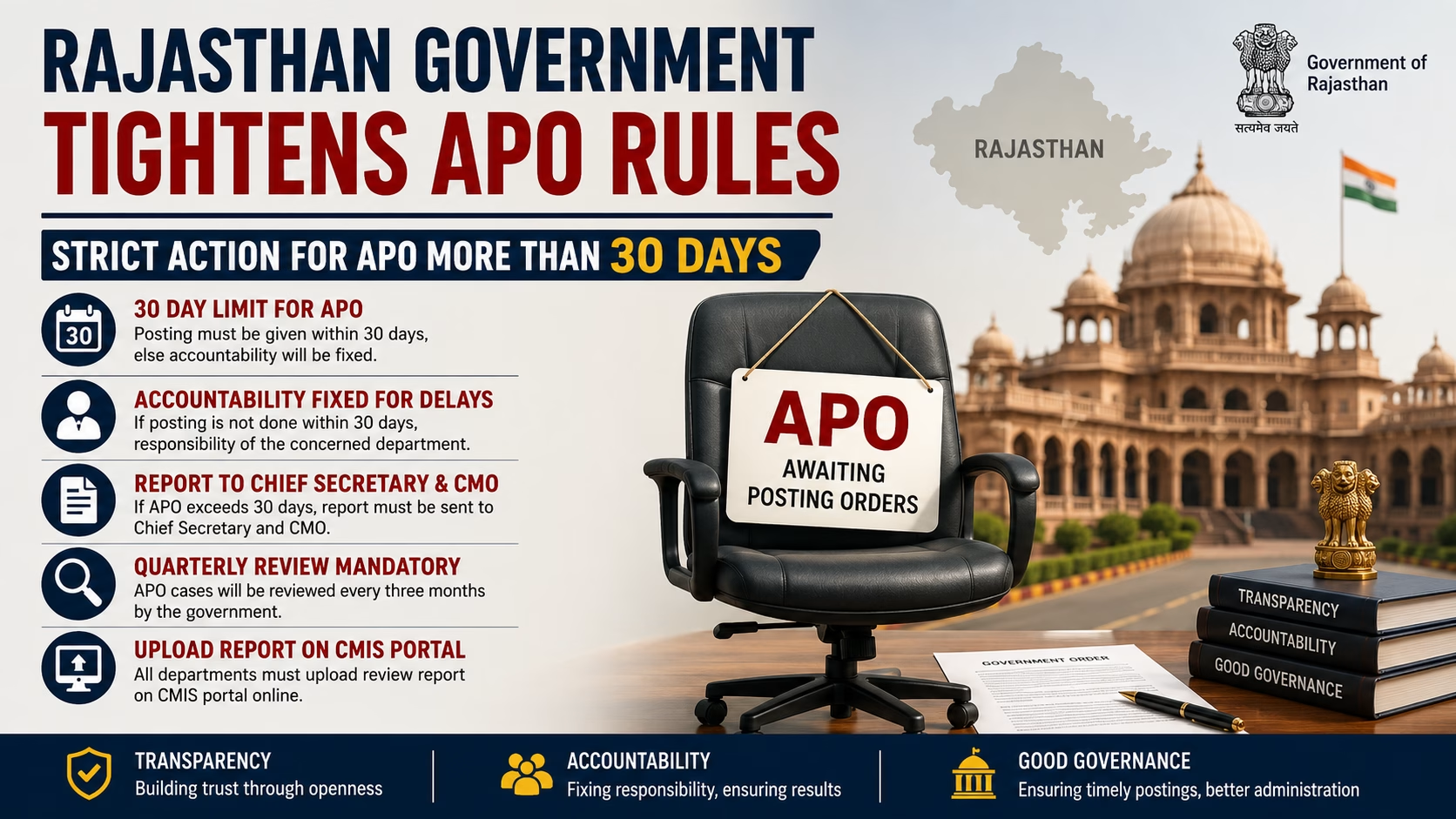
The Rajasthan Finance Department has issued directions that if an employee or officer remains on APO for more than 30 days, the concerned department will have to explain the reasons and responsibility will be fixed. The concerned Additional Chief Secretary (ACS), Principal Secretary, or Secretary-level officer will have to provide details to the Chief Secretary and Chief Minister’s Office.
Finance Department Rules on APO
According to Rajasthan Government service rules and Finance Department instructions:
- A government officer can normally be kept on APO for a maximum period of 30 days.
- If posting is not given within this period, reasons must be recorded.
- Cases continuing beyond the prescribed period require proper justification and approval from competent authorities.
- The employee continues to receive salary and is treated according to government service provisions during the APO period.
Official Rajasthan Finance Department Portal:
https://finance.rajasthan.gov.in/website/SearchOrders.aspx
Rajasthan Service Rules (RSR) Official Reference:
https://finance.rajasthan.gov.in/docs/rules/rsr/rsrrules.pdf
Important Finance Department Order of 2018
The Rajasthan Finance Department order dated 06 August 2018 (F-RULES-7704-06082018) provided further guidelines regarding APO cases.
Key points:
- If an officer is not given posting within 30 days, the matter must be reported by the concerned department to senior authorities.
- APO cases must be reviewed periodically.
- Quarterly review of APO cases has been made mandatory.
- Review reports are required to be uploaded on the CMIS portal.
- If disciplinary action is required against an officer, proper departmental proceedings should be started instead of keeping the officer under APO for an unlimited period.
Finance Department Order Reference:
https://finance.rajasthan.gov.in/PDFDOCS/RULES/F-RULES-7704-06082018.pdf
Rajasthan High Court Guidelines on APO
The Rajasthan High Court has also examined the issue of APO and observed that APO cannot be used as a punishment.
The court stated:
- APO should be based on administrative necessity or public interest.
- The reason for placing an officer under APO should be mentioned in writing.
- APO cannot be used as an alternative to suspension.
- Officers should not be kept without posting for an unreasonable period.
The court emphasized that if there are allegations against an officer, the government should follow proper disciplinary procedures instead of keeping the officer under APO for a long time.
Why APO Became a Major Issue in the Last Five Years?
In Rajasthan, APO cases have frequently been discussed in departments including:
- Education Department
- Health Department
- Police Department
- Administrative Services
- Local Bodies Departments
Transfer disputes, departmental inquiries, administrative reshuffling, and government changes have often resulted in officers being placed under APO.
However, names of individual officers should only be mentioned when supported by official government records or court documents.
Problems Caused by Long APO Periods
Keeping officers on APO for long periods creates several issues:
- Government continues paying salary without full utilization of services.
- Administrative work can suffer.
- Officers’ career progression may be affected.
- Departments face uncertainty in decision-making.
This is why the government has focused on regular monitoring and quarterly review of APO cases.
States Facing APO-Related Challenges
The problem of “waiting for posting” exists across India. It is generally more visible in states where:
- Transfer policies are unclear.
- Administrative decisions take longer.
- Departments have large employee structures.
- Transfer disputes are frequent.
Large states such as Rajasthan, Uttar Pradesh, Madhya Pradesh, Bihar, and Maharashtra have witnessed such issues from time to time due to their large administrative systems.
States Considered More Systematic in Transfer Management
Some states have tried to improve transparency through digital systems and structured transfer policies.
Examples:
Karnataka has developed online transfer systems in several departments.
Kerala has focused on digital service management and cadre administration.
Gujarat is also considered to have comparatively structured administrative management systems.
However, the situation varies department-wise in every state.
APO System in Central Government
The Central Government also has systems related to transfer, posting, and compulsory waiting.
Different services are controlled by their respective Cadre Controlling Authorities.
The Department of Personnel and Training (DoPT) issues guidelines related to government service matters, postings, and administrative procedures.
In central services such as IAS, IPS, and IRS, the term APO is used less frequently, but similar arrangements like:
- Waiting for posting
- Compulsory waiting
- Awaiting orders
exist under government service procedures.
DoPT Official Website:
https://dopt.gov.in/
Expected Impact of New Rajasthan Directions
The new instructions are expected to:
- Prevent unnecessary long-term APO cases.
- Ensure timely posting orders.
- Increase transparency in administration.
- Reduce unnecessary financial burden on the government.
The challenge will be effective implementation because rules become meaningful only when departments follow the timelines.
APO cannot be completely removed because administrative situations sometimes require temporary arrangements. However, it should not become a tool for punishment or pressure. The latest Rajasthan Government directions and High Court observations aim to maintain a balance between administrative needs and employee rights.