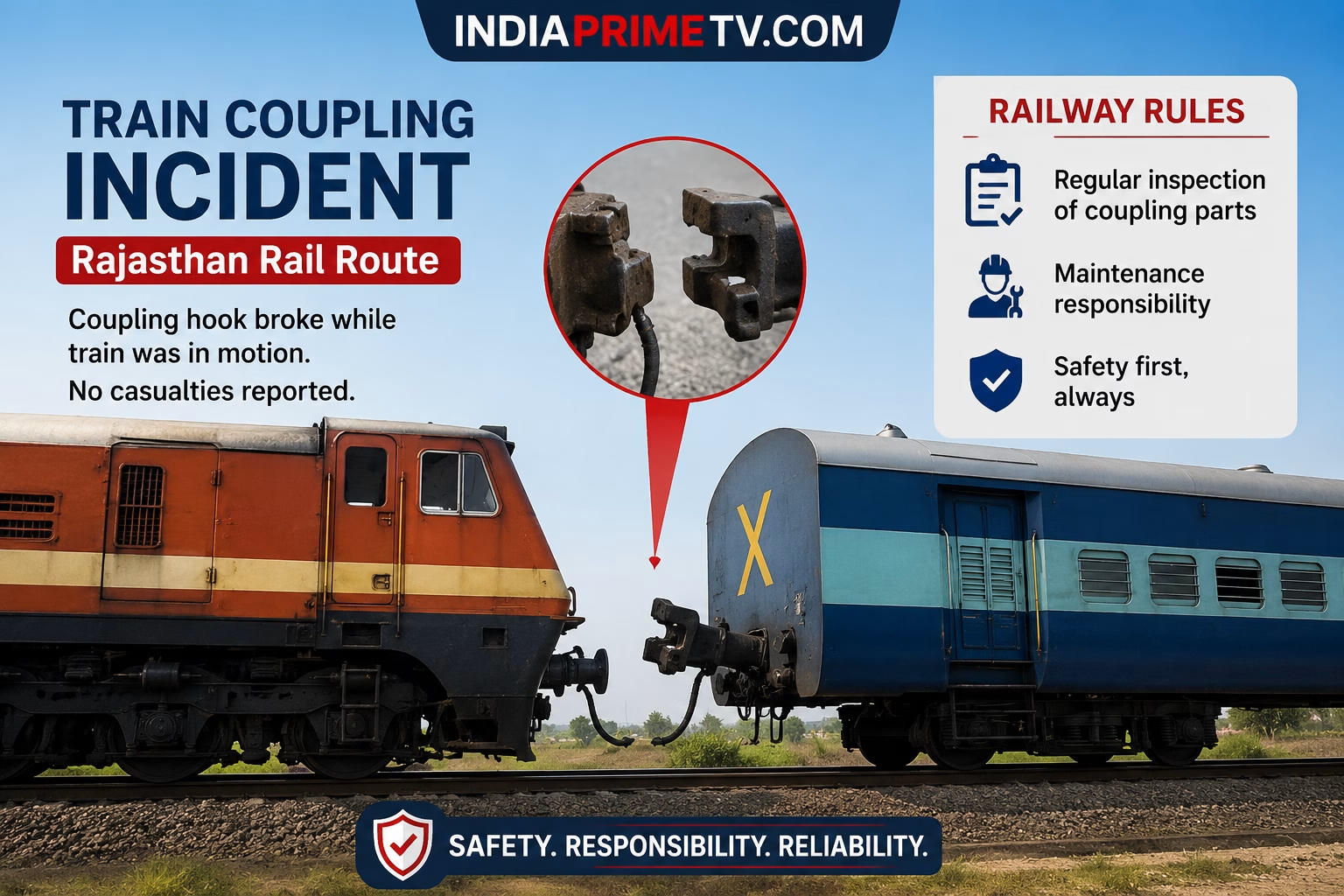
India Prime TV City Desk | Rewari, Haryana Train Engine Detaches from Coaches A major railway accident was narrowly avoided on Tuesday, June 30, 2026, when the engine of the Rewari–Sri Ganganagar Express (Train No. 14030) unexpectedly separated from its coaches while the train was in motion on the Rewari–Hisar railway section in Haryana.
The incident took place shortly after the train departed Rewari Railway Station at around 3:14 PM, running behind its scheduled time. As the train approached Gokalgarh Railway Station, the locomotive became detached from the passenger coaches due to the sudden failure of the train’s coupling hook, a serious technical malfunction known in railway terminology as “Train Parting.”
Fortunately, no passengers were injured, and all approximately 150 passengers on board remained safe.
What Exactly Happened?
According to the preliminary information, the coupling hook connecting the locomotive with the coaches suddenly broke while the train was moving. As soon as the coupling separated, the air brake pressure pipeline also disconnected.
Modern Indian Railways coaches are equipped with an automatic emergency braking system. The moment the air pressure dropped, emergency brakes were instantly applied across all coaches, bringing them safely to a stop on the tracks and preventing the coaches from rolling away.
The locomotive pilot immediately noticed the separation, stopped the engine, and followed standard railway safety procedures. The engine was carefully reversed and reconnected with the coaches after a complete technical inspection. Only after confirming that all safety systems were functioning properly was the train allowed to continue its journey.
Railway Operations Temporarily Affected
The incident temporarily disrupted train operations on the Rewari–Hisar route.
During the recovery process, railway staff secured the detached coaches using hand brakes and wooden wedges to prevent any movement, particularly if the track had a slight gradient.
Engineers then carried out the re-coupling process, checked the alignment of the train, restored the air brake system, and conducted pressure tests before clearing the line for traffic. Train movement on the section resumed after the safety inspection was completed.
Meanwhile, North Western Railway (NWR) and officials from the Bikaner Division have ordered a detailed technical investigation into the failure of the coupling mechanism.
Why Is “Train Parting” Considered a Serious Railway Incident?
Under the Indian Railways General and Subsidiary Rules (G&SR), train parting is treated as a major operational safety incident because it involves the separation of a moving train into two parts.
Although automatic braking systems prevented a disaster in this case, railway authorities must determine why the coupling failed and whether the incident resulted from mechanical failure, inadequate maintenance, or operational error.
Who Can Be Held Responsible?
The investigation will determine responsibility after examining maintenance records, inspection reports, and locomotive data.
1. Carriage & Wagon (C&W) Department
The Carriage & Wagon department is primarily responsible for inspecting coaches and ensuring that the coupling equipment is fit before a train departs.
If investigators discover that cracks, excessive wear, or metal fatigue existed before departure and were missed during inspection, responsibility may fall on the maintenance and inspection staff.
2. Loco Pilot
The locomotive’s event recorder stores operational data such as throttle movements and acceleration.
If the investigation finds that the locomotive experienced an unusually strong jerk because of improper handling, railway authorities may also examine the role of the loco pilot.
3. Maintenance Workshop
If the broken coupling is found to have failed because of defective repairs, poor-quality spare parts, or improper overhaul during scheduled maintenance, accountability may extend to the workshop or depot responsible for servicing the equipment.
How Is a Train Reconnected Safely?
Indian Railways follows a strict technical procedure before allowing a detached train to move again.
First, the guard secures all coaches by applying hand brakes so that they remain completely stationary.
After receiving permission from the guard through wireless communication, the loco pilot slowly reverses the locomotive at a controlled speed of around 8–10 km/h.
An Assistant Loco Pilot manually aligns the Centre Buffer Coupler (CBC) and ensures that the locking mechanism engages properly.
Next, the Brake Pipe (BP) and Feed Pipe (FP) air hoses are reconnected. Engineers then restore air pressure and carefully inspect the entire system for any leakage.
Finally, a continuity test is conducted to verify that brake pressure is reaching every coach from the locomotive to the last coach. Only after confirming that the braking system is fully functional is the train permitted to resume its journey.
Investigation Underway
Railway officials are expected to examine the damaged coupling hook, maintenance records, inspection history, and operational data from the locomotive.
The investigation will determine whether the failure occurred because of:
- Metal fatigue in the coupling hook
- Improper maintenance or inspection
- Defective spare parts
- Operational handling during train movement
- Any other technical deficiency
If negligence is established, disciplinary action may be taken against the responsible officials under Indian Railways safety and service regulations.
Safety Systems Prevented a Major Disaster
Although the incident appeared alarming, railway safety experts note that the automatic emergency braking system worked exactly as designed. The immediate loss of brake pipe pressure caused the coaches to stop automatically, preventing the detached coaches from moving independently.
This built-in safety mechanism played a crucial role in ensuring that all passengers remained safe and that a potentially serious railway accident was successfully avoided.
As railway authorities continue their technical investigation, the incident serves as another reminder of the importance of rigorous inspections, preventive maintenance, and strict adherence to railway safety standards across India’s vast rail network.