
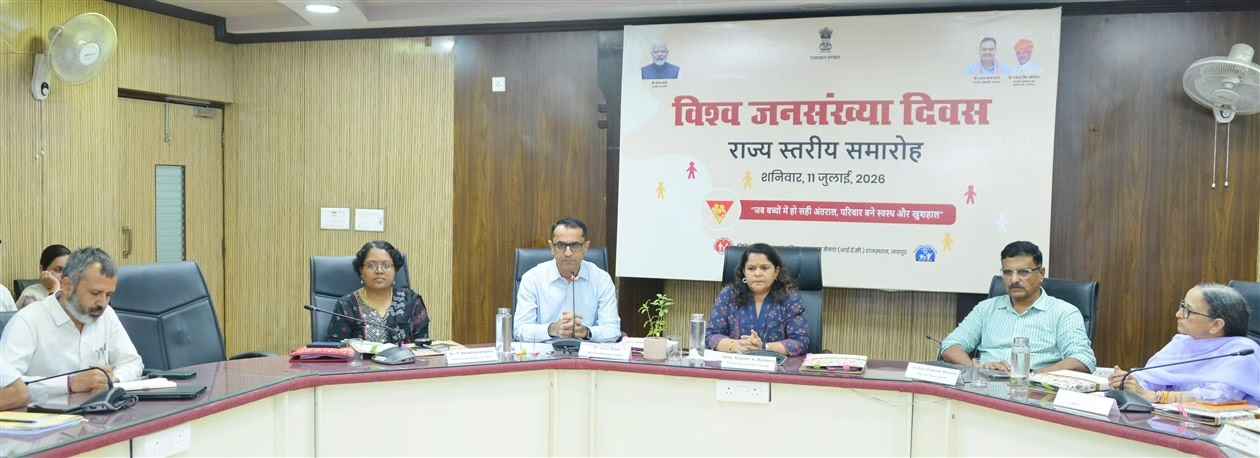
IndiaPrime Health Desk | Jaipur On the occasion of World Population Day, the Rajasthan Government honoured districts, panchayat samitis, gram panchayats, healthcare institutions, and frontline health workers for their outstanding contribution to the state’s Family Welfare Programme. The state-level awards ceremony, held at the Health Bhawan in Jaipur, was chaired by Gayatri Rathore, Principal Secretary, Medical, Health & Family Welfare Department, who virtually presented cash awards and certificates of appreciation to the winners.
Addressing the ceremony, Rathore said the state’s sustained public health efforts have helped bring Rajasthan’s Total Fertility Rate (TFR) down to 2.1, matching the replacement-level fertility target. She also highlighted that Rajasthan has surpassed the national average in the adoption of modern contraceptive methods. While the national average stands at 52.7%, Rajasthan has achieved 57.1%, reflecting improved access to family planning services.
Rajasthan’s Progress in National Perspective
A comparison of available Sample Registration System (SRS) and National Family Health Survey (NFHS-5) data shows that Rajasthan has made significant progress over the past decade. However, the state still records a relatively higher fertility rate than several economically advanced states.
| State | Total Fertility Rate (TFR) | Comparison with Rajasthan |
|---|---|---|
| Bihar | 2.8 | Higher |
| Uttar Pradesh | 2.6 | Higher |
| Madhya Pradesh | 2.4 | Slightly Higher |
| Rajasthan | 2.3 | — |
| Chhattisgarh | 2.2 | Slightly Lower |
| Jharkhand | 2.1 | Lower |
| Gujarat | 1.8 | Significantly Lower |
| Haryana | 1.9 | Lower |
| Maharashtra | 1.4 | Much Lower |
| Punjab | 1.5 | Much Lower |
| Tamil Nadu | 1.3 | Much Lower |
| Kerala | 1.5 | Much Lower |
| Delhi | 1.2 | Among the Lowest |
Although Rajasthan has successfully reduced its fertility rate over the years, it continues to lag behind states such as Maharashtra, Gujarat, Kerala, Tamil Nadu and Delhi. The encouraging trend is that the state’s fertility rate, once above 3.0, has now approached the replacement level. This indicates sustained improvements in family planning, women’s education, maternal healthcare, and public health delivery. The next policy challenge will be to maintain the fertility rate at 2.1 or below while improving overall quality of life.
Focus on Timely Healthcare Delivery
Rathore directed all government health institutions to ensure timely access to healthcare services for every citizen. She stressed efficient utilisation of available resources, regular antenatal check-ups, complete immunisation, uninterrupted availability of family planning services, and timely maintenance of medical equipment. She also instructed officials to strengthen preparedness for seasonal diseases.
Chittorgarh Emerges as Best Performing District
Under the Institutional Award Scheme for Family Welfare Programme:
- Chittorgarh – First Prize (₹18 lakh)
- Sikar – Second Prize (₹11 lakh)
- Kota – Third Prize (₹9 lakh)
- Karauli – Fourth Prize (₹5 lakh)
Previously awarded districts including Banswara, Bhilwara, Pratapgarh, Jhalawar, Baran, Ajmer, Beawar and Bundi received certificates of appreciation.
Banswara Tops in PPIUCD Services
- Banswara – First Prize (₹4 lakh)
- Pratapgarh – Second Prize (₹3 lakh)
- Nagaur – Third Prize (₹2 lakh)
Panchayats Recognised for Excellence
Best Panchayat Samiti
- Itawa (Kota)
- Balotra
- Phalodi
- Dholpur
Best Gram Panchayat
- Harrajpura (Beawar)
- Khedki Veerbhan (Kotputli-Behror)
- Thikariya Kalan (Bundi)
- Bhojasar (Hanumangarh)
Health Institutions and Frontline Workers Honoured
Among government health institutions, PHC Genta (Kota), CHC Neemrana (Kotputli-Behror), and Sub-District Hospital Rawatbhata (Chittorgarh) were recognised for excellence.
In the private healthcare category, Raj Hospital, Jodhpur received the award, while Unshade Paramedical Foundation (Jhalawar) and FRHS India (Jaipur) were honoured in the NGO category.
Individual honours were presented to LHV Asha Verma (Bhawanimandi), ANMs Madhu Srivastava (Bikaner) and Sarita Kumari (Jaipur), ASHA workers Kaushalya Devi, Asha Sharma and Santosh Devi, and Dr. Sahab Singh Meena, who performed the highest number of sterilisation procedures in the state.
IndiaPrimeTV Analysis
This year’s awards go beyond recognition and reflect the Rajasthan Government’s shift towards a performance-based accountability model in public healthcare. The state’s progress towards replacement-level fertility, combined with contraceptive usage above the national average, indicates that the Family Welfare Programme is evolving from a population control initiative into a broader strategy focused on maternal and child health, reproductive healthcare, preventive medicine, and efficient public health governance. Sustaining these gains while improving healthcare quality across all districts will be the state’s next major challenge.
#WorldPopulationDay,, #Rajasthan, #PublicHealth, #FamilyWelfare, #Population, #HumanCapital, #Healthcare, #IndiaPrimeTV