
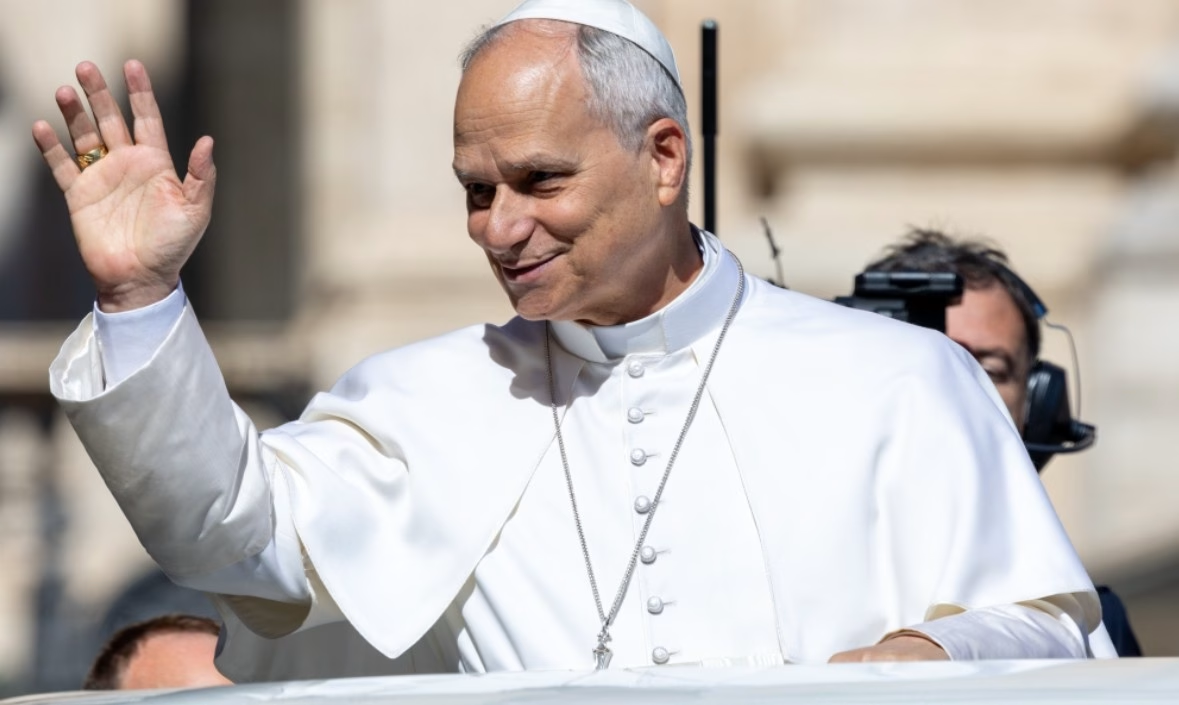
Conversations about AI often focus on job security and future skills. However, the key issue is not jobs, but developing individuals’ character and dignity amid rapid technological advancement.
By Amy Servais – June 9, 2026 – EWTN Great Britain
When parents talk about the future today, the conversation often turns quickly to artificial intelligence.
Will AI take my child’s job? What careers will still exist in twenty years? What skills should young people develop? How do we prepare children for a world changing faster than any previous generation has experienced?
These are not unreasonable questions. Every week seems to bring another announcement of a technological breakthrough. AI systems are writing essays, generating images, diagnosing illnesses, translating languages, producing software code, and increasingly performing tasks that only a few years ago were considered uniquely human. For many people, the future appears uncertain.
Yet perhaps the most important question is not what jobs our children will do. It is what kind of people they will become.
This, in many ways, is the central concern of Pope Leo XIV’s first encyclical, Magnifica Humanitas: On Safeguarding the Human Person in the Age of Artificial Intelligence. Far from being a technical document about computers, the encyclical is ultimately about human beings. It is about dignity, freedom, truth, work, education, family life, and the formation of the human person. Above all, it asks whether technological progress will remain at the service of humanity, or whether humanity will gradually begin to reshape itself according to the logic of technology.
The Human Question Behind the Technological Question
One of the most striking aspects of Magnifica Humanitas is what it is not.
It is not a condemnation of technology, nor is it a nostalgic plea to return to some imagined pre-digital age. Pope Leo readily acknowledges the enormous benefits artificial intelligence can bring to medicine, scientific research, communication, education, and countless other fields. Like every significant technological advance before it, AI can be an instrument for good.
The Church has long recognised that human creativity is itself a gift from God. Created in the image of a Creator, human beings naturally invent, build, discover, and innovate. The problem, therefore, is not technology itself. The danger arises when technological power outpaces moral wisdom, or when efficiency becomes the primary measure by which society judges human activity.
The question facing us is not whether artificial intelligence is powerful. Clearly, it is. The deeper question is whether we remain capable of asking what technology is for and whom it serves.
This concern places Pope Leo firmly within the tradition of Catholic social teaching. The Church has never opposed progress. Rather, she has consistently insisted that progress must be judged according to its effect on the human person. Economic systems, political institutions, and technological developments exist for people, not the other way around.
A New Industrial Revolution
The date on which Pope Leo signed his encyclical was significant. It marked the 135th anniversary of Rerum Novarum, Pope Leo XIII’s landmark encyclical on the rights and dignity of workers.
In 1891, the Church was confronting the social consequences of the Industrial Revolution. New technologies had transformed production and generated extraordinary wealth, yet they had also created new forms of exploitation. Workers were often treated as instruments of production rather than persons with inherent dignity.
Today, Pope Leo XIV sees a similar moment unfolding.
Artificial intelligence has the potential to transform society as profoundly as the steam engine, the factory, or the assembly line. It may reshape labour markets, alter educational systems, change the nature of communication, and influence almost every aspect of daily life. As in previous periods of rapid change, the central challenge is not technological but human. Will this new power be directed towards authentic human flourishing, or will people increasingly be valued according to the same metrics of speed, efficiency, and productivity that govern machines?
The Church’s answer remains unchanged. Human dignity must remain the starting point and the destination of all social and technological development.
What Work Is Really For
Few aspects of Catholic social teaching are more relevant to the age of AI than its understanding of work.
Modern societies often evaluate work according to output. The faster a task can be completed, the more successful the process appears. The fewer people required to accomplish it, the more efficient the system is judged to be.
Artificial intelligence excels by these standards.
Yet Catholic teaching proposes a richer understanding. In Laborem Exercens, Pope John Paul II argued that work possesses both an objective and a subjective dimension. Objectively, work produces goods and services. Subjectively, work shapes the person performing it.
This insight is frequently overlooked.
A teacher does more than educate students. Through years of teaching, she develops patience, wisdom, discipline, and generosity. A doctor does more than diagnose illness. Through caring for patients, he learns responsibility, compassion, and prudence. A craftsman does more than produce beautiful work. Through the practice of his craft, he develops skill, perseverance, and attention to detail.
Work, therefore, is not merely about producing something. It is also about becoming someone.
This is why the Church has always viewed labour as a participation in God’s creative activity. Human beings are not simply economic units generating outputs. Through work, they contribute to society, serve their neighbours, support their families, and develop their own character.
In the age of artificial intelligence, this perspective becomes especially important. If a machine can perform a task more efficiently than a person, we naturally ask whether the machine should perform it. Catholic social teaching encourages us to ask an additional question: what human capacities might be lost if people cease engaging in certain forms of meaningful work altogether?
The answer will not always be straightforward. Many tasks should be automated. Few people would wish to return to unnecessary drudgery. Yet the Church reminds us that efficiency alone cannot determine the value of human activity.
Education Is More Than Information
The same principle applies to education.
One of the recurring themes of Pope Leo’s encyclical is the distinction between information and formation. This may be one of the most important distinctions of the digital age.
Students today have access to more information than any previous generation in history. Within seconds, artificial intelligence can summarise books, answer questions, generate essays, solve equations, and explain complex concepts.
These capabilities are undoubtedly useful. Yet education has never been simply about acquiring information.
A student who learns to read deeply develops habits of attention. A student who writes learns to think. A student who wrestles with difficult problems develops perseverance. A student who learns to distinguish truth from falsehood develops judgment. These capacities are not incidental to education; they are among its primary goals.
The danger is not that AI provides answers. The danger is that we may begin to mistake answers for understanding.
Much of human growth occurs precisely through effort, struggle, and sustained attention. The process of learning shapes the learner. An education that prioritises convenience above formation may produce technically competent individuals while leaving deeper human capacities underdeveloped.
This concern reflects a broader theme within Catholic thought. Virtue cannot be downloaded. Wisdom cannot be automated. Character cannot be outsourced.
The habits that enable human beings to flourish are acquired gradually through practice, discipline, and experience. No technology, however sophisticated, can perform that task on our behalf.
The Essential Role of Parents
It is perhaps unsurprising, then, that Pope Leo places considerable emphasis on the role of parents.
Paradoxically, the more advanced technology becomes, the more important parents become.
The central challenge facing families today is not simply helping children learn how to use technology. It is helping them learn how to live well in a world saturated by technology.
Parents are called to cultivate qualities that no machine can provide: attentiveness, self-discipline, empathy, honesty, resilience, and the capacity for genuine human relationships. They teach children how to converse, how to listen, how to navigate disappointment, how to accept responsibility, and how to care for others.
These lessons have always mattered. They matter even more in an age when digital systems increasingly compete for our attention and shape our habits.
The future may require technical competence, but it will also require wisdom. It will require people capable of discerning when technology serves human flourishing and when it begins to undermine it. Such discernment is learned first and foremost within families.
The Return of Vocation
One of the most intriguing consequences of the AI revolution may be a renewed appreciation for vocation.
For decades, many people viewed work primarily through the lens of status, income, and career progression. Yet many of the professions that appear most resilient in the face of automation have something in common: they are fundamentally relational and service-oriented.
Teachers, nurses, doctors, counsellors, social workers, clergy, and skilled tradespeople all engage in work that requires trust, judgment, responsibility, and human presence.
The word vocation comes from the Latin vocare, to call. While often associated with religious life, the concept speaks to something universal. A vocation is not merely a job. It is a response to a need beyond oneself.
Artificial intelligence may ultimately remind us of this forgotten truth. The most valuable forms of work are often those rooted in service, responsibility, and care for others.
Remaining Human
At the heart of Magnifica Humanitas lies a simple but profound conviction: technological progress must never come at the expense of human flourishing.
Catholic social teaching begins from a truth that every age must rediscover. The human person can never be reduced to a unit of production, a collection of data, or a consumer within an economic system. We are persons created in the image of God, endowed with reason, freedom, conscience, and the capacity for love. Any technology, however powerful, must ultimately be judged according to whether it serves that dignity or diminishes it.
The challenge posed by artificial intelligence is therefore not primarily technological. It is moral, cultural, educational, and spiritual.
The future will undoubtedly bring new professions, new opportunities, and new challenges. Some jobs will disappear. Others will emerge. Predictions will come and go, many of them proving inaccurate.
What is far more certain is that the qualities most essential to human flourishing will remain unchanged.
Wisdom will still matter more than information.
Character will still matter more than efficiency.
Relationships will still matter more than algorithms.
Service will still matter more than status.
The real question is not whether our children will be able to compete with artificial intelligence. It is whether we can help them become adaptable, resilient, virtuous, and fully human.
For if they possess those qualities, they will have something no machine can ever replicate and something every age, including our own, desperately needs.

Amy Servais is Studio and Production Manager at EWTN Great Britain, based in Walsingham, where she lives with her family. A video editor by profession, she has a deep love for the Church, evangelisation, and telling beautiful, faith-filled stories. She also writes reflective pieces drawn from her own experiences of faith.
Get EWTN Great Britain
in your inbox.
First Name
Last Name
Email Address *
By subscribing, you agree to receive communications from EWTN. You can unsubscribe at any time. For more information on how to unsubscribe, and how we are committed to protecting and respecting your privacy, please review our Privacy Policy.
15 High Street, Walsingham, Norfolk NR22 6BY
E: email@ewtn.co.uk
P: +44 (0)208 3502542
Copyright © St Clare Media (EWTN GB) Limited