CT Mirror
Connecticut's Nonprofit Journalism. 
This work is licensed under a Creative Commons Attribution-NoDerivatives 4.0 International License.
Nonprofit and hyperlocal news organizations are welcome to republish CT Mirror stories and opinion pieces at no charge. If you do republish CT Mirror content we ask that you follow a few guidelines:
- You must use the HTML code below (including the Canonical code).
- You must include a byline, ideally in this format: “by Ginny Monk, CT Mirror.”
- Access to CT Mirror content that you republish must remain free. You may not sell access to this article, place it behind a paywall, or grant downstream publication rights to other publishers.
- You must receive approval from CT Mirror Publisher Bruce Putterman prior to re-publishing your first CT Mirror story.
- See additional Republishing Guidelines, including conditions by which you may make small changes to story content, here.
by Associated Press, CT Mirror
June 9, 2026
Support the CT Mirror reporting you rely on.
Any advertisements in New York that feature artificial intelligence-generated people in place of actors will now be violating state law if they don’t clearly label that they have used a “synthetic performer.”
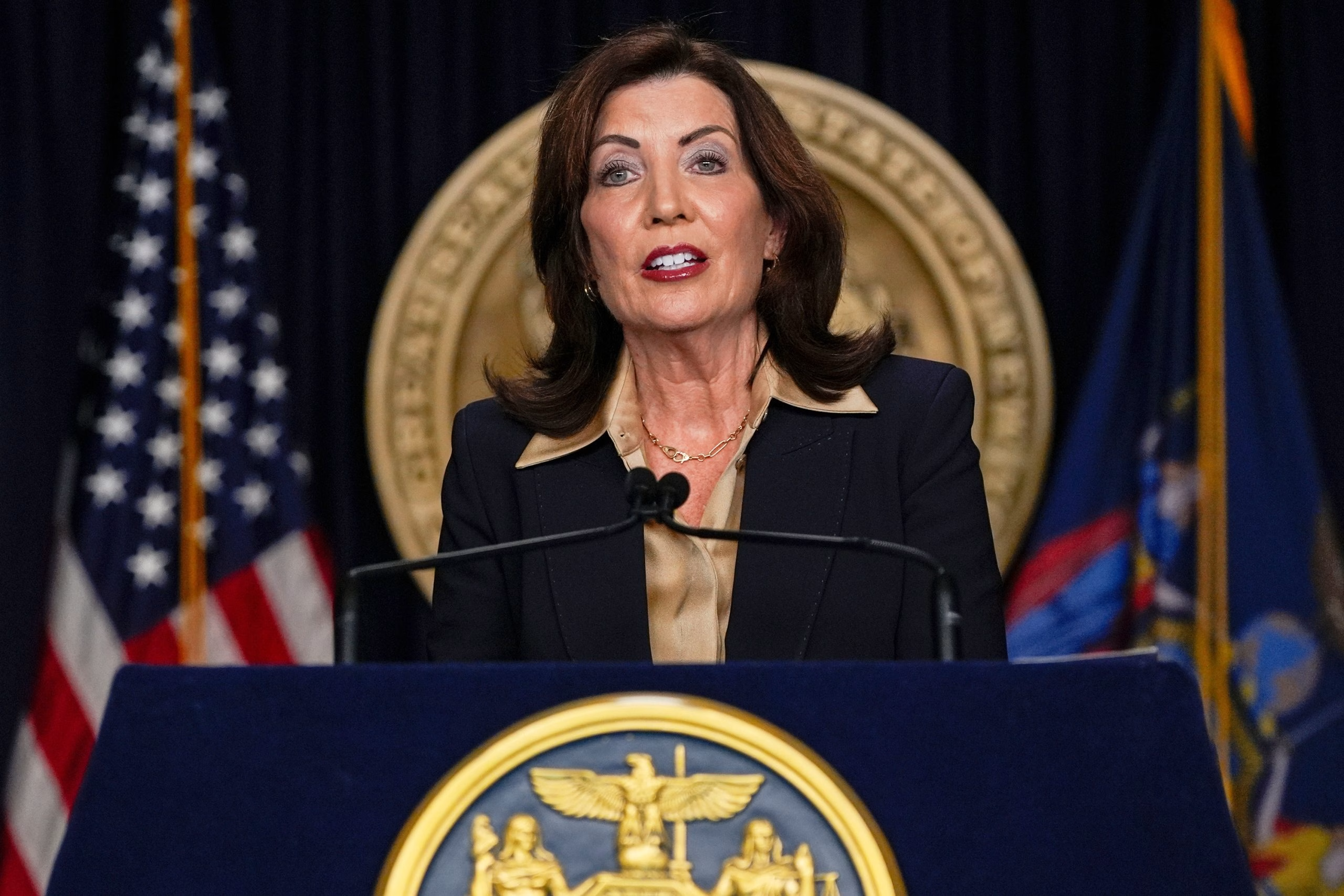
The law, signed in December by Gov. Kathy Hochul, went into effect Tuesday. Her office is calling it a “first-in-the-nation law” that will boost transparency at a time when it says AI generated performers are popping up across all forms of media, including on social platforms and in digital advertising.
Synthetic performers are defined under state law as “digitally-created media that appear as a real person.” The law applies to ads in any medium.
“In New York, we are setting the rules of the road instead of letting AI run the show,” Hochul, a Democrat, said in a statement. The “simple, honest disclosure” required by the law “protects consumers, respects our creative workforce and keeps New York at the forefront of responsible innovation,” she said.
Ads that don’t “conspicuously disclose” that they have used a synthetic performer will be subject to a penalty of $1,000 for a first violation and $5,000 for any further violations.
There are specific carve outs listed in the law to exempt ads for movies, television shows, streaming content, video games and other works that feature synthetic performers in the entire work. It also doesn’t apply to audio advertisements or ads where AI is solely used for language translation.
When the law was making its way through the state legislature last year, the American Association of Advertising Agencies and several other advertising organizations issued statements in strong opposition to the law.
The 4As, as the organization is better known, said in one blog post that it would hurt advertisers by “injecting compliance uncertainty into the advertising process, burdening brands (and their agencies) who advertise in New York and undermining creative and technological innovation.”
Other organizations, like the The New York State Broadcasters Association, said in public statements during the legislation’s journey to become law that they were relieved to see some of those carve outs that were created through amendments, but remained concerned about the broad definition of a synthetic performer.
The biggest supporter of the law was SAG-AFTRA, the actors’ union that recently ratified a new contract with studios and streamers that they say provides further protections against synthetic performers.
The law is one of many proposed or enacted in several U.S. states with the goal of boosting job security for real humans or curbing the potential privacy and safety risks posed by AI. The existing state laws that have been passed include barring deepfakes in specific instances, limiting the collection of certain personal information and requiring more transparency from companies.
Just after Hochul signed the synthetic performers law in December, President Donald Trump signed an executive order pressuring states not to regulate AI. The move came out of fear that the patchwork of regulations across the states could impede AI companies’ growth and allow China to catch up to the U.S. in the AI race. Critics of the executive order argue it will allow tech companies to operate with little to no oversight.
Across the country, reporters and news organizations are challenged, dismissed, even targeted for doing their jobs. It’s happening to CT Mirror journalists, too.
This year, for the first time, CT Mirror has needed to budget for security to protect our reporters from threats online where they have been harassed and in-person at events and large-scale demonstrations where their physical safety was at risk.
That’s the environment we’re operating in. And it’s exactly why local journalism is needed now.
CT Mirror reporters run toward the hard questions. They dig into budgets, contracts, and submit near-endless information requests to uncover stories that need telling. They sit through the long hearings. They follow the facts wherever they lead. Holding power to account isn’t a slogan here — it’s our mission.
CT Mirror exists for one reason: to inform and strengthen a civically engaged public. When local journalism is strong, communities are stronger. Transparency improves. Accountability deepens. Democracy works better.
If you believe Connecticut deserves local reporting that is fearless, fair, and accessible to all, can you start a $15 monthly donation today?
Stand with the journalists who stand up for Connecticut and our democracy. Strengthen your community. Be a co-publisher of CT Mirror.
Thank you.
Our trusted Connecticut public policy reporting is always free to read. Get it directly in your inbox every morning.
You’ll get newsletter-exclusive insights and commentary so you can be part of the conversation.