
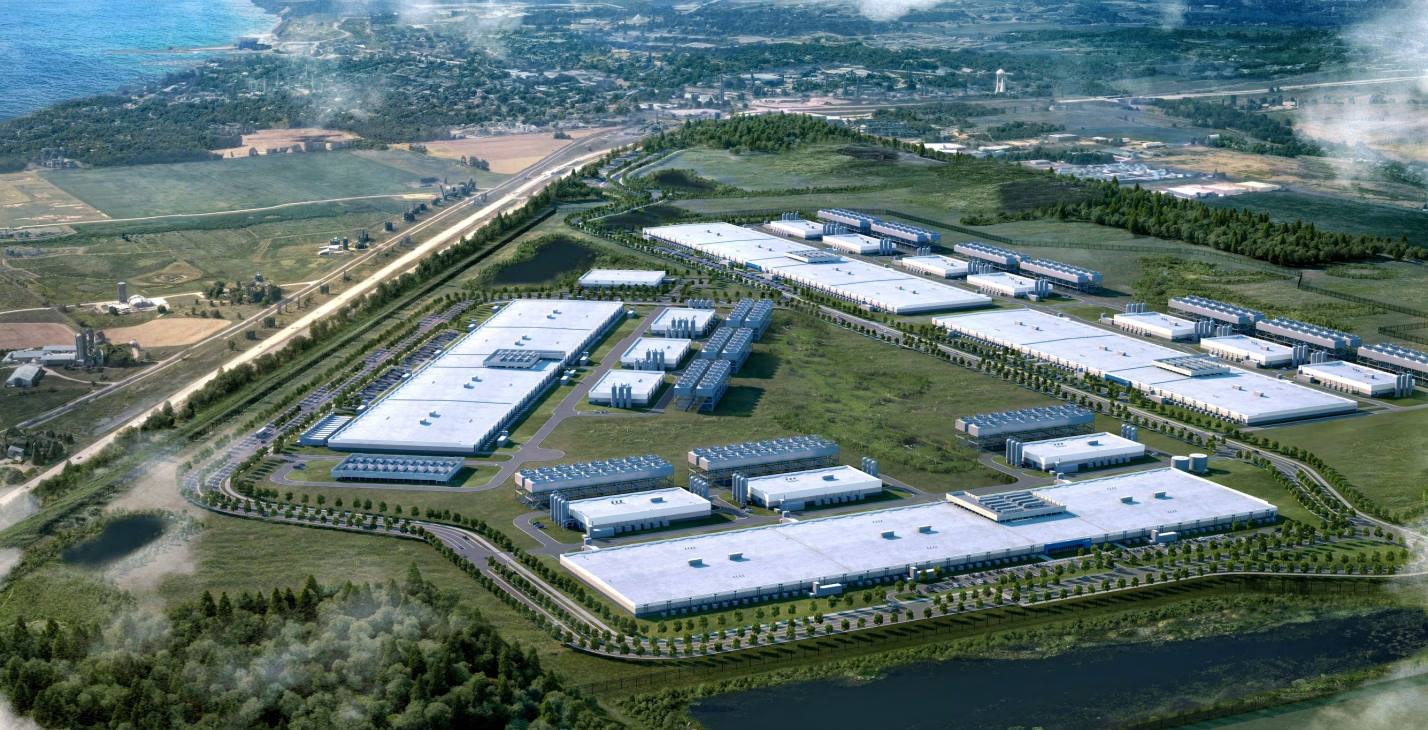
Wisconsin companies Generac and Moline recently signed deals worth hundreds of millions of dollars with unnamed hyperdata scalers like Google or Microsoft
At least $46 billion worth of data centers are being developed in Wisconsin. One analyst told WPR some Wisconsin businesses are cashing in on the rush to develop these facilities in the state.
Earlier this month, Waukesha-based manufacturer Generac announced that it signed an agreement to provide backup generators for an unnamed hyperscale data center operator like Google or Microsoft. While Generac CEO Aaron Jagdfeld did not disclose the full amount of the deal, he told CNBC the unnamed data center customer provided Generac $650 million for 2027 alone.
This comes as Modine Manufacturing, a producer of data center cooling systems, announced at the end of May that it entered a $4 billion contract to provide cooling systems for an unnamed data center customer through 2029.
WPR’s “Wisconsin Today” newsletter keeps you connected to the state you love without feeling overwhelmed. No paywall. No agenda. No corporate filter.
Tom Kertscher is a reporter with Wisconsin Watch who has covered the burgeoning artificial intelligence data center industry. He told WPR’s “Wisconsin Today” that just three companies — Generac, Modine and the Milwaukee motor manufacturer Regal Rexnord — had already completed more than $1 billion in data center work as of March.
“There’s no question that if you look at stock prices, for example. Some of these companies have seen their stock prices go up quite a bit,” Kertscher said. “You can’t attribute all of that to data center business, but it’s certainly a big part of it.”
Both Generac and Modine’s stock price more than doubled since January.
Dijo Alexander is a professor of practice at the Lubar College of Business at UW-Milwaukee specializing in technology management, digital transformation and artificial intelligence. He told “Wisconsin Today” demand for in-state suppliers is tied to Wisconsin’s position in the middle of the country.
“Saving a few milliseconds is going to be the key sometime in the future … this is all about movement of photons and electrons, the digital age of moving information from one end of the country to the other end,” Alexander said. “We are at the center, feeding across the East Coast and West Coast.”
Alexander said companies like Modine may benefit from new liquid cooling technologies currently being developed.
“Proximity is a big thing. You get to participate in these discussions up front, and then slowly but surely expand into other regions and get global exposure,” Alexander said.
While Alexander argued Wisconsin is primed to see wide-ranging economic benefits from data center development, Kertscher said it remains to be seen if the jobs created supplying components for data centers will be longer-lasting than short-term construction jobs.
“I think the expectation would be that that would be a lasting project. The data centers will continue to need generators (and) cooling systems,” Kertscher said. “That being said, this is all pretty new frontier.”
Alexander said in the wake of this data center boom, state leaders need to take a more proactive role in negotiating with hyperscalers instead of having negotiations take place on a community-by-community basis.
“We have to understand the value that we are providing. These data centers need our water, land, our power grid, and workers. And of course we need their investment research partnership, the supply chain demand,” Alexander said. “These are not small companies that are coming in. They are companies that have deep pockets. It is just a matter of negotiating.”
© 2026 by Wisconsin Public Radio, a service of the Wisconsin Educational Communications Board and the University of Wisconsin-Madison