
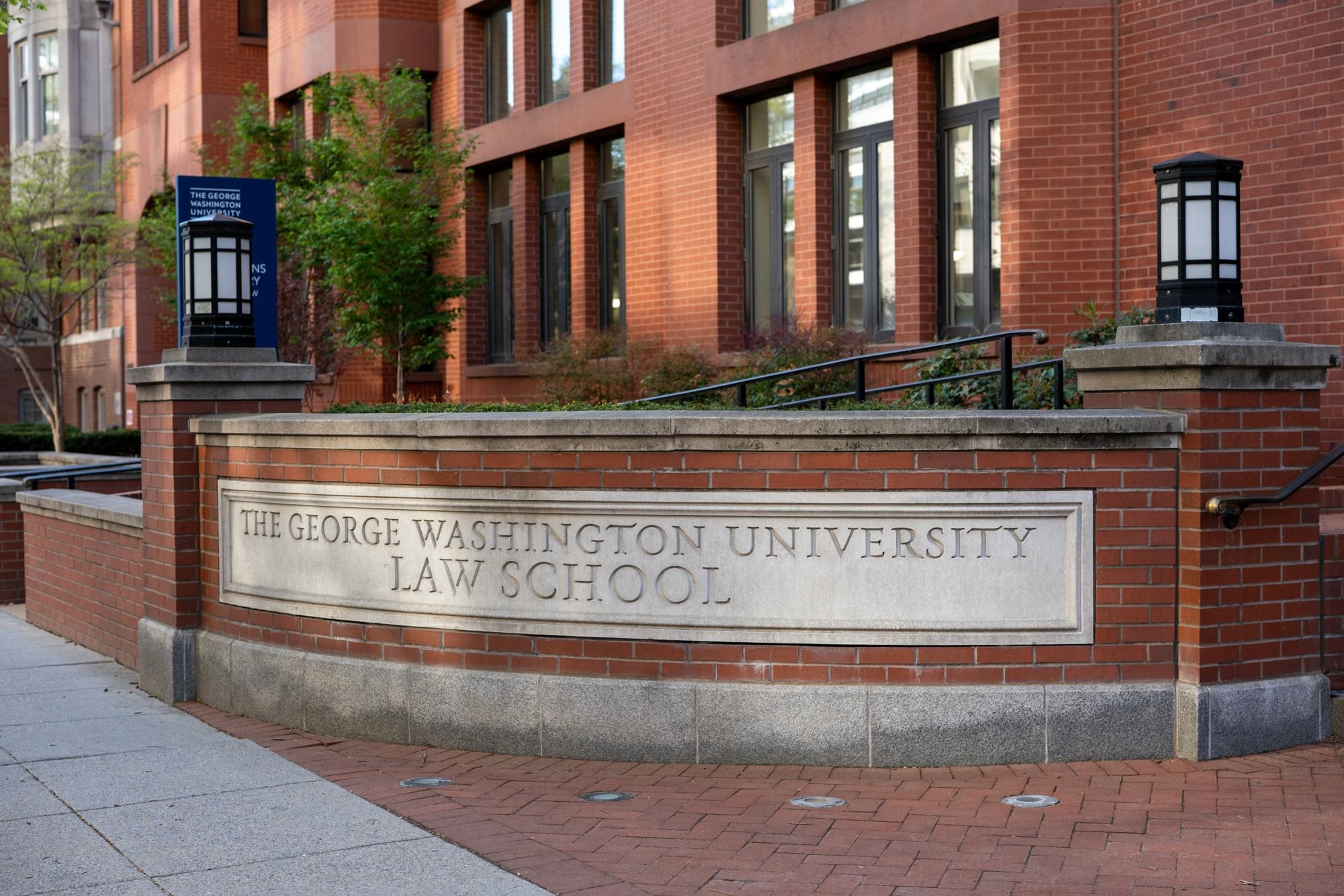
A group of law students who created a forum to discuss how artificial intelligence is changing the legal field completed their first year in operation, covering the technology’s growing presence in law.
A group of rising second-year law students founded the GW Law AI Forum, which recently concluded its first academic year in operation, in November to create dialogue around AI in the legal field, which members said is necessary for a class of law students who will enter the workforce as AI infiltrates the industry. The forum’s founders said their casual lunchtime events provide an opportunity for students from all backgrounds with differing perspectives on AI to discuss related issues and reduce the “stigma” around AI without having to take an entire class on the topic.
Eren Karaburun, an incoming 2L and the executive director of the forum, said he created the organization because he has always been interested in technology, and students can no longer ignore technological advances in AI because of the technology’s rapid development.
“I realized that a lot of the problems and situations that arise in the world that are pretty consequential in terms of the direction that society is going, or that businesses are going, or you name the industry, all reverberate back from kind of the front lines of technology and how quickly and in what way the technologies are evolving,” Karaburun said.
Karaburun said transparency about AI requires engaging with different perspectives rather than “echo chambering,” as he said a survey of law students in his section revealed students were split on their AI use and literacy. He said the forum doesn’t have a target audience, and it aims to appeal to both people who are skeptical and supportive of AI.
“I think you learn a lot more from somebody that you disagree with than someone that you agree with,” Karaburun said. “There have been some very fascinating conversations that we’ve had.”
Karaburun said he began meeting with his advisor to discuss his ideas for the forum in September, shortly after starting his first year at the law school, and the Student Bar Association officially approved the group in November. He said while the group originated from GW Law, it has since expanded to include undergraduate students from other schools — like GW’s School of Engineering and Applied Science, after engineering students expressed interest after seeing flyers on campus for the forum — and he hopes to bring in marketing students to promote the group.
Karaburun said the forum is a “low-barrier-to-entry” mechanism that any student can join to discuss AI who don’t want to commit to an entire class about the topic. He said they hold events during lunchtime a few times a month and do not have any requirements to attend because many law students are “pressed for time.”
In March the GW Law AI Forum hosted a panel with lawyers and professors to discuss how AI is reshaping legal practice and featured a live demonstration of Bloomberg Law’s AI tool that extracts and analyzes financial documents. The group has also hosted discussions open to students interested in talking about AI’s impact on their career trajectories and a meeting highlighting student research on how Albania has integrated AI into the government earlier in the semester.
Karaburun said law is an “adversarial” profession, so lawyers should gain a “competitive edge” by learning to be creative with AI, like through using inference alignment — a strategy where an AI model uses a judge’s previous rulings to estimate their preferences.
“Our goal was never to silo ourselves in the law school,” Karaburun said. “I actually think the undergraduate students and people that are specializing in certain areas bring a really novel perspective as well that can be kind of incorporated into the discussion.”
Noah Pellen, the forum’s director of communications, said he wanted to get involved with the forum to change the “stigma” surrounding AI through discussions with his peers because “fear mongering” over the technology is prevalent surrounding case hallucination and environmental impacts.
“We hear that, and I think a lot of it was trying to take those into account, build them out and talk about them,” Pellen said. “Why do they exist? Is AI just a tool for talking to? Is it a tool for more? Why are data centers so important right now?”
Pellen said while the forum did not receive any SBA funding for the spring semester, since they formed after the body allocated funds in the fall, they were willing to cover costs like coffee for meeting attendees out of pocket because they wanted to get the conversation started. He said outreach was not difficult because professors and AI developers expressed interest in being a part of the group’s conversations.
“Over time we grew, but the conversation element I think that we provide is so important, and you know that’s free, conversation’s free,” Pellen said. “People just come, and they show up, and they talk, and while not everyone’s an expert, we all see different things, and feeding through that mess is, I think, what we try to provide.”
Carson Mills, the forum’s director of operations, said future generations of lawyers will be starkly different from current lawyers because of quickly changing developments in AI. He said AI will become integrated into lawyers’ workflows, like with the digital legal research platform Westlaw, which transitioned from Boolean searching to AI-assisted “deep research.”
“The way that we have approached it, and given my background, I’m originally from the San Francisco Bay Area, kind of always on that innovative field, is to kind of have a creative way to use AI to make some sort of edge, whether that’s how can I more effectively get this memo or brief done,” Mills said.
He said one of the group’s public forums last semester attracted over 80 members without any SBA funding because the forum is open and conversation-based, which he said sets them apart from other student organizations.
“We are trying to start a dialogue about AI, so I think we want to extend an open invitation to the people who are the biggest AI users or the biggest AI haters,” Mills said.
Your donation directly empowers the student journalists of The GW Hatchet, giving them the tools to investigate, report and publish stories that matter. Every contribution helps us continue our decades long tradition of independent journalism at GW.