
Devender Singh Indiaprimetv.com Artificial Intelligence (AI) is no longer limited to chatbots or content generation tools. In 2026, AI is rapidly evolving into a powerful “digital collaborator” that enhances productivity, supports decision-making, and simplifies complex tasks across industries.
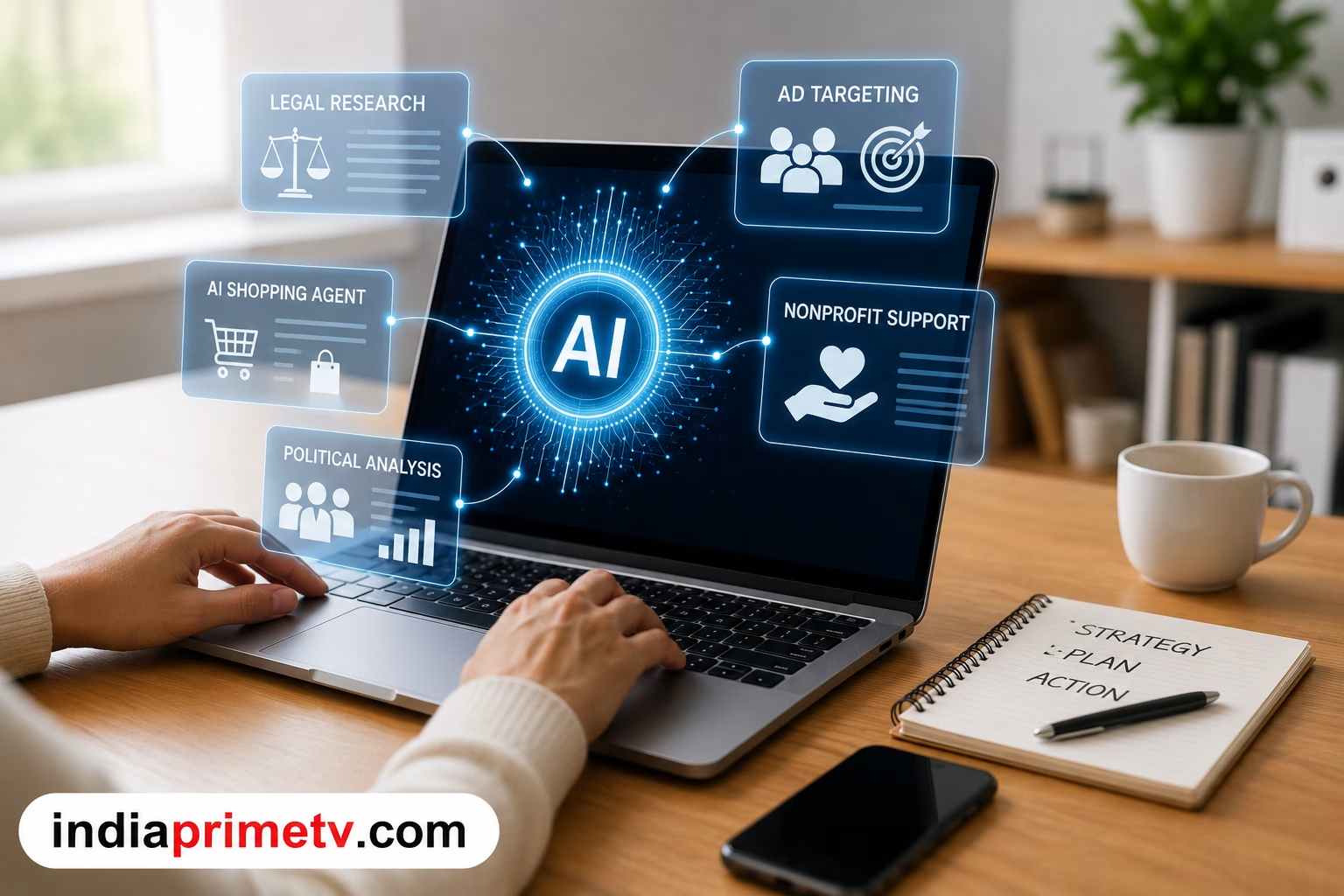
A series of recent reports from Moneycontrol, AI News, The Washington Post, and Inc. Magazine highlights the accelerating shift toward an AI-powered economy. According to these reports, AI is gaining traction across legal services, e-commerce, political campaigns, and nonprofit organizations.
Industry experts believe the world is moving beyond generative AI and entering the era of the Agentic Economy—a future in which AI systems do more than provide information; they actively perform tasks on behalf of users.
From Courtrooms to Boardrooms: AI as the Equivalent of “Ten Employees”
According to a report by Moneycontrol, a U.S.-based attorney said AI tools handled legal research, document analysis, and data management tasks with a level of speed and efficiency comparable to the work of an entire team of approximately ten employees.
The example illustrates how AI is reshaping not only repetitive tasks but also knowledge-intensive professions.
Key Applications of AI in the Legal Sector
- Reviewing and analyzing large volumes of legal documents
- Identifying relevant case law and precedents
- Drafting and reviewing contracts
- Assisting with litigation preparation
- Accelerating legal research
Analysts say law firms in the United States, the United Kingdom, Singapore, and India are increasingly adopting AI-driven solutions to improve efficiency and reduce costs.
However, experts emphasize that accountability, ethical judgment, and final decision-making must remain in human hands.
Consumers Are Increasingly Trusting AI Shopping Agents
According to reports from Accenture and AI News, consumers are becoming more comfortable with AI-powered shopping assistants.
These AI agents analyze customer preferences, budgets, browsing behavior, and purchase history to deliver highly personalized recommendations.
For example, a consumer searching for a new laptop can rely on an AI agent to compare products, evaluate features, identify discounts, and recommend the best option based on specific needs.
Why Consumers Trust AI Shopping Agents
- Faster purchasing decisions
- Personalized recommendations
- Real-time price comparisons
- Improved customer experiences
- Greater convenience
Industry experts predict that AI agents will become a core component of the e-commerce ecosystem over the next several years.
AI in Political Advertising: A New Challenge for Democracy
An analysis by The Washington Post suggests that political organizations are increasingly using AI to understand voter preferences, behaviors, and local issues.
AI is enabling campaigns to deliver more targeted and personalized messages than ever before.
How AI Is Being Used in Political Campaigns
- Voter data analysis
- Personalized messaging
- Social media content generation
- AI-generated video and audio
- Real-time sentiment analysis
While these capabilities can improve campaign efficiency, experts warn that AI also introduces significant risks.
Concerns include:
- The spread of deepfakes
- Misinformation and disinformation
- Manipulative voter targeting
- Reduced transparency in political communication
As a result, policymakers in the United States, the European Union, and other regions are considering new regulations for AI-generated political content.
AI for Social Good: Anthropic’s $150 Million Initiative
According to Inc. Magazine, AI company Anthropic has launched a $150 million initiative aimed at helping nonprofit organizations harness the power of AI.
The program will support approximately 1,000 fellows by providing access to AI tools, training, and technical resources.
The initiative focuses on areas such as education, healthcare, climate change, and community development.
How Nonprofits Can Benefit from AI
- Faster data analysis
- Improved resource allocation
- Lower administrative costs
- Better impact measurement
- More informed decision-making
Experts believe AI could become a critical tool for addressing some of the world’s most pressing social challenges.
Which Countries Are Leading the AI Transformation?
United States
The U.S. remains the global leader in AI investment, research, and startup innovation.
China
China is strengthening its position through low-cost AI models, large-scale infrastructure, and rapid commercialization.
India
AI adoption is accelerating across information technology, healthcare, education, and digital public services.
United Kingdom
Financial services and legal industries are driving significant AI implementation.
Singapore and the United Arab Emirates
Both countries are integrating AI into government services, smart city initiatives, and digital transformation strategies.
Industries Facing the Biggest Transformation
- Legal services
- E-commerce
- Digital marketing
- Political communications
- Customer service
- Healthcare
- Education
- Financial services
- Nonprofit organizations
Experts believe AI will significantly increase productivity and operational efficiency across these sectors.
The Next Phase: The Agentic Economy
Many technology leaders are calling 2026 “the year of AI agents.”
In the near future, AI systems will move beyond answering questions and begin performing tasks autonomously.
Imagine a world where AI can:
- Book your travel arrangements
- Draft legal documents
- Manage your shopping decisions
- Analyze business data and recommend strategies
This shift could mark the beginning of the next major phase of the global digital economy.
Conclusion
Recent reporting from Moneycontrol, Accenture, AI News, The Washington Post, and Inc. Magazine points to a clear conclusion: AI is evolving from a productivity tool into foundational infrastructure for the modern economy.
At the same time, concerns around data privacy, algorithmic bias, misinformation, and accountability are becoming increasingly urgent.
The organizations, governments, and individuals that succeed in the coming decade will be those that adopt AI responsibly, transparently, and with a human-centered approach.