
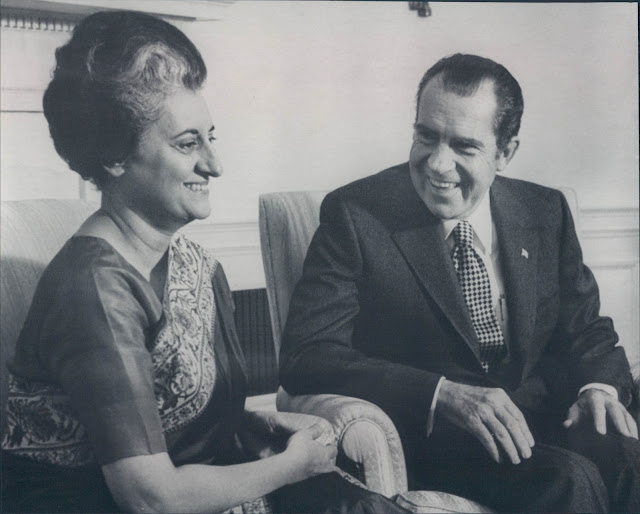
indiaprimetv Desk In a striking parallel to recent diplomatic tensions, historical records from 1971 reveal a significant episode where Indian Prime Minister Indira Gandhi firmly countered U.S. President Richard Nixon’s attempts to dissuade India from intervening in In a momentous historical event titled When Indira Gandhi Stood Firm Against Nixon: The 1971 Bangladesh Liberation Saga, the year 1971 witnessed a defining chapter with East Pakistan’s liberation, birthing the nation of Bangladesh. In echoing modern diplomatic standoffs, this confrontation showcases the resolve of then-Prime Minister Indira Gandhi as she navigated the pressures exerted by U.S. President Richard Nixon.
Read More about this in Book
Indira Gandhi’s Defiant Stand Against U.S. Pressure
During the 1971 Bangladesh Liberation War, East Pakistan (now Bangladesh) was engulfed in a brutal conflict, resulting in a massive influx of refugees into India. Prime Minister Indira Gandhi sought international support to address the crisis and embarked on a diplomatic mission, which included meetings with global leaders. On November 4 and 5, 1971, she met with U.S. President Richard Nixon in Washington, D.C.
In these meetings, President Nixon attempted to pressure Gandhi into refraining from military intervention in East Pakistan, warning of severe consequences. Despite the intimidating stance, Gandhi remained resolute, emphasizing India’s responsibility to protect its national interests and the humanitarian crisis unfolding at its border. She highlighted the atrocities committed in East Pakistan and the untenable situation created by the refugee influx.
Suggestion for interesting Book
This magnificent history provides the first full account of Richard Nixon and Henry Kissinger’s secret support for Pakistan in 1971 as it committed shocking atrocities in Bangladesh—which led to war between India and Pakistan, shaped the fate of Asia, and left major strategic consequences for the world today. Drawing on previously unheard White House tapes, recently declassified documents, and his own extensive investigative reporting, Gary Bass uncovers an astonishing unknown story of superpower brinkmanship, war, scandal, and conscience. Revelatory, authoritative, and compulsively readable, The Blood Telegram is a thrilling chronicle of a pivotal chapter in American foreign policy.
Click to know more
Outcome: Emergence of Bangladesh
Ignoring U.S. warnings, India launched a military intervention in December 1971, leading to a swift victory and the subsequent independence of Bangladesh on December 16, 1971. This decisive action not only reshaped the geopolitical landscape of South Asia but also demonstrated India’s commitment to regional stability and humanitarian principles.
Contemporary Reflection
This historical episode resonates today as nations navigate complex diplomatic landscapes, balancing external pressures with sovereign decision-making to uphold national and humanitarian interests.
Suggestion to Read
Brief Story The Wars for Asia, 1911–1949 shows that the Western treatment of World War II, the Second Sino-Japanese War, and the Chinese Civil War as separate events misrepresents their overlapping connections and causes. The long Chinese Civil War precipitated a long regional war between China and Japan that went global in 1941 when the Chinese found themselves fighting a civil war within a regional war within an overarching global war. The global war that consumed Western attentions resulted from Japan’s peripheral strategy to cut foreign aid to China by attacking Pearl Harbor and Western interests throughout the Pacific on December 7–8, 1941. S. C. M. Paine emphasizes the fears and ambitions of Japan, China, and Russia, and the pivotal decisions that set them on a collision course in the 1920s and 1930s. The resulting wars – the Chinese Civil War (1911–1949), the Second Sino-Japanese War (1931–1945), and World War II (1939–1945) – together yielded a viscerally anti-Japanese and unified Communist China, the still-angry rising power of the early twenty-first century. While these events are history in the West, they live on in Japan and especially China.
Amazing Facts About Football: Worldwide Wonders of the Beautiful Game