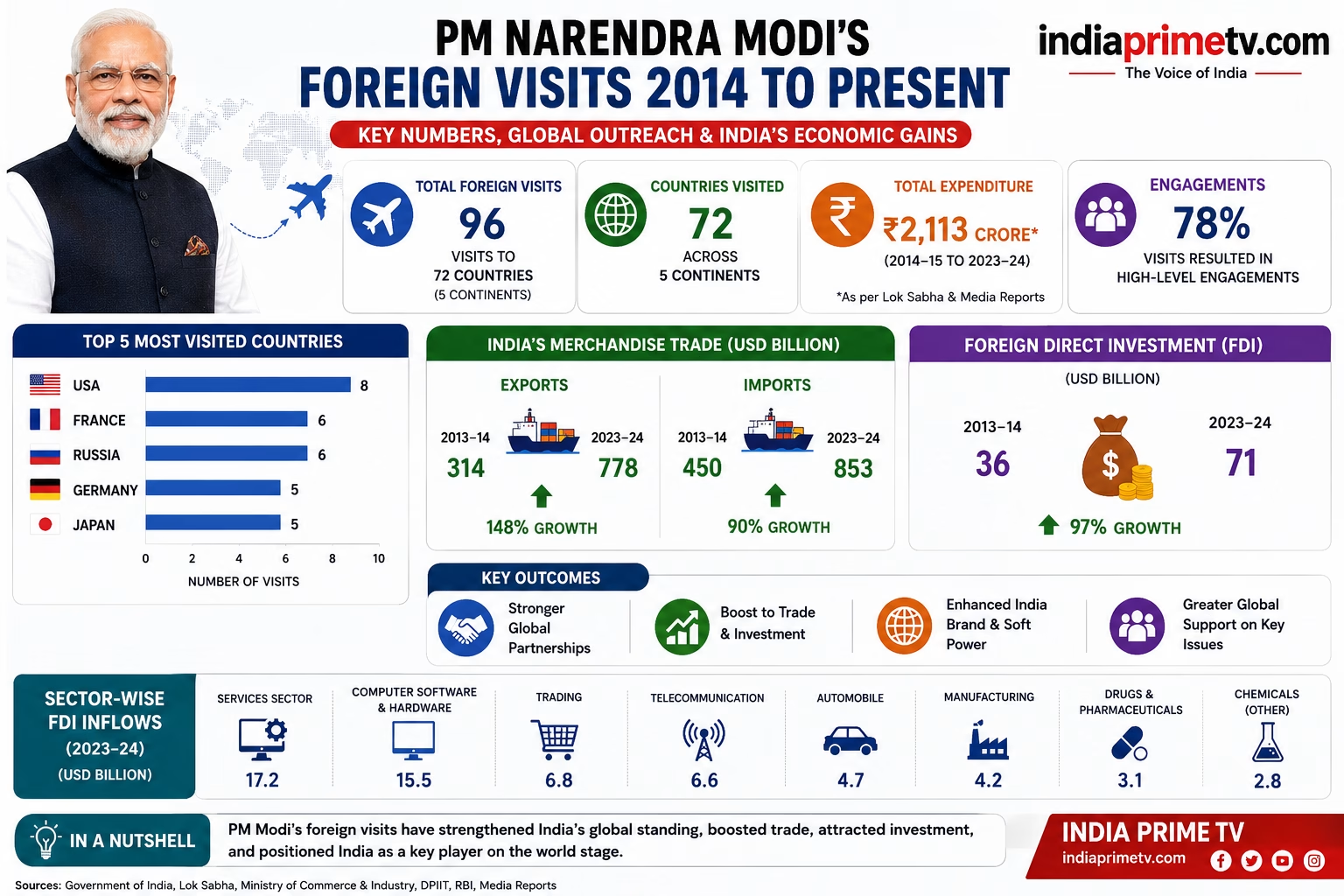
Devender Singh Indiaprimetv.com/ PM Modi’s Foreign Visits in Numbers: 101 Trips, 81 Countries, and What India Gained in Trade When Narendra Modi took the oath as Prime Minister on 26 May 2014, his first overseas trip — to Bhutan that June — set off what would become the most extensive travel record of any Indian Prime Minister. As of June 2026, Modi has made 101 international trips to 81 countries, a pace unmatched by any of his predecessors.
But the trip count alone doesn’t tell you much. The more useful question — and the one this piece tries to answer using official data rather than political claims from either side — is: what changed in India’s trade, investment and economy alongside all this travel, and what didn’t?
2014 vs 2026: The Big Numbers Side by Side
Before getting into the visits themselves, here’s the baseline picture, drawn from government and central bank data:
- Union Budget (total expenditure): Rs 17.95 lakh crore in 2014-15 → Rs 53.47 lakh crore in 2026-27 — roughly a three-fold increase in nominal terms over twelve years.
- Total exports (goods + services): around $466 billion in 2013-14 → roughly $860 billion in 2025-26, per Commerce Ministry and RBI data.
- Total imports: around $915 billion in 2024-25 (latest full-year figure available), reflecting India’s growing energy and gold import bill alongside its export growth.
- FDI inflows: $36.05 billion in 2013-14 → $81.04 billion in 2024-25. Cumulatively, India attracted $748.78 billion in FDI between 2014-25, a 143% jump over the $308.38 billion attracted in the preceding eleven years.
These are economy-wide numbers shaped by dozens of factors — global oil prices, the pandemic, domestic reforms, exchange rates — not just foreign travel. But they’re the backdrop against which the visits happened, and worth keeping in mind before crediting or blaming any single trip for a trade figure moving.
 How Many Times Has PM Modi Actually Travelled?
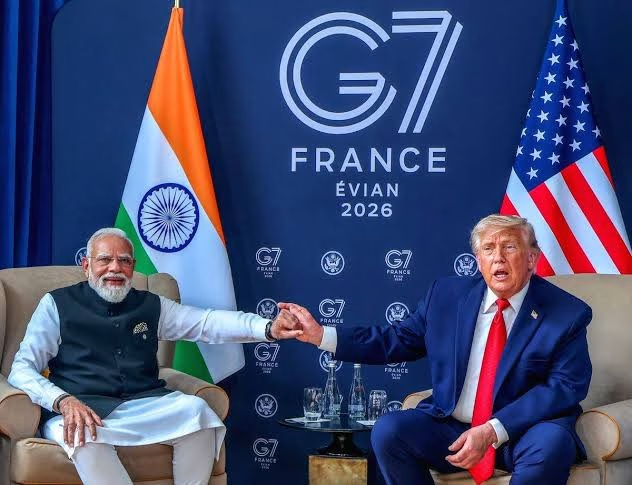
According to the Prime Minister’s Office’s own published log of visits, and cross-checked against independent tallies, Modi made 49 foreign trips in his first term (2014-19) and 27 in his second term (2019-24), with the remainder coming during the current term — bringing the total to 101 by June 2026. He did not travel abroad at all in 2020 because of the pandemic.
The most-visited destinations tell their own story about India’s strategic priorities: France and the United States have each hosted him 10 times, while Japan and the UAE have each hosted him 8 times. He holds several firsts among Indian Prime Ministers — the first to visit Israel (2017), Mongolia (2015), Ukraine (2024) and Slovakia (2026), and the only one to have visited Palestine (2018). One notable gap: he has never visited North Korea, and several other countries with significant trade or technology relevance to India remain unvisited.
What Has the Government Spent on These Trips?
This is a question that has come up repeatedly in Parliament. According to figures the Ministry of External Affairs has given in written replies to the Lok Sabha and Rajya Sabha, India spent approximately Rs 762 crore on the Prime Minister’s foreign visits between 2015 and 2025. Separate, overlapping figures for narrower windows have also been disclosed — for instance, around Rs 258 crore was spent across 38 trips between May 2022 and December 2024, according to Business Standard’s reporting of government data.
Worth being upfront about: these figures come from different parliamentary questions covering different time windows, so they don’t neatly add into one lifetime total — and the opposition has periodically questioned both the cost and the return on these visits. That’s a legitimate part of the story, not a footnote to it.
The Most-Visited Countries — and the Trade Story Around Them
United States: Trade in goods between India and the US reached $119.71 billion in 2023-24, making it consistently India’s largest single trading-partner relationship — though there is still no comprehensive India-US Free Trade Agreement, and tariff disputes have flared up periodically, including fresh US tariffs on Indian goods through 2025 that briefly slowed export growth.
Japan: Trade with Japan has grown steadily, anchored by long-running infrastructure cooperation (including the Mumbai-Ahmedabad bullet train project) and a free trade arrangement that predates 2014 but has deepened since.
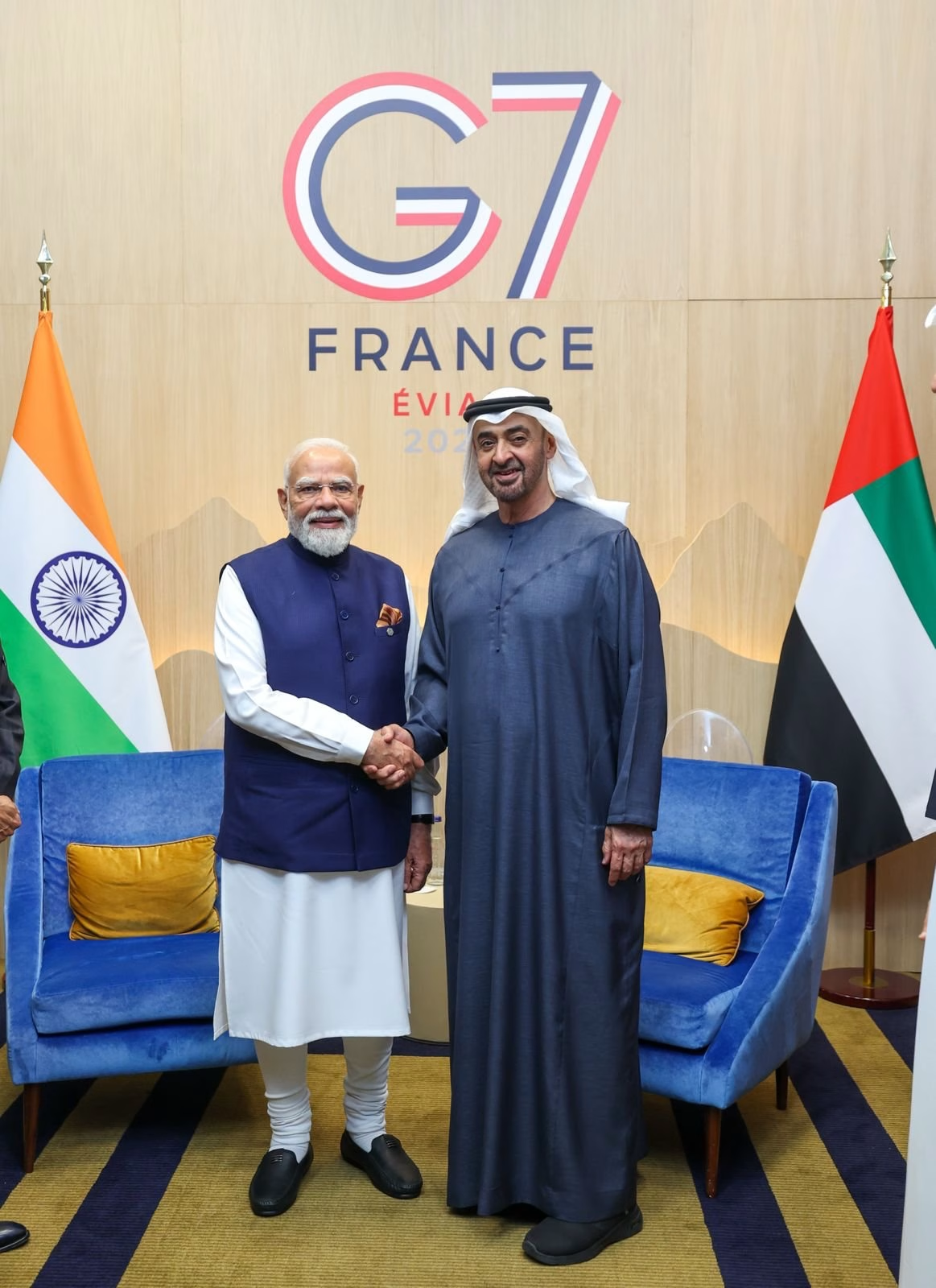 UAE: This is the clearest before-and-after story in the data. Bilateral trade had actually fallen to $49.3 billion in 2016 from about $67 billion in 2013. During a 2018 visit, India and the UAE signed an agreement to settle trade in local currencies. Trade momentum picked up further after the two countries signed a Comprehensive Economic Partnership Agreement (CEPA) in 2022, which cut tariffs on over 90% of Indian exports. Bilateral trade has since crossed $100 billion — $100.03 billion in 2024-25 and $101.25 billion in 2025-26, according to Commerce Ministry statements.
Asia, Africa and Europe: A Region-by-Region Look
Asia (Gulf and Southeast Asia): Beyond the UAE, India implemented the ASEAN-India Free Trade Area in 2015 and has continued to deepen Gulf ties — the UAE relationship in particular has become a template India is now trying to replicate with other Gulf and Central Asian economies.
Africa: India’s bilateral trade with Africa rose from $56 billion in 2019-20 to over $100 billion in 2024-25, according to Commerce Ministry officials, making India one of Africa’s top trading partners alongside China and the EU. India’s cumulative investment in Africa over 1996-2024 stands at over $75 billion, with the government aiming to double trade by 2030.
Europe: Trade in goods between India and the EU has grown 83.7% over the past decade, reaching roughly €118 billion in 2025, per the European Commission’s own trade data. The EU’s FDI stock in India rose from €105.1 billion in 2021 to €132.8 billion in 2024. The headline development here is very recent: India and the EU concluded negotiations on a long-pending Free Trade Agreement on 27 January 2026 — a deal that had been under discussion, on and off, since 2007, well before Modi took office, but was finally closed during his tenure.
What the Numbers Don’t Tell You
A fair accounting has to include what hasn’t moved, or has moved in the wrong direction:
- The trade deficit widened, not just exports. Imports have grown roughly as fast as exports in dollar terms, partly due to gold, electronics and crude oil — meaning the trade gap itself hasn’t closed.
- Several big relationships remain unresolved. There is still no India-US FTA, and India walked away from the Regional Comprehensive Economic Partnership (RCEP) in 2019 over concerns about Chinese imports — a decision that continues to be debated.
- Attribution is genuinely hard. Trade and FDI growth reflect global capital flows, domestic reforms (GST, PLI schemes, ease-of-doing-business changes), and currency movements as much as diplomacic outreach. The visits and the trade agreements often coincide, but coincidence in timing is not the same as proof of causation.
Bottom Line
By the numbers: India’s exports nearly doubled, FDI inflows more than doubled, and several long-stalled trade agreements (UAE CEPA, EU FTA) were finally concluded during a period when the Prime Minister travelled more than any predecessor. Whether the travel caused the trade gains, accompanied them, or simply happened to run in parallel with broader economic reforms is a fair question — and one this data alone can’t fully settle. What’s clear is that the headline numbers on both sides — visits and trade — are real, verifiable, and worth tracking together rather than apart.
Sources
- Prime Minister’s Office, India — Details of Foreign/Domestic Visits
- Wikipedia — List of international prime ministerial trips made by Narendra Modi
- The Federal — From Bhutan to Slovakia: Tracking PM Modi’s record 100 overseas visits
- PRS Legislative Research — Union Budget 2025-26 Analysis and Union Budget 2026-27 Analysis
- Press Information Bureau, Government of India — India’s Exports Reach Historic Heights, Trade Data FY 2024-25, FDI Inflows FY 2024-25
- IBEF — Foreign Trade Policy and Trade Statistics
- European Commission — EU Trade Relations with India
- Business Standard — India-Africa Trade Surpasses $100bn in 2024-25
- Outlook Business — India-UAE CEPA Boosts Bilateral Trade Past $100 Billion