
India Prime Crime Desk, Devender Singh Religion, Oil, and Empire: The Causes of Wars and the Journey of Weapons Wars have been an undeniable and tragic part of human history, driven by religion, control over resources (especially oil), and imperial ambitions. Powers like France, Britain, and the United States have fought for centuries to achieve these goals. Alongside, the evolution of weapons and strategies has transformed the nature of warfare.
1. Wars in the Name of Religion: Bloodshed Fueled by Faith
Religion has sparked numerous wars, where “holy wars” led to the loss of countless lives. These conflicts were fought not just with swords and shields but with the fervor of faith.
Key Examples:
Crusades (1096–1291)
What Happened? Christian Europe launched crusades to “liberate” Jerusalem from Muslim rulers.
Weapons: Swords, spears, and cavalry.
Strategy: Soldiers fought with religious zeal, driven by the call of “God’s will.”
Outcome: 200 years of bloodshed, ultimately defeated by Muslim leaders like Saladin.French Wars of Religion (16th–17th Century)
What Happened? Violent clashes between Catholics and Protestants (Huguenots).
Weapons: Swords, early muskets.
Strategy: The St. Bartholomew’s Day Massacre (1572) saw thousands of Protestants killed.
Outcome: The Edict of Nantes (1598) brought limited peace, but tensions persisted.Ottoman-European Wars (e.g., Battle of Vienna, 1683)
What Happened? Conflicts between Christian Europe and the Muslim Ottoman Empire.
Weapons: Cannons, fortifications.
Strategy: Europe formed alliances to halt Ottoman expansion.
Outcome: Religious tensions forced Europe to unite.
Reasons for Victory:
Military Might and Religious Fervor: Crusaders fought in the name of God.
Political Unity: Spain’s Reconquista united forces to expel Muslims.
Today’s Context: Religious tensions still fuel conflicts, such as the Israel-Palestine dispute.
 2. Wars for Oil and Resources: Black Gold, Red Blood
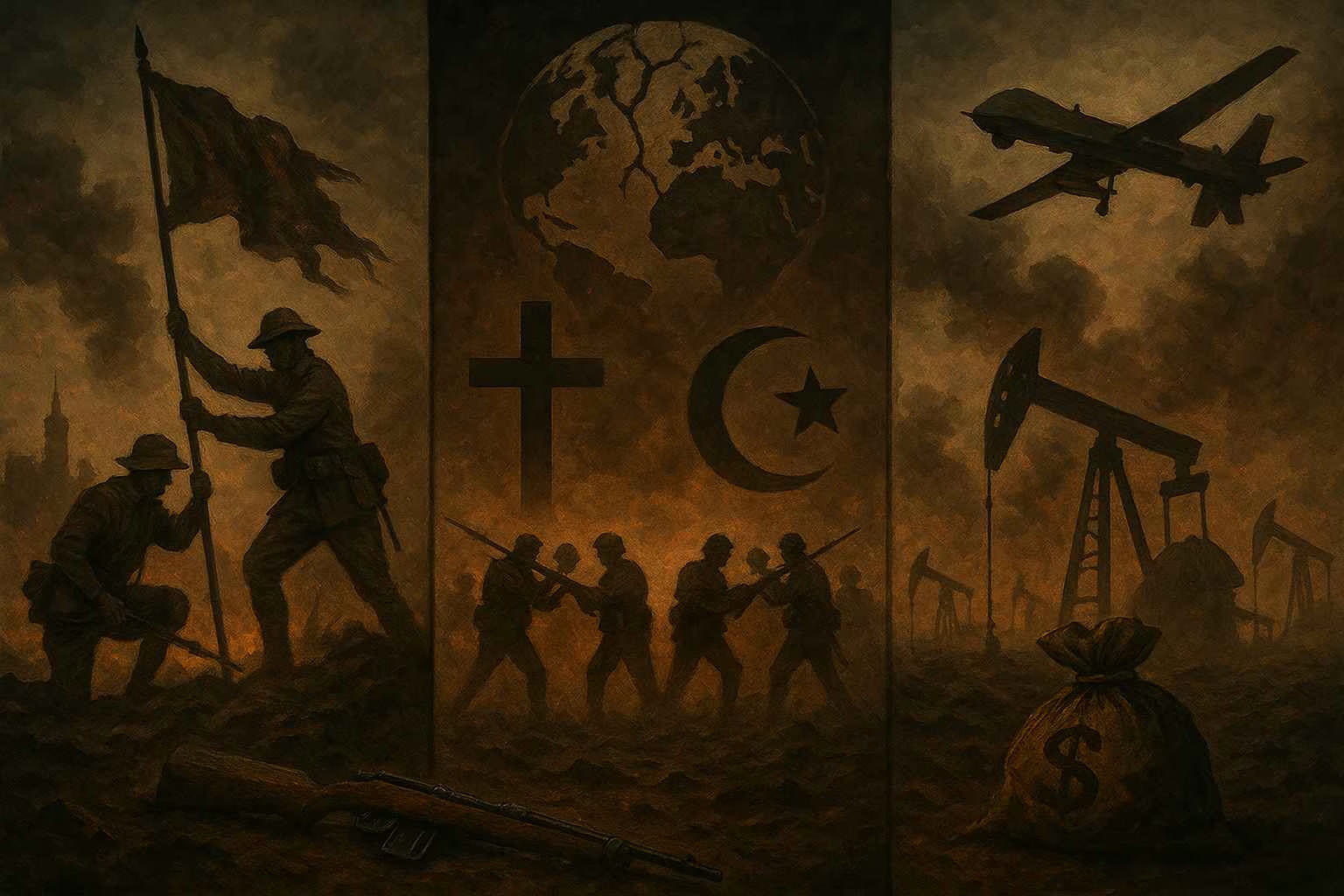 2. Wars for Oil and Resources: Black Gold, Red Blood
In the 20th century, oil became synonymous with global power. Countries with oil reserves became targets of world powers. These wars were fought not only on battlefields but also in economic and political arenas.
Key Examples:
First World War and the Middle East (1914–1918)
What Happened? After the Ottoman Empire’s fall, oil-rich regions like Iraq and Syria became battlegrounds for control.
Weapons: Machine guns (MG-08, Vickers), early tanks (Mark I), chemical weapons (chlorine gas).
Strategy: The Sykes-Picot Agreement (1916) divided the Middle East between Britain and France.
Outcome: Control over oil shaped the global economy.Iran-Iraq War (1980–1988)
What Happened? A battle for control over the oil-rich Shatt al-Arab waterway.
Weapons: Tanks (T-72), missiles (SCUD), chemical weapons.
Strategy: Both sides targeted oil fields.
Outcome: A million deaths, no decisive victory.U.S. Invasion of Iraq (2003)
What Happened? Invasion based on false claims of weapons and control over Saddam Hussein’s oil reserves.
Weapons: M1 Abrams tanks, drones (Predator), GPS-guided bombs (JDAM).
Strategy: “Shock and Awe” – rapid, overwhelming attacks.
Outcome: Instability in Iraq, rise of ISIS, and oil contracts for U.S. companies.
Reasons for Victory:
Economic and Technological Superiority: The U.S. leveraged high-tech weapons and economic power.
Resource Control: Seizing oil fields became a foundation for global dominance.
Today’s Context: The Russia-Ukraine war highlights energy resources as a central conflict driver.
3. Wars for Empire: The Quest for Global Domination
Imperial ambitions turned the world into a battlefield. France, Britain, and the U.S. sacrificed millions to expand their empires. These wars tell a story of power and dominance.
Key Examples:
French Colonial Expansion (19th Century)
What Happened? Conquest of Africa (Algeria, Senegal) and Indochina (Vietnam).
Weapons: Muskets, cannons (Gribeauval), early rifles.
Strategy: Alliances with local rulers and military suppression.
Outcome: Defeat at Dien Bien Phu (1954) sparked Vietnam’s independence movement.British Empire and India (1757–1947)
What Happened? The Battle of Plassey (1757) led to British control over India.
Weapons: East India Company’s cannons, muskets.
Strategy: “Divide and Rule” – pitting local rulers against each other.
Outcome: 200 years of exploitation, independence in 1947.Cold War and Proxy Wars (1947–1991)
What Happened? The U.S. (capitalism) and Soviet Union (communism) vied for global supremacy.
Examples:Korean War (1950–53): North (Soviet-backed) vs. South (U.S.-backed).
Vietnam War (1955–75): The U.S. intervened to stop communism but lost.
Weapons: M16 rifles, AK-47, napalm bombs, helicopters (UH-1 Huey).
Strategy: Guerrilla warfare (Vietcong), strategic bombing (U.S.).
Reasons for Victory:
Military and Naval Power: Britain’s navy secured control over India.
Local Allies: France leveraged local rulers in Africa.
Today’s Context: Imperialism now manifests as economic control (China’s Belt and Road) and military bases (U.S. presence in the Middle East).
Evolution of Weapons: From Swords to Drones
The history of wars is also a story of weapon and strategy evolution. Let’s examine the transformation in major conflicts:
War | Key Weapons | Strategy | Impact |
|---|---|---|---|
Napoleonic Wars (1803–1815) | Muskets (Charleville), cannons (Gribeauval) | Column formation, march divided | Infantry dominance, rapid attacks |
First World War (1914–1918) | Machine guns (MG-08), tanks (Renault FT-17), chemical weapons | Trench warfare, blockades | Horrific bloodshed, technological warfare begins |
Second World War (1939–1945) | Tanks (Panzer, T-34), nuclear bombs, radar | Blitzkrieg, strategic bombing | Total war, global destruction |
Vietnam War (1955–1975) | M16, AK-47, napalm, helicopters | Guerrilla warfare, air strikes | Local support triumphs |
Iraq War (2003–2011) | Drones (Predator), smart bombs (JDAM) | Shock and Awe, asymmetric warfare | Dawn of digital warfare |
Key Transformations:
19th Century: Era of swords, muskets, and cannons.
20th Century: Mechanized warfare – tanks, machine guns, aircraft.
21st Century: Smart weapons – drones, cyber warfare, AI-based systems.
Conclusion: Lessons from Wars and the Future
The history of wars teaches us that power, resources, and ideology are at the core of human conflict. Religion, oil, and empire have not only shaped history but continue to drive global struggles.
Religion: Tensions persist in conflicts like Israel-Palestine.
Oil: Energy resources remain central in wars like Russia-Ukraine.
Imperialism: It now appears as economic control and military bases.
Modern Warfare: Wars are no longer confined to guns. Cyber warfare, information warfare, and AI-based weapons are the new frontiers. France and other nations have learned from these wars, strengthening security through NATO and the EU, but history warns us: as long as the hunger for power and resources persists, the shadow of war will linger.