By Devender Singh | IndiaPrimeTV.com With nearly two years to go before the Uttar Pradesh Assembly elections, political alliances and vote-bank calculations have already begun to shape the state’s political landscape.
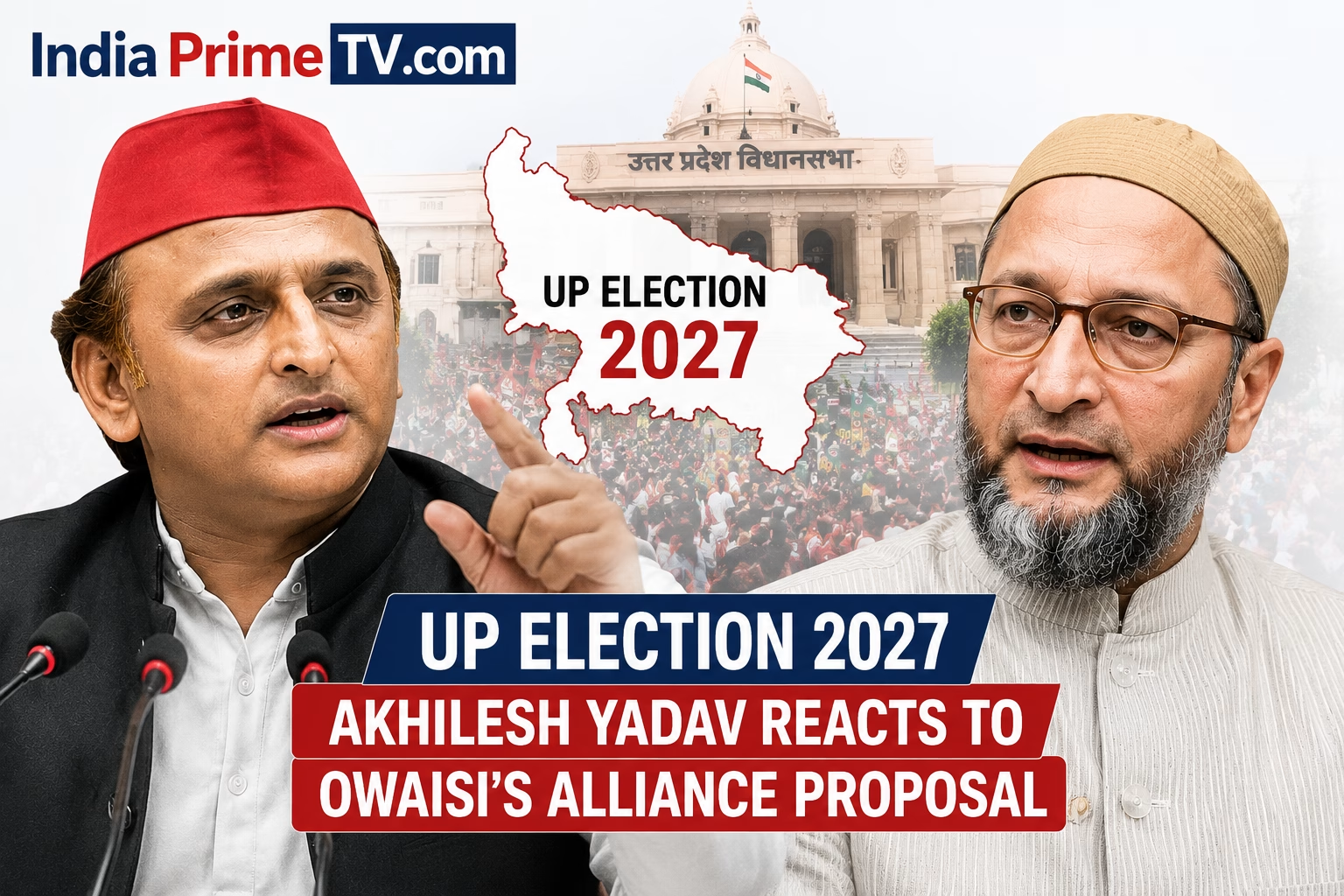
Samajwadi Party (SP) chief Akhilesh Yadav has responded to All India Majlis-e-Ittehadul Muslimeen (AIMIM) president Asaduddin Owaisi’s offer for an electoral alliance, indicating that his party intends to remain within the framework of the INDIA opposition bloc.
Addressing reporters in Lucknow, Yadav said, “The INDIA alliance remains intact, and it will continue. This alliance has successfully challenged the BJP in recent elections.”
Without directly naming AIMIM, he added, “Many people will come forward, and many obstacles will be created. Such efforts are aimed at helping the BJP.”
His remarks are being interpreted as a clear indication that the Samajwadi Party is not currently considering a formal alliance with Owaisi’s party for the 2027 state election.
Owaisi Offers Alliance to Defeat BJP
A day earlier, AIMIM chief Asaduddin Owaisi publicly expressed his willingness to join a broader opposition alliance in Uttar Pradesh.
“We are ready for an alliance to stop the BJP from returning to power in Uttar Pradesh, provided we are given respect and treated as equal partners,” Owaisi said.
The AIMIM has been attempting to expand its footprint in Uttar Pradesh since the 2022 Assembly elections, focusing primarily on constituencies with sizeable Muslim populations in eastern and western parts of the state.
However, Owaisi’s entry into UP politics has often drawn criticism from opposition parties, which accuse AIMIM of splitting anti-BJP votes.
Why the Muslim Vote Matters in Uttar Pradesh
Muslims account for nearly 19% of Uttar Pradesh’s population, making them the state’s largest minority community and a crucial electoral bloc.
Their influence is particularly significant in more than 140 assembly constituencies, especially in western Uttar Pradesh, Rohilkhand, Awadh and parts of eastern UP.
Traditionally, the Samajwadi Party has been the preferred political choice for a large section of Muslim voters due to its long-standing Muslim-Yadav (MY) social coalition.
However, the emergence of AIMIM and the Congress party’s attempts to regain lost ground have added a new dimension to the competition for Muslim votes.
Political analysts believe that a fragmented Muslim vote could potentially benefit the Bharatiya Janata Party (BJP), which has consistently consolidated support among non-Yadav OBCs, upper castes and sections of Dalit communities.
Current Political Landscape in Uttar Pradesh
The Uttar Pradesh Assembly has 403 seats, and a party or alliance requires 202 seats to form the government.
In the 2022 Assembly elections:
- BJP and its allies won 273 seats.
- The Samajwadi Party-led alliance secured 125 seats.
- Congress won 2 seats.
- AIMIM failed to win any seat.
- Bahujan Samaj Party (BSP) secured just 1 seat.
Despite its limited electoral success, AIMIM believes it can influence outcomes in closely contested constituencies by mobilising Muslim voters.
Can Congress Play Kingmaker?
The Congress remains a marginal force in Uttar Pradesh but could still play a strategic role within the INDIA alliance.
The party’s vote share in the 2022 Assembly elections fell below 3%, but its alliance with the Samajwadi Party in the 2024 Lok Sabha election produced encouraging results for the opposition.
Congress leaders have consistently argued that opposition unity is essential to counter the BJP’s electoral machinery in India’s most politically significant state.
Whether Congress and SP can sustain their cooperation until 2027 will be one of the biggest factors determining the opposition’s prospects.
BSP’s Stand: Going Solo Again?
The Bahujan Samaj Party, led by Mayawati, has traditionally preferred contesting elections independently.
While the BSP’s electoral performance has declined in recent years, the party still commands a dedicated support base among Jatav Dalits and retains influence in several constituencies.
Mayawati has so far shown no indication of joining either the BJP-led NDA or the opposition’s INDIA bloc.
BJP Focuses on Welfare and Social Engineering
The BJP is preparing for a third consecutive term in Uttar Pradesh under Chief Minister Yogi Adityanath’s leadership.
The party is expected to campaign on its governance record, welfare schemes, infrastructure projects and law-and-order agenda.
The BJP’s strategy continues to rely on a broad social coalition comprising upper castes, non-Yadav OBCs, non-Jatav Dalits and beneficiaries of central and state welfare programmes.
Party leaders have repeatedly dismissed opposition alliance talks, arguing that voters prefer stability and development over coalition politics.
The Road to 2027
While the Uttar Pradesh Assembly election is still some time away, the battle for alliances and vote banks has already begun.
Akhilesh Yadav’s latest remarks suggest that the Samajwadi Party intends to strengthen the INDIA bloc rather than expand it to include AIMIM.
For Owaisi, the challenge remains converting political visibility into electoral success. For Congress, the task is to regain relevance in India’s most politically crucial state.
And for the BJP, the objective is clear: retain its dominance in a state that sends 80 MPs to Parliament and often sets the tone for national politics.
As the race towards 2027 gathers momentum, Uttar Pradesh is once again emerging as the epicentre of India’s political contest.