"A.I. was really about sentient robotics," the director tells Polygon.
There are two types of Steven Spielberg movies: the ones he directed by himself (classics like Jaws and Jurassic Park) and the ones he shares with another director. The latter category has always interested me more, as Spielberg’s distinct style and sensibility clearly filters through the visions of other filmmakers.
Consider Poltergeist, directed by Tobe Hooper (The Texas Chainsaw Massacre) based on a story by Spielberg, who may have also ghost-directed the horror classic depending on who you ask. Or there’s The Goonies, technically directed by Richard Donner with another “story by” credit for Spielberg. According to the film’s child stars, he probably deserved a co-directing credit on the ’80s adventure classic.
The most interesting example of this phenomenon might be 2001’s A.I. Artificial Intelligence, which flips the dynamic to have Spielberg direct the movie in an attempt to execute the vision of another great filmmaker: Stanley Kubrick. So when I had a chance to speak to Spielberg about his new film, Disclosure Day, I couldn’t resist asking one question about Artificial Intelligence as well.
In a moment when AI feels increasingly inescapable — from generative technology to state-of-the-art Roombas — Artificial Intelligence has grown into Spielberg’s most relevant movie. So how does he feel about the movie 25 years after its release? And is there anything he’d change about it now, knowing what he does today? Spielberg’s response to Polygon reveals a director who’s both grappling with and rejecting artificial intelligence as it exists today. But to understand his response, we first have to revisit how the film Artificial Intelligence came to be in the first place.
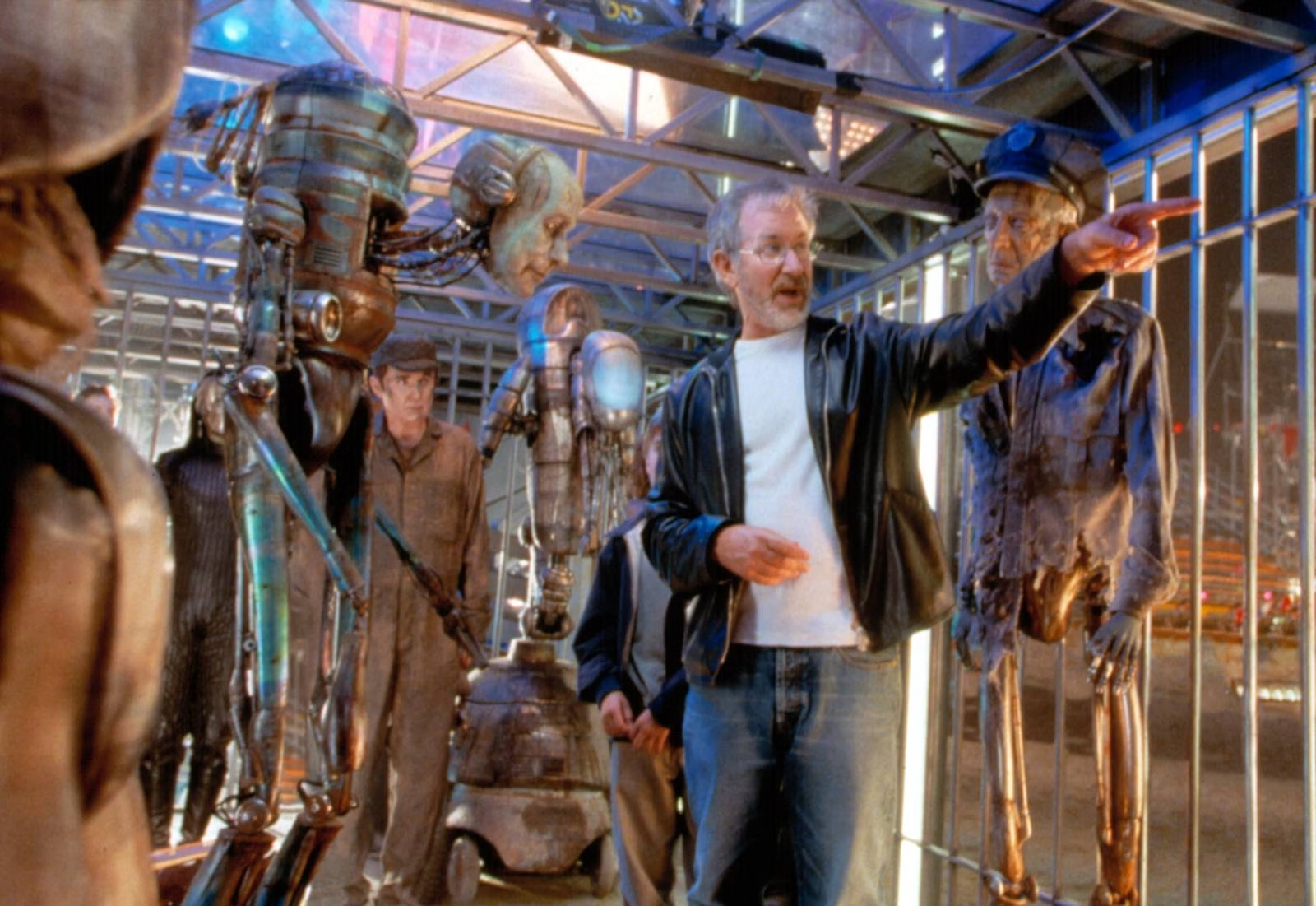
Unlike Poltergeist, there’s no debate over who really directed the film, but there was a long history to the project before Spielberg rolled cameras. Artificial Intelligence, which went on to follow the epic journey of a robot boy played by Hailey Joel Osment from the 22nd century to a distant post-human future, started with Kubrick commissioning science-fiction writer Brian Aldiss to adapt his 1969 short story, “Super Toys Last All Summer Long,” into a movie. After firing Aldiss off the project, he hired a series of other writers before eventually abandoning the project. By the early ’90s, Kubrick decided CGI still wasn’t advanced enough to bring the story to life.
It wasn’t until Jurassic Park pushed the limits of special effects in 1993 that Kubrick reconsidered Artificial Intelligence, with plans to start filming in 1994, but a year after that, he handed the project to Spielberg.
“Stanley showed Steven 650 drawings which he had, and the script and the story, everything,” producer Jan Harlan recalled in a 2001 interview with IGN. “Stanley said, ‘Look, why don’t you direct it, and I’ll produce it.’ Steven was almost in shock.”
This new arrangement didn’t last long. Kubrick couldn’t resist micromanaging, and Spielberg eventually offered to switch places, acting as a producer while Stanley took the reins. Kubrick soon became distracted by his final film, Eyes Wide Shut, and in 1999 he died of a heart attack. In 2000, Spielberg returned to finish the movie, which meant giving up the opportunity to direct Harry Potter and the Sorcerer’s Stone.
The result is an uncanny combination of two distinct filmmakers with unique styles and sensibilities. You might think that Kubrick’s epic scale and often bleak storytelling would clash with Spielberg’s sense of childlike wonder. Instead, they fit together like two puzzle pieces, which may be a testament to how well Spielberg’s distinct approach plays with others. There’s also a fairytale-like quality to Artificial Intelligence with its soothing narration from Ben Kingsley and its Pinocchio-inspired narrative of a robot boy seeking a fairy to make him real that elegantly covers up any seams in its cinematic patchwork.
Despite writing the entire script himself — Artificial Intelligence was Spielberg’s first solo screenplay credit since 1977’s Close Encounters of the Third Kind — the plot carefully follows Kubrick’s original vision. This includes the ending, when David (Osment) is frozen solid only to awaken 2000 years later and be greeted by a race of hyper-advanced AI robots that have long outlived their human creators.
For Kubrick, this concept of machines that could evolve on their own and eventually surpass their makers was central to A.I. Artificial Intelligence. It’s a topic he also explores in 2001: A Space Odyssey with the story of a rogue AI named HAL 9000 that tries to murder the two human astronauts on a spacecraft headed to Jupiter.
“Our movie, A.I., was really about sentient robotics,” Spielberg tells Polygon. “It was about thinking machines building thinking machines building thinking machines until the human race has evolved itself out of business and the machine culture begins. That was Stanley’s concept and that’s what I signed on to direct after Stanley passed away, even though we collaborated for six years on a series of treatments and ideas.”
70 snapshots from a 50-year career.
A lot has changed since the ’90s, when Spielberg and Kubrick worked together on Artificial Intelligence. So with that in mind, what would Spielberg do differently if he was making the movie today?
“If I knew where AI was really going, I probably would’ve had a little more emphasis on the amount of input you can put into your devices,” Spielberg says. “And from that input, you could really change your worldview. I wouldn’t have made it just about robotics, but also about the threat of having everything that we consider creativity from the soul supplanted and taken over by machine tools.”
On the one hand, that feels like a totally different movie from the one Kubrick envisioned. On the other hand, it’s a movie I’d definitely like to see. And in a moment when more and more directors seem to be embracing AI, it’s nice to see one filmmaker take a stand against it.
Make your anti-AI movie, Steven. Tell us how you really feel!
Disclosure Day is in theaters June 12.
We want to hear from you. Share your perspective in the comments below, and please keep the conversation respectful.
Your comment has not been saved
This space is open for discussion.
Be the first to share your thoughts.