
Prior training can cause artificial intelligence to misinterpret signs of new physics beyond the standard cosmological model.
Cosmologists rely heavily on the standard cosmological model, known as Lambda Cold Dark Matter, to describe properties like cosmic expansion and galaxy distribution. However, physicists recognise this model is likely incomplete.
Recent data suggests that phenomena such as massive neutrinos, modified gravity, or changing dark energy could point toward entirely new physical laws.
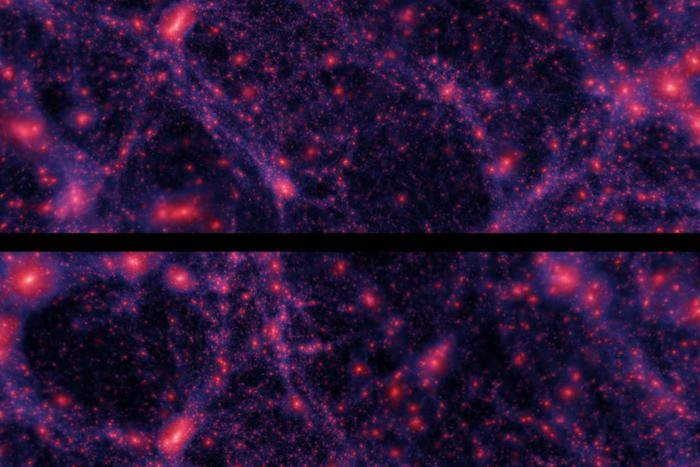
Testing these alternative theories requires running massive, high-precision computer simulations of virtual universes under varying physical assumptions. Because these simulations demand immense computational processing resources, researchers look for technical shortcuts to streamline the work.
A study published in the Journal of Cosmology and Astroparticle Physics evaluated the use of transfer learning to solve this processing bottleneck. Conducted by researchers from Princeton University and the Flatiron Institute, the project tested whether an AI could reuse knowledge gained from one task to speed up learning in a more complex one.
Instead of training a neural network directly on highly expensive data, the team pretrained the AI on simpler, less demanding simulations of the standard cosmological model. Once the network understood basic cosmic structures, the scientists adapted it to more complex models containing hypothetical physics. The method worked exceptionally well in initial tests, reducing the number of expensive simulations required by more than a factor of ten.
Despite the processing advantages, the statistical analysis uncovered a significant problem termed negative transfer. This occurs when an AI relies too heavily on its pretraining, causing it to fit genuinely new discoveries into old, familiar categories.
The researchers observed this issue during simulations involving massive neutrinos. Certain structural effects caused by neutrino mass look almost identical to patterns associated with a standard cosmological parameter called sigma eight, which dictates how matter clusters throughout space.
Because the two distinct physical parameters produce nearly identical observable effects, the pretrained neural network initially struggled to separate them, interpreting the new neutrino data through the lens of the standard model.
The study highlights that negative transfer is not a random computing error, but rather a direct result of underlying physical degeneracies where different cosmic mechanisms create matching visual results. While pretraining can accelerate data processing, it can simultaneously block an AI from recognising physics beyond the Standard Model.
The framework has only been tested on virtual universe models, but it establishes essential safeguards for analysing real deep-space data. As upcoming cosmological surveys generate unprecedented amounts of high-precision observational data, understanding these machine learning blind spots will be vital to ensure AI tools help identify new physical laws rather than masking them.
Open Access Government produces compelling and informative news, publications, eBooks, and academic research articles for the public and private sector looking at health, diseases & conditions, workplace, research & innovation, digital transformation, government policy, environment, agriculture, energy, transport and more.
As a Crossref Sponsored Member we are able to connect your content with a global network of online scholarly research, currently over 20,000 other organizational members from 160 countries. Crossref drive metadata exchange and support nearly 2 billion monthly API queries, facilitating global research communication.
© Adjacent Digital Politics Ltd