Careers
Web Story
Innovation
4 min read
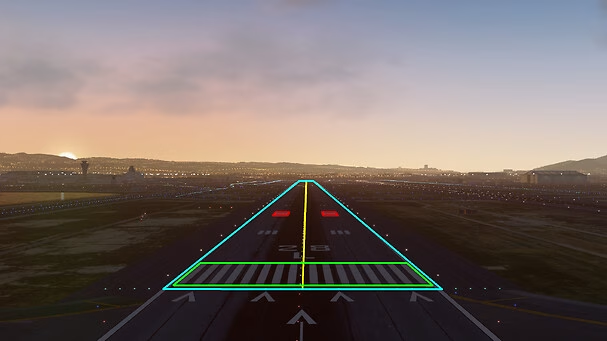
At the upcoming VivaTech forum in Paris this June, Airbus is set to showcase a demonstration highlighting the use of computer vision to enhance automated landing procedures and operational efficiency. The Vision Landing Application utilises artificial intelligence to analyse runway features in real-time using onboard cameras. The goal of this research is to create an additional and independent positioning source to guide pilots and/or their aircraft reliably, opening up the perspective of bringing autoland (fully automated landing procedure) capabilities to airports that lack advanced ground infrastructure.
While the technology is still in the research phase and far from commercial certification, this technical exploration aligns directly with Airbus’ global roadmap for Smart Automation. Airbus already has a head start, since it has already conducted numerous research projects during the last decade, which have led to the demonstrator at Airbus’ stand at this year’s show.
Airbus research opened with the launch of the Autonomous Taxi, Take-Off & Landing (ATTOL) project on June 1, 2018. Designed as a rapid risk-reduction demonstrator, ATTOL aimed to prove that an aircraft could safely navigate airport environments using image recognition technology entirely independent of conventional ground-based signalling infrastructure like Instrument Landing Systems (ILS) or Ground Based Augmentation Systems (GBAS).
With physical feasibility explored by ATTOL, Airbus entered its second development phase: verifying operational relevance and scaling data processing pipelines to handle real-world complexities (e.g., adverse weather, late runway alignments, unequipped airfields). This requirement saw the start of the Airbus UpNext DragonFly demonstrator project, which launched in November 2020. Key Project Objectives included: automated emergency operations, enhanced pilot assistance, workload reduction during taxi, and global data capitalisation.
In parallel, the project Auto’Mate was an Airbus UpNext project partnering with Airbus Defence and Space. While the autonomy objectives were different (air-to-air refuelling), the technology bricks were very similar. Auto’Mate utilised different types of cameras (resolution, field of view), high-precision satellite global positioning, and LiDAR (Light Detection And Ranging) sensors, combined with AI algorithms to achieve their objectives. All of these technologies are used for vision-based landing.
Building directly on the legacy of ATTOL, Airbus UpNext DragonFly, and Auto’Mate, the technology was advanced enough to launch the Airbus UpNext Optimate demonstrator in 2023 (as an ‘A350 cockpit on wheels’) – which was showcased the vehicle for real at VivaTech in 2024. Optimate synthesises previous technology bricks into a single unified mission profile.
Designed to explore full gate-to-gate strategic automation, Optimate introduces advanced trajectory protection models, automated anti-collision features, runway incursion safeguards, and a digital, virtual flight assistant designed to interpret ATC clearances and streamline ground communication. The three-year research project will culminate with a complete automated gate-to-gate mission profile on an A350 flight test airframe, representing the final step in the automation research countdown before industrialisation decision-making and certification.
In summary, these projects show how Airbus is assembling the technological ‘bricks’ to be able to move beyond conventional instrument based landing systems toward autonomous optical recognition.
Concretely, this means we are moving towards:
Meanwhile, to complement the Computer Vision aspects, Airbus is also designing the evolution of its future cockpits toward a more intuitive environment, crafted to improve situational awareness and alertness for flight crews. Overall, smart automation relieves pilots of repetitive tactical tasks so they can focus fully on the strategic and safety-critical aspects of the flight.
To ensure key missions such as trajectory management, navigation, surveillance, and crew decision support, the aircraft’s systems must be capable of autonomously perceiving their environment. Embedded AI could serve as a powerful tool to improve existing sensor technologies and provide an additional safety net for flight operations.
However, integrating artificial intelligence on board an aircraft (i.e. “embedded”) demands industrial criteria radically different from consumer, cloud-based AI applications. In an aerospace context, AI is constrained by a strictly limited computing and power environment within the aircraft’s hardware. To design certifiable functions, Airbus engineers must fully master the hardware behaviour and maintain absolute visibility over all software lines of code. This strict framework – combining recognition capabilities through Machine Learning, reasoning via Agentic AI, and creation through Generative AI – is what defines embedded AI at Airbus.
To drive these complex research efforts forward, Airbus has refocused its primary development activities within a multi-disciplinary research organisation located in Europe. This centre of excellence enables the pooling of expertise to overcome the technological and regulatory barriers unique to the future of aviation. By combining the rigour of aerospace engineering with the potential of computer vision, Airbus is stepping steadily toward the technological building blocks of its next-generation flight systems, while also providing support tools for flight crews, in order to enhance flight efficiency and safety.
Related keywords:
We design the invisible to protect the visible.
17-20 June 2026 | Paris Expo Porte de Versailles
Continue reading
Web Story
Innovation
4 min read
Web Story
Innovation
6 min read
Web Story
Innovation
3 min read
Web Story
Innovation
4 min read
Press Release
Innovation
3 min read
© Airbus 2026.