Encyclicals have high authority. They’re not infallible, though they often quote and explain infallible teachings. There’s a duty to plunge in to them, ask questions, discover their meaning.
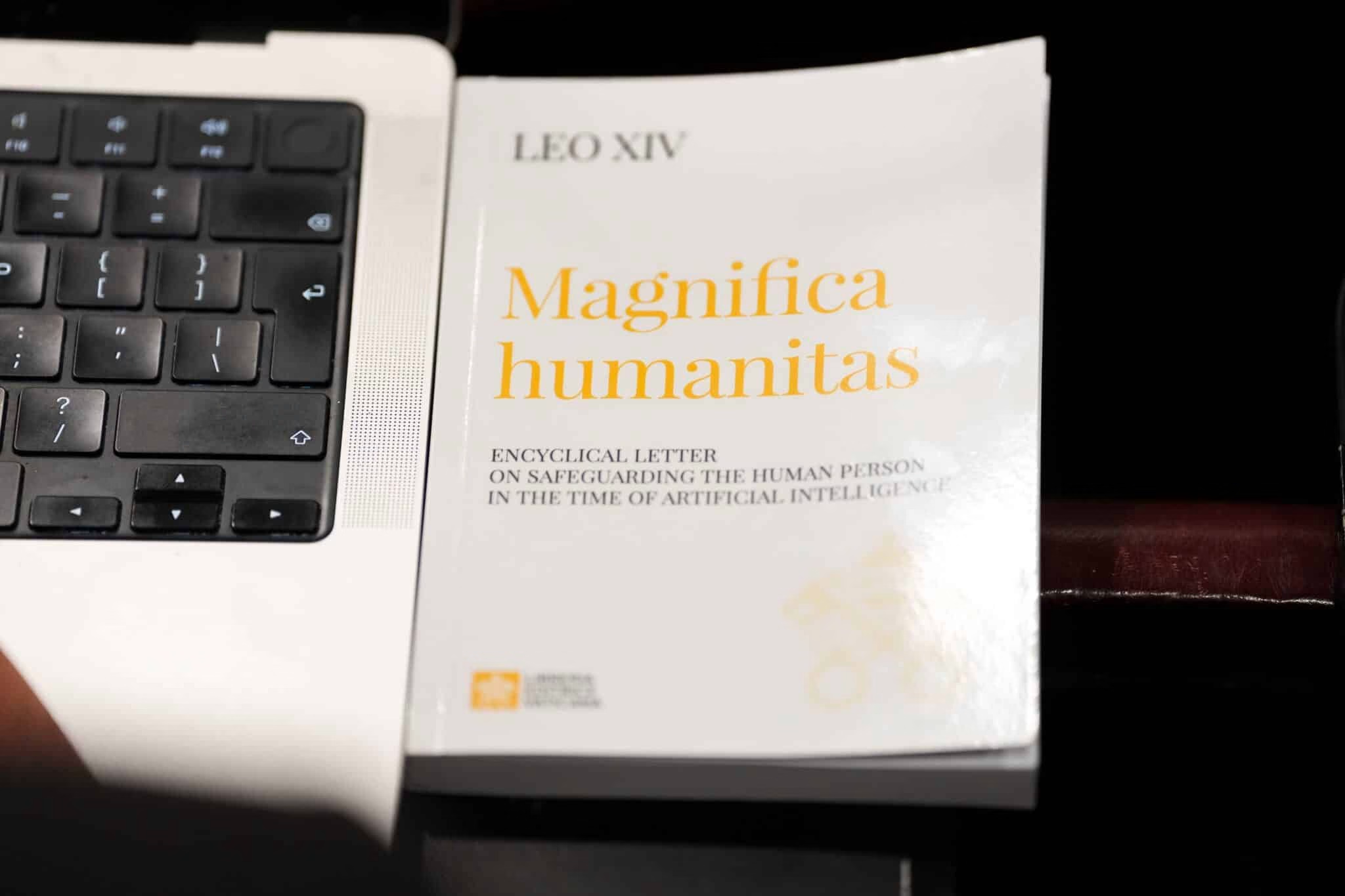
Pope Leo’s Magnifica Humanitas covers a vast number of topics – though it’ll always be the ‘AI Encyclical’. Clever folk will interpret the letter. I’ll wait for those interpretations to mature before reading them. I’ve read the letter twice and though I’m not attempting an interpretation here, it did prompt some thoughts.
Educationalists have spent years handling the risks of AI. It’s encouraging that the pope sees education as part of the solution to AI. He also recognises the inevitability of rapid tech change, dominance of the profit motive, the issue of power, the risks of insincerity and cynicism in tech companies. He makes many excellent points which hit home.
Pope Leo’s Letter stirred up three thoughts in me. If something is genuinely intelligent, it’s not a something but a person ie. a human or an angel (or it’s God – a rather special case). There isn’t a third way of being intelligent (though we can use the word “intelligence” to mean whatever we like of course). So, if you’re intelligent, you’re real, not artificial. And if you’re artificial, you’re not real, not a person.
People who study the human person or ‘anthropology’ start by showing persons don’t just process information. They understand what they process. And that requires self-consciousness as well as consciousness. And on that basis, we build up understanding. Understanding covers two things: the world around us (reality) and how to change the world (ethics). So intelligent people can become wise and also virtuous: moral beings. None of this applies to manmade systems or machines.
The second thing I’ve been pondering is different Catholic contexts for thinking about AI. One obvious context would be the dialogue begun 30 years ago in the encyclical Fides et Ratio, with its profound meditation on the nature of thinking, intelligence, philosophy and truth. Another would be moral teaching with its focus on the ultimate human purposes that give meaning to our choices – life, friendship, truth, faith, peace, family, etc. Instead, the pope has gone with social teaching. Why?
Partly, this is tactical. To some inside the Church and most outside social teaching is an acceptable face of Catholicism: terms like solidarity, rights, dignity, social justice are warmly received, particularly by people troubled by other parts of doctrine or morals.
Yet sound social teaching is entirely premised on Catholic moral teaching – and you certainly can’t accept the one without the other. ‘Common good’ presupposes the ‘individual good’: each of us valuing the ultimate purposes of human life, including preserving life from conception, seeking truth in all its fullness, promoting marriage and family etc. ‘Dignity’ is simply the value possessed by intelligent life or persons. ‘Solidarity’ isn’t political activism but a virtue developed through lived communion.
There’s a noble tradition of the popes writing social encyclicals to commemorate the anniversaries of Rerum Novarum, the encyclical in which the last Pope Leo directed the Church’s attention towards the concrete realities of social life. But the Magisterium does not define a set of ‘social principles’ that somehow run parallel to moral principles. These are simply the implications of Catholic moral teaching lived out in the world.
As treatment of AI requires anthropology, so it requires ethics. Pope Leo has very cleverly positioned us for the necessary anthropological and ethical debate to come and done this by first scooping up the vast majority of people outside the Church and a great many inside too.
Finally, in the introduction the encyclical identifies tech advance as among the great trends of our times about which the Church must speak out. The pope has spoken, but he hasn’t lectured the world on the science or sociology of AI – for which the papacy has no competence. Rather, he has stuck to the papal competence: identifying and applying principles from Catholic tradition and teaching.
This is surely the way in which the pope and his collaborators will go on to explain the other great trends of the age – the dangerous race and religion debates, gender identity, immigration, war and conflict, the fluctuating story of religious belief and practice. Leo has convincingly demonstrated how to address an issue that matters to everyone by turning to the Magisterium. We can anticipate scholarly interpretations of Magnifica Humanitas, and Magisterial teaching on the other great trends of the age.
Hayden Ramsay is the President of the Catholic Institute of Sydney and Professor of Moral Philosophy at the University of Notre Dame Australia.
The Catholic Weekly is proudly Catholic, proudly counter-cultural, proudly in favour of life. We strive to share our vision of the Church, the Lord and the life-changing possibilities of the Christian path with our readers, providing a degree of Catholic clarity for complex times.
© The Catholic Weekly 2025
© The Catholic Weekly 2026