In a Q&A, Yale radiologist John Lewin explains how artificial intelligence can not only be used to detect breast cancer but also predict future risk.
Image © stock.adobe.com
Image © stock.adobe.com
In another life, John Lewin was a spy.
Well, technically, he worked on spy satellites. In 1983, equipped with a degree in physics from Harvard, Lewin helped launch the very first digital spy satellite while working at Kodak.
“Back then, satellites were a huge secret,” said Lewin, now an associate professor of radiology and biomedical imaging at Yale School of Medicine (YSM). “We weren’t even allowed to say we had spy satellites, even though it was well known that we spied with satellites. That fact was an official secret until President Bill Clinton declassified it in 1995. Now, there’s a spy satellite exhibit at the Smithsonian.”
With his experience in imaging, Lewin eventually pivoted from spy satellites to studying radiology at medical school. By a twist of fate, he started researching digital mammography, which happened to use the same scanning technology as the spy satellites.
Today, Lewin is the division chief of breast imaging at YSM where he provides comprehensive care through breast imaging, including mammography, which helps in the early detection and management of breast cancer.
John Lewin
In an interview, Lewin discusses the importance of mammograms, how they’ve evolved over the years, and how AI might change how they’re done in the future.
The interview has been edited for length and clarity.
John Lewin: Mammography, even though it’s not perfect by any stretch, will decrease the number of breast cancer deaths by about one-third. It’s not wiping out all breast cancer deaths, but because breast cancer is so common and breast cancer deaths are so common, that’s a lot of lives saved. We obviously want to do better. We’re always working on research to do better.
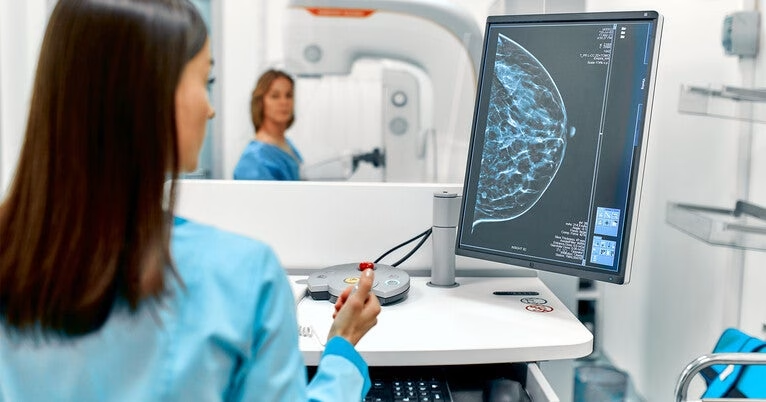
Lewin: We started doing screening mammograms in the 1960s. So it’s an extremely old technology. It’s obviously had some technical improvements, but we still compress the breast in the same way. You would think that something else would have come along that would be far superior to it, but actually nothing can beat it. It’s kind of amazing that we’re still doing mammography in basically the same way that we did in the ’70s. In about 2000, we switched to digital mammography, and I was part of that effort. For the last 26 years, we’ve been doing it the same, except that, about 10 years after we went digital, we added another technology called tomosynthesis. With that, instead of just taking one picture, we take a series of them, typically 15 to 25 pictures depending on the machine. Together, those pictures make a 3-D picture which helps you see more things than the standard picture.
Lewin: It was critical because the rest of radiology was already digital, and we were the outliers. Before digital, you had to develop sheets of film, which was fraught with problems, including dust, scratches, and chemistry issues. The hope was that digital mammography would make better pictures than film mammography but the first digital prototypes, which were the ones I tested, were not better than film. They were not significantly worse though, which is all the company wanted so that they could get FDA approval. Once we could say digital is about as good as film, then we could switch from film. Just as with film cameras, which also made better pictures than the first digital ones, people switched for convenience, and so that they could see their pictures right away. With film cameras, for example, you would mail a roll of film and get your pictures back two weeks later. With film mammography, it only took about two minutes to develop the film, but when multiplied over thousands of mammograms that was a big deal. Also, there’s so much you can do with digital that you can’t do with film. You can share the images without having to send the originals. You can store them in much less space, and you can manipulate them.
Lewin: It’s being used to help radiologists read mammograms. In Europe, for many decades, they’ve had mammograms read by two different readers. Two radiologists would both read the mammogram. If there was a dispute, they had a third reader who would break the tie. Now, in those situations the idea is that AI will replace one of the two readers. So you’ll have a human reader and an AI reader and then a tiebreaker if needed. In the U.S., where we’ve always only had single reading, it will turn from single reading into single reading plus AI. It’s been shown that a single reader plus AI will find more cancers. So, the U.S. will essentially start doing double reading by having human plus computer, whereas in Europe they will go from double reading to human-plus-computer. The next question is, “Will AI ever be good enough that it can be used alone?” It will probably get better and better, but it’s always going to be hard to get better than human plus AI.
Lewin: AI can predict risk to a certain extent, but it’s far from perfect. Let’s say they have two groups. For one, they predict the risk of getting breast cancer over their life is 10%, and for the other group, they say it’s 25%. What do you do with that knowledge? Do you screen the 25% group every year with MRIs? A lot of those women will never get breast cancer and yet they would have dozens of MRIs throughout their lives. In Connecticut, we don’t have enough MRI machines to do everybody. Nationwide, we don’t have the money to do an MRI on everybody because it’s an expensive technology.
Right now, there are women who are at higher risk, and they get screened with MRI every year. But for normal risk women, we don’t do that, even though we know we would find cancers earlier by doing MRI every year. What we don’t know is would that translate into saving lives, how many lives would we save, and would it be worth the extra cost, the extra biopsies, and the extra false positives. That’s all great research that needs to be done and will be done.