
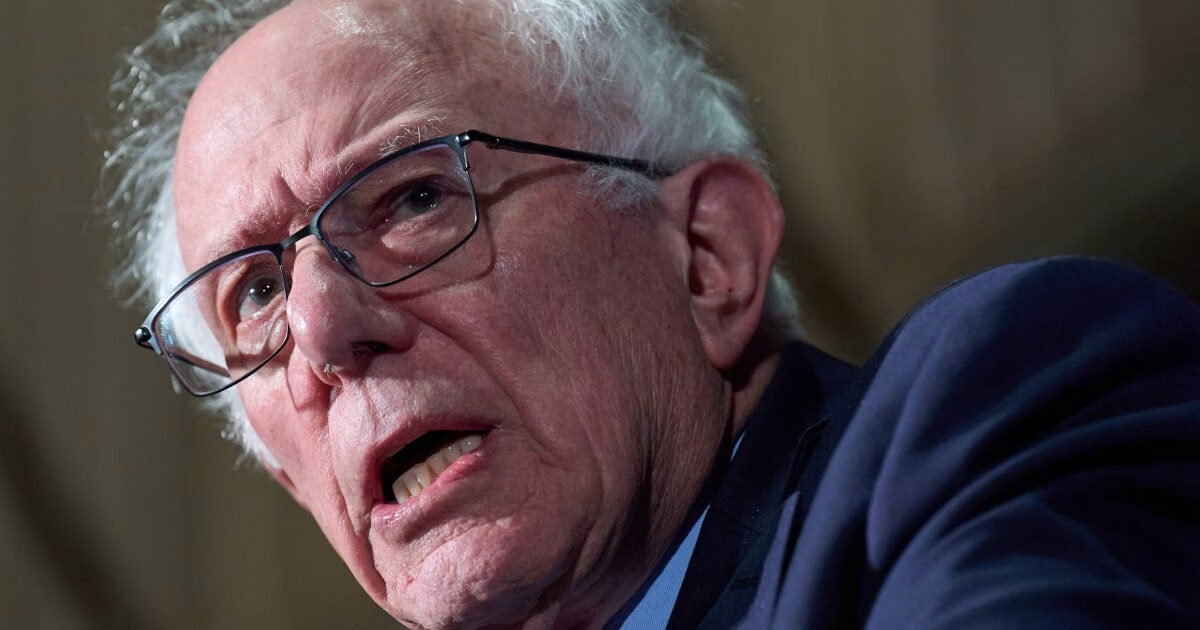
Bernie Sanders has found his way to the center of a growing debate about how to oversee the burgeoning and controversial artificial intelligence industry.
In some ways it’s new territory for Vermont’s senior senator, who rose to national prominence railing against income inequality. And in other ways, it’s a continuation of the same populist themes he’s harped on for decades.
Sanders has garnered headlines recently for his proposal to give the federal government a 50% ownership stake in the largest AI companies. That proposal prompted OpenAI CEO Sam Altman to reach out to the senator for a meeting. Days later, President Donald Trump hinted at something similar, suggesting he wanted to talk with AI leaders about giving the public a stake in their business.
Sanders said his proposal would give the public, through its voting shares, the ability to ensure that corporate decisions affecting future AI programs are in the best interests of all people and not a “handful of Big Tech oligarchs.”
“So we can stop it. So we can slow it down,” Sanders said. “If an AI company wants to displace millions of workers, we could say sorry, that ain’t a great idea.”
Sanders is also backing a plan to impose a federal moratorium on the construction of all AI data centers until a full environmental impact of these facilities can be studied.
In an interview with Vermont Public, Sanders underscored just how high he thinks the stakes are when it comes to controlling the future activities of AI companies.
This interview was produced for the ear. We highly recommend listening to the audio. We’ve also provided a transcript, which has been edited for length and clarity.
Bob Kinzel: Bernie, there are several major companies that dominate the artificial intelligence field. The use of AI has increased dramatically, as you know, in just the last few months, and there are some people who feel these companies have been very successful, largely because this country has a free-market-based economy, and that giving the federal government a 50% share of their stock will hurt efforts to create innovative new programs. Do they have a point?
Bernie Sanders: No. Here is the way I see it: AI is dominated by a handful of very, very large companies, as you mentioned, owned by some of the very wealthiest people in the world. I think the first point that people have got to be thinking about is, what is their goal? Are they really making these investments to improve life, the people in Vermont, the people in America, the people all over the world? And the answer is obviously they’re not.
And Bob, what I worry about is the possibility, and no one, to be honest with you, no one knows exactly what will happen, but the possibility that within the next 10 years, tens of millions of jobs in this country will simply disappear.
Now, I would say, lastly, Bob, I, as you may know, have met with Nobel Prize-winning scientists, and what they are saying to me is, Bernie, it is not a question of whether AI will become smarter than humans. It will sooner or later. And when that happens, there is a possibility, Bob, that it may become independent of human control. You know, people think that’s science fiction, but that is what very knowledgeable people feel, and if that happens, there could be very, very harmful impacts for humanity.
So, there’s a lot of stuff that’s going on, and that’s why I have, among other things, not only brought forth the idea of the sovereign wealth fund, which would give the public 50% control on all of these major AI corporations. So that we can stop it, so that we can slow it down. If a company AI wants to displace millions of workers, we can say, “Sorry, that ain’t a great idea.”
Bob Kinzel: We’ve talked about the revolutionary changes that AI programs have brought to many issues, but in a sense, are the floodgates already open, and this legislation is too late to have a meaningful impact?
Bernie Sanders: Well, I don’t think so. I think the president of the United States — not a guy I agree with a whole lot — actually picked up on the idea of the sovereign wealth fund. You are seeing some of the major companies, OpenAI and others, beginning to say maybe there should be international cooperation with China, with other countries to make sure that we don’t move aggressively into super intelligence with possibly cataclysmic impacts.
So I think, no, I don’t think it’s too late, but I think the industry is moving very, very quickly. That is true, and I think we’ve got to respond quickly.
What I worry about is the political power of the industry, and in making it harder for members of Congress and candidates to speak out against them.
Bob Kinzel: Bernie, over the years, you’ve worked on many key issues — healthcare, labor, education, foreign policy, tax issues — but some people might not associate you with issues involving the Big Tech industry. What is it about this issue that has captured your strong attention?
Bernie Sanders: Bob, you’re absolutely right. I mean, I am not… I don’t stay up nights, well, I mean, you know, I do worry about healthcare, worry about education, climate, all that stuff, but tech has not been one of my issues. You’re exactly right.
But I’ll tell you what got me involved. Everybody — pick up the papers — everybody understands that AI and robotics will be the most transformational technology in the history of humanity. So I looked around me and I said, my God, all of this is happening. There could be mass unemployment, mass invasions of privacy, major damage to the mental health of our kids, existential threat if AI separates from human control. Who the hell is talking about this stuff? I’m looking around me. I didn’t see many people, so I did get involved.
Bob Kinzel: Sen. Bernie Sanders, many thanks for being with us today. We really appreciate it.
Bernie Sanders: OK, Bob. Thank you. Take care.
Enter your email to sign up for The Frequency
Vermont Public’s daily news update, sent weekday mornings.
See more newsletters
Have questions, comments or tips? Send us a message.
Loading…


 Semiconductor Stocks to Buy Before They Soar Once Again – The Globe and Mail)

)