
During a recent trip to South Korea, Nvidia CEO Jensen Huang leaned into a key urgency rippling through semiconductor supply chains. Huang said, "The whole industry supply chain — everything from wafers to packaging to silicon photonics…everything's in short supply because the demand is so high. It is going to persist for several years."
I think this statement is a sobering assessment of a new reality. Artificial intelligence (AI) has turned memory into one of the most critical — and constrained — resources in hyperscale chip stacks. What was once a cyclical commodity has become a secular growth engine virtually overnight. This shift is important because, as Huang notes, it is not a temporary spike. Rather, insatiable demand for memory is becoming a multiyear reordering of supply and demand that will determine how fast AI scales.
While most investors obsess over Micron and Sandisk, I think one of the best ways for investors to participate in the entire AI memory supercycle is through the Roundhill Memory ETF (DRAM 4.16%), a specific fund built precisely for this moment.
Image source: Getty Images.
Training generative models and inference deployments require enormous bandwidth between processors and memory. High-bandwidth memory (HBM), which is an advanced form of dynamic random-access memory (DRAM) layered with graphics processing units (GPUs), delivers these speeds.
Hyperscalers like Alphabet, Amazon, Microsoft, and Meta Platforms are spending hundreds of billions of dollars annually to build massive chip clusters for next-generation data centers. Over the last year, a larger share of these AI infrastructure budgets has been allocated to memory and storage.
Exploding demand for HBM coupled with reduced supply of DRAM has fueled prices for memory chip manufacturers. All the while, demand shows no sign of decelerating.
Smart investors understand that memory markets have always been cyclical — boom, bust, repeat. This playbook is common because supply often lags demand and then overshoots once production ramps up. In other words, memory producers would flood the market with new capacity, only to see prices drop when the gadget cycle cooled.
The difference now is that demand for AI is not only tied to price-sensitive consumer devices or PCs. The hyperscalers are increasingly treating memory as a critical input within their chip stacks instead of a cost to minimize.
On the supply side, HBM production is far more complex than standard DRAM and requires multiyear fab investments. Wall Street analysts describe the current memory chip landscape as a structural imbalance that is unlikely to resolve quickly. Simply put, supply growth is not keeping pace with AI-driven demand — which continues to compound annually.
For investors seeking exposure to the AI memory trade without picking individual winners, the Roundhill Memory ETF (exchange-traded fund) offers a pure-play solution focused on companies delivering DRAM, HBM, NAND, and related storage technologies.
Its actively managed portfolio is diversified across the global memory leaders, including Micron Technology, Samsung Electronics, SK Hynix, Kioxia, Sandisk, Seagate, Western Digital, and a couple of other smaller specialists. One thing that I particularly like about the fund is its geographic reach spanning the United States, South Korea, Japan, and Taiwan.
With an expense ratio of 0.65%, the Roundhill Memory ETF is a low-cost way to access the AI memory theme. If the shortage persists for years — as Huang suggests — AI memory stocks should have more room to run, making DRAM a compelling opportunity to buy in the AI infrastructure era.
Adam Spatacco has positions in Alphabet, Amazon, Meta Platforms, and Microsoft. The Motley Fool has positions in and recommends Alphabet, Amazon, Meta Platforms, Micron Technology, Microsoft, and Western Digital. The Motley Fool has a disclosure policy.
*Average returns of all recommendations since inception. Cost basis and return based on previous market day close.
Invest better with The Motley Fool. Get stock recommendations, portfolio guidance, and more from The Motley Fool's premium services.
Making the world smarter, happier, and richer.
© 1995 – 2026 The Motley Fool. All rights reserved.
Market data powered by Xignite and Polygon.io.
About The Motley Fool
Our Services
Around the Globe
Free Tools
Affiliates & Friends
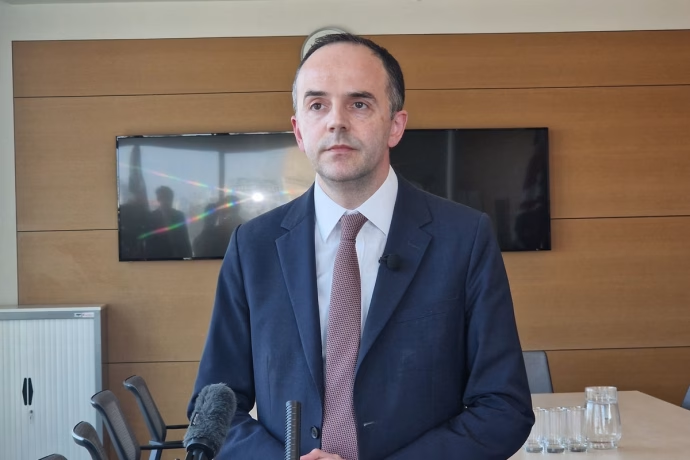
Nvidia CEO Jensen Huang recently said the AI memory shortage will likely last several more years.

 Memory Boom Is Impossible to Ignore. Here's My Top Pick That No One Is Talking About. – The Motley Fool)


