

Nvidia (NVDA 0.43%) has long been considered the industry standard for artificial intelligence (AI) computing stocks. Since 2023, it has been an amazing performer and has delivered strong, market-crushing returns for shareholders. However, 2026 hasn't been so kind.
Nvidia's stock is up about 12% this year, which isn't a bad return, but it's only beating the S&P 500 (^GSPC 0.26%) by a few percentage points (the index is up about 8% so far). Investors are used to much stronger double-digit percentage returns from Nvidia, leaving many investors disappointed in its 2026 results, especially when other stocks like Micron (MU 2.40%) and Sandisk (SNDK +0.38%) have crushed Nvidia and the market so far in 2026.
Micron is up 228% in 2026, while Sandisk is up nearly 600%. Those are returns that Nvidia investors can only dream about, but could that continue throughout 2026? Let's take a look.
Image source: Getty Images.
Both Micron and Sandisk are involved in the memory chip sector. Although Micron makes both NAND and DRAM memory, Sandisk only makes NAND. NAND demand from an AI perspective mostly comes from solid-state drives (SSDs), which are used for long-term data storage in data centers. DRAM is used in computing chips as these devices need to rapidly pull from a memory bank to process computations quickly. Demand far outpaces supply for both memory chip types, causing prices to soar. This effect has led to a boom in both stocks, and that growth may not slow down for a while.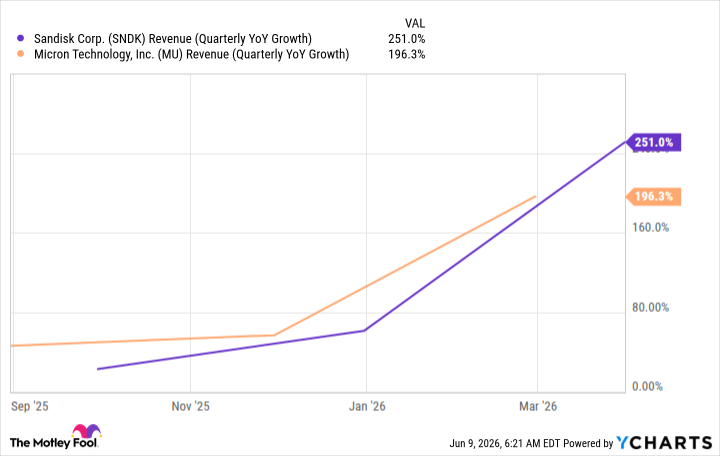
SNDK Revenue (Quarterly YoY Growth) data by YCharts
This could allow both stocks' returns to extend through 2026 and well into 2027 and beyond. Both companies (and their peers) are racing to build up more supply, but demand from data centers could still outpace new supply, leading to sustained memory chip constraints. That would bode well for both businesses and could lead them to outperform Nvidia for the rest of the year. But that doesn't mean investors should race out to swap Nvidia shares for Sandisk and Micron stock, either.
Nvidia may have had a slow start to 2026, but it may not stay that way for long. There has really been nothing to be disappointed about with Nvidia, besides its lackluster returns. During its latest earnings announcement, it beat expectations and revenue rose an outstanding 85% year over year. It gave a forecast for $91 billion in revenue for the next quarter, which could result in more than a 100% year-over-year growth if Nvidia beats expectations by a similar amount as it typically does.
It also told investors to expect $1 trillion in AI capital expenditures by hyperscalers next year, up from about $650 billion this year. That unlocks another year of strong growth for investors, but none of that has been priced into the stock to date. 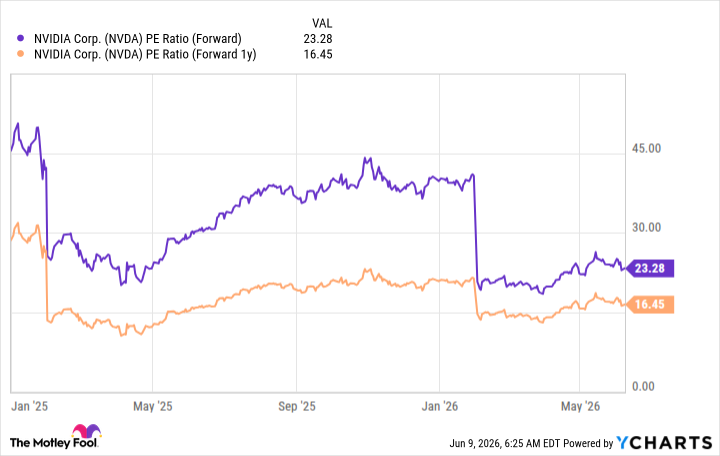
NVDA PE Ratio (Forward) data by YCharts
Nvidia trades for 23.3 times fiscal year 2027 earnings (ending January 2027) and 16 times 2028 earnings. That's a pretty low price to pay for Nvidia, especially if Nvidia's other projection comes true. It believes global data center capital expenditures will rise to $3 trillion to $4 trillion annually by 2030.
None of that is priced into Nvidia's stock right now. If some of it is priced into the stock at the end of this year, it could ignite a significant rally in the stock price, but it likely won't be enough to catch Micron or Sandisk's 2026 performance. Nvidia is still a great investment, but its growth capabilities still trail Micron and Sandisk.
Keithen Drury has positions in Nvidia. The Motley Fool has positions in and recommends Micron Technology and Nvidia. The Motley Fool has a disclosure policy.
*Average returns of all recommendations since inception. Cost basis and return based on previous market day close.
Invest better with The Motley Fool. Get stock recommendations, portfolio guidance, and more from The Motley Fool's premium services.
Making the world smarter, happier, and richer.
© 1995 – 2026 The Motley Fool. All rights reserved.
Market data powered by Xignite and Polygon.io.
About The Motley Fool
Our Services
Around the Globe
Free Tools
Affiliates & Friends
Nvidia's time could be coming.



 Stock in 2026. Can That Continue? – The Motley Fool)


