
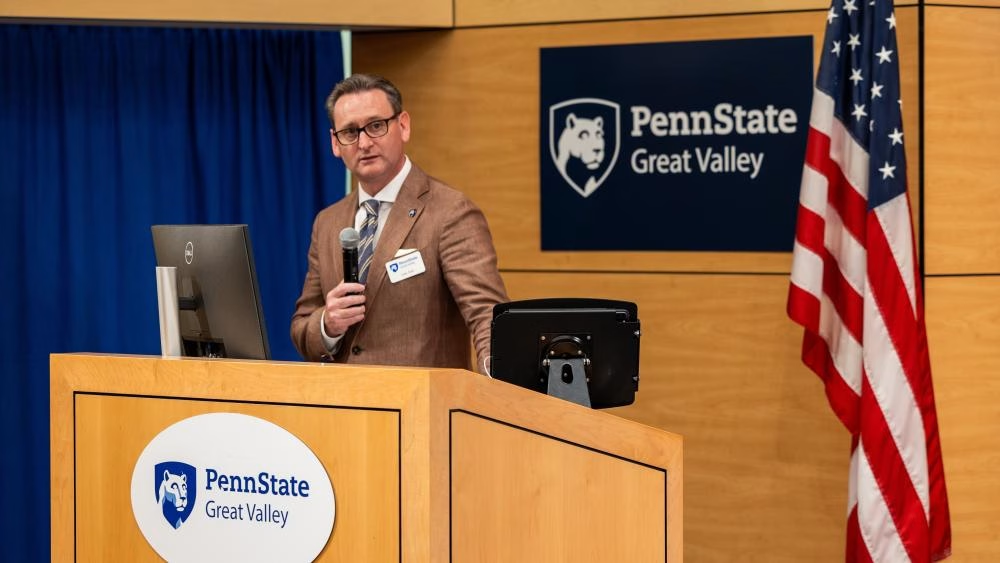
Professor and Chancellor Colin J. Neill speaks at a podium at Penn State Great Valley. Credit: Penn State. All Rights Reserved.
By Allison S. Duncan
MALVERN, Pa. — On Penn State Great Valley’s new podcast, Chancellor Colin Neill talked with campus advisory board chair Sassan Hejazi to discuss Neill’s experience with AI in the 1990s and how Great Valley is preparing students and organizations today for the far-reaching changes AI is sparking across industries.
Neill also explained why AI often produces mediocre output and how to use it to get exceptional results.
The Q&A below has been edited for length and clarity. Listen to the full conversation on the Impact at Penn State Great Valley podcast.
Neill: It’s interesting to see the cycle of AI. It was a very hot topic back in the ’90s. I started in a research group that was interested in robotics and automation in manufacturing facilities, but then transitioned to looking at mission-critical applications of AI like instrument landing systems for aircraft.
As a postdoc, I worked with a group at Oxford University looking at how to improve production schedules at British Aerospace and Rover Cars. And the AI at the time, which was knowledge-based systems, model-based reasoning, wasn’t up to the task.
And now we come to the present day, and it’s interesting to see — as computing power has evolved and techniques and algorithms have advanced — the incredible things you can do with AI.
Neill: It’s very easy to get a generative AI system to answer a simple question, even to do some rather complex tasks. So you can ask it to do some financial analysis, for example, and it can do a really good job.
But we shouldn’t be approaching it as, “How can the system do what I can do?” We should be looking at it as, “How can I use this system so that I can do so much more than I could before? How do I stand on top of AI to provide real value to my organization?”
And that means, where does critical thinking come in? Where do values, ethics and morals come into decision-making? What’s really critical to us is making sure our students realize that the human is still necessary.
A general AI solution is a system trained on a dataset to produce the most likely outcome, the middle of the curve. And that means the solutions that we get out of AI are the average solution.
Then you can see where you can provide value to take that average solution to be an exceptional solution. It still needs humans. It still needs a deep understanding of what you’re doing, regardless of what business you’re in. And it requires tailoring of the output.
We’re looking to see how we can have our students use these tools in the classroom, in their assignments. But that’s not the end goal. It’s not, “Can you solve this equation with AI?” or “Can you write this paper with AI?” It’s — once you have the result from one or multiple prompts, how do you then reason about those different outputs? How do you determine which one is the right path moving forward? That’s where our graduates will have a leg up over those who are just using AI to do their jobs.
Neill: We are a forward-thinking, entrepreneurial campus, so all of our programs come from our understanding of where industry is moving.
AI is affecting everything about business at the moment. It’s one of the primary goals of our provost to make Penn State the leader in AI, not just in AI education or AI research, but also leveraging AI for the operations of the institution and within our pedagogy.
And we’ve been doing all of those things here at Great Valley for several years now. On the curricular side, we are infusing AI throughout every course we teach — AI in accounting, finance, how AI is changing those fields and every branch of business. We want to make sure that our students are well-prepared for that evolution.
Our AI-centric programs form a continuum — from the very technical training in how to build and advance AI, to the no-code, low-code programs, which are about how to create AI platforms and solutions without in-depth coding ability. We have a new MBA in AI, which is launching in the fall, designed for those who are going to be implementing AI across their organizations — how do you do that? Where does AI succeed? Where do you still need to have a human in the loop?
Neill: Penn State Great Valley can help in many different ways. Obviously, if you’re interested in pursuing one of our degree programs, it’s very easy to reach us at gvinfo@psu.edu and talk about our offerings.
If you’re interested in collaborating with us, there are many avenues by which to do that. Our students love experiential learning opportunities, and they want to work on real-world problems for real clients. We could do capstone studies, we can do projects within classes, we can do research projects with our faculty and our students.
And we’ve recently adopted a consulting model so that we can scale the team and the time that they spend on a project to reflect the scale, scope and complexity of the problem that’s been chosen.
We’re doing this with corporate clients as well as non-profits. So we launched the Community Impact Collective, which is a student-staffed consulting group to provide these kinds of services and advice and outcomes to the non-profit community. We partner with United Way of Chester County, and the first project was with United Way themselves. And it can be anything from exploring how a non-profit could leverage, say, Copilot, to creating an entire AI pipeline.
For anyone who’s interested in corporate and community collaboration, or even just having a discussion to see what the options are, they can contact gvcollaborate@psu.edu.
Get the news by email


)
 – Fathom Journal)
