
Thank you for visiting nature.com. You are using a browser version with limited support for CSS. To obtain the best experience, we recommend you use a more up to date browser (or turn off compatibility mode in Internet Explorer). In the meantime, to ensure continued support, we are displaying the site without styles and JavaScript.
Advertisement
Nature Communications volume 17, Article number: 4959 (2026)
While the artificial intelligence (AI) revolution is advancing rapidly, the open-source paradigm offers key pathways and potential risks for accelerating progress towards the Sustainable Development Goals and beyond. This comment introduces four governance actions that consider how sustainability, evaluation, safety, and cooperation can be integrated into the transformation of open-source AI, thereby reducing uncertainties and challenges posed by open-source AI for sustainable global prosperity.
The Artificial Intelligence (AI) Action Summit, held on February 10, 2025, in Paris, highlighted the rising international commitment to harness AI for the Sustainable Development Goals (SDGs) proposed and endorsed by the United Nations1,2, aligned with calls to govern AI in the context of planetary health, across environmental, social, and safety domains3. Between 2018 and 2024, the use of AI to support the SDGs grew by 300%4, with contributions in agriculture monitoring (SDG2), ecosystem governance (SDG15)5, and climate change mitigation (SDG13)6. The rise of open-source paradigms underpins this transition toward a ubiquitous and efficient AI ecosystem. By making the source code, weights, and training data open, releasing them under an open-source license7, and allowing the community to study, use, modify, and distribute them, open-source AI was initially envisioned to inherently and efficiently accelerate global progress toward sustainable development.
However, as the open-source AI models have expanded, their impact on the SDGs has revealed an increasingly complex and dualistic nature for SDG progress7,8. The accessibility of open-source models within unregulated environments has introduced critical inhibiting effects that were previously overlooked. Specifically, the lack of structured governance often leads to excessive resource consumption and ethical vulnerabilities, which have not yet been well discussed. The emerging reality suggests that without a deliberate transformation in how these open-source AI models are managed, the openness intended to empower global SDGs could instead undermine it.
While many previous studies and frameworks have advanced the understanding of open-source AI and sustainability, they remain fragmented and separated. On the one hand, most studies emphasize single-stage impacts (e.g., training or deployment) rather than addressing interdependencies across the full lifecycle of open-source AI models9,10. On the other hand, existing open-source AI governance frameworks, ranging from the United States’ innovation-oriented framework to the European Union’s risk-based regulatory framework11, primarily operate within national or institutional silos, lacking mechanisms for cross-border coordination and enforcement.
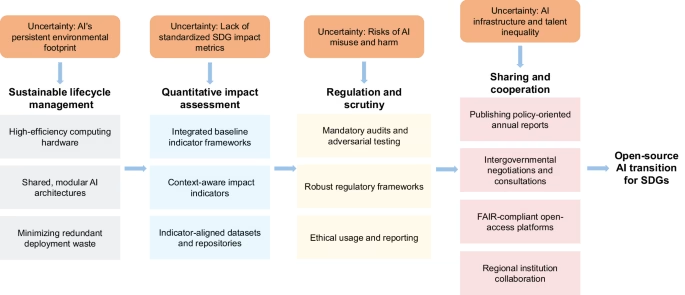
To address the challenges of open-source AI models and governance frameworks, we propose four actions tailored to them, which would advance previous studies and frameworks in two ways. First, they could contribute to shifting the focus from passive implementations to proactive interventions, embedding sustainability, accountability, and transparency throughout the development, deployment, and reuse of open-source AI models. Second, the transformative actions could introduce a multi-stakeholder and cross-scalar perspective, aligning developers, regulators, and users within a coordinated framework that connects local implementation with global cooperation. We conceptualize open-source AI governance as a dynamic interaction among sustainability (sustainable lifecycle management), evaluation (quantitative impact assessment), safety (regulation and scrutiny), and coordination (sharing and cooperation) (Fig. 1), thereby aligning the open-source AI paradigm with sustainable, ethical, and equitable principles.
Key uncertainties of open-source AI persist regarding environmental impacts, assessment methodologies, potential misuse, and infrastructure inequalities. Our proposed solutions address these through integrated governance mechanisms: sustainable lifecycle management; quantitative impact assessment; regulation and scrutiny; and sharing and cooperation. These coordinated actions are essential to harness open-source AI’s potential for Sustainable Development Goal (SDG) progress.
Leveraging the opportunities offered by AI for SDGs is both desirable and feasible. Recent innovations signal a transition toward an open-source paradigm8, aligning with the more accessible and adaptable solutions of the SDGs. Furthermore, they enable localized modeling of the SDGs and foster global collaboration in SDG modeling and policy-making.
The transition toward the open-source paradigm promotes the dissemination of knowledge and the iterative refinement of SDG modeling, which involves mathematical, statistical, and/or computational approaches for analyzing and projecting SDGs (e.g., SDG interaction analysis and scenario simulation)12. Through open access to algorithms and collaborative development environments, this paradigm enables rapid model iteration in response to emerging SDG challenges, such as epidemics, natural disasters, or conflicts, thereby generating faster and more reliable insights into future SDG trends. The ability to host open-weight AI models on highly optimized, dedicated infrastructure enables speeds of over 179 tokens per second (versus 138 for a proprietary AI model)13, which is an advantage for latency-sensitive applications addressing SDG challenges in specific regions. In the environmental dimension of SDGs, open-source natural language processing models like ChatClimate are being developed to respond exclusively with validated scientific knowledge, which contributes to mitigating the risk of climate misinformation14. In the social dimension of the SDGs, open-source language models like Llama have been explored as potential tools to help address global shortages of therapists, particularly in meeting specific community health needs15. In the economic dimension of the SDGs, open architecture enables small and medium-sized enterprises to adopt and customize cutting-edge AI to optimize production by providing open access to foundational models16.
The open-source paradigm shift significantly lowers the costs of utilizing AI models, fostering broader participation in achieving the SDGs. For instance, while delivering comparable performance, open-source AI models cost 5 to 29 times less than proprietary models17. This extends the scope of AI applications beyond specialist domains to a broader spectrum of users and organizations18, effectively democratizing access to AI while facilitating knowledge co-creation for the SDGs19. Environmentally, low-cost computer vision models enable decentralized, affordable monitoring of ecosystems, for example, in polar and high-mountain regions20. Socially, universities and global citizen science platforms, such as Zooniverse, leverage these low-cost, accessible open-source AI tools to deliver curricula and facilitate knowledge co-creation at a massive scale21. Economically, global studies indicate that organizations using open-source AI are 24% more likely to report positive cost savings and a higher return on investment than those relying solely on proprietary solutions22. This paradigm improves the balance and equality of SDG progress globally and reduces gaps in regions’ ability to analyze the SDGs.
In recent years, open-source AI has experienced unprecedented growth. However, in the absence of governance frameworks, open-source AI poses significant challenges and risks for its application in advancing the SDGs.
Openness introduces a set of uncertainties. While open-source AI reduces the energy and water footprints of downstream processes such as inference, fine-tuning, and model repurposing, these efficiencies do not extend to upstream hardware and infrastructure tiers, where resource intensity remains high. Its hardware lifecycle, spanning chips, GPUs, data center infrastructure, and consumer AI devices, has been identified as a potential contributor to global material and toxic waste streams. In addition, the decentralized nature of open-source AI development has led to a fragmented landscape in which numerous smaller institutions repeatedly deploy functionally redundant models on inefficient local infrastructure or legacy data centers, thereby exacerbating systemic energy and computational waste. This phenomenon of redundant computing significantly amplifies the overall carbon footprint of the open-source AI industry, a problem further compounded by the lack of a standardized quantitative framework for measuring AI’s environmental impact.
The proliferation of open-source AI models has significantly reduced the cost of producing deepfakes and targeted disinformation. Compared with commercial systems, open-source AI typically lacks consistent maintenance, dedicated technical support, and rigorous security auditing, relying instead on community-based efforts that can be uneven in quality and stability. For example, nearly 60% of AI models labeled “open” have no license as of late 202523. Owing to the absence of pre-release auditing, the release of training weights and parameters alongside the proliferation of unregulated open-weight AI models also makes it easier for malicious actors to identify weaknesses, develop phishing tools, or propagate bias, hate speech, and harmful misinformation.
Open-source AI models have exacerbated the phenomenon of “AI colonialism”, whereby powerful countries, corporations, and institutions in the Global North exert disproportionate control over training data and digital infrastructures, often at the expense of autonomy and equitable participation in the Global South24. Datasets and digital infrastructures rooted in Global North countries risk being misapplied to geographical contexts of the Global South. Such misapplications often result in higher error rates and lower relevance of geopolitical governance in SDG solutions. Countries in the Global South will face further marginalization in the future of open-source AI due to a lack of robust digital infrastructure and structured data24.
In the meantime, the few attempts at international coordination and agreement on the development of open-source AI have been largely unsuccessful, as evidenced by the 2025 AI Action Summit, where no agreement was reached2.
The 2025 AI Action Summit revealed that there are even more challenges in this area than initially anticipated in the absence of dedicated governance actions. Hence, we propose a set of actions that encompasses lifecycle management, impact assessment, regulatory policy, and shared mechanisms to ensure that open-source AI solutions tangibly advance progress toward the SDGs.
Integrating sustainability across the AI lifecycle requires a multi-pronged strategy that addresses computing hardware, model development, and application deployment25, which could shift from fragmented reinvention to governed commons. The computing hardware phase requires a fundamental shift toward high-efficiency computing, built on the principles of energy-efficient architectures, liquid cooling, and renewable energy, which have demonstrated significant environmental benefits such as reducing data center energy demand by up to 20% and water consumption by up to 52%26. In the model development phase, creating shared, modular AI architectures can eliminate the immense waste from redundant development efforts. For example, using model distillation and pruning techniques can result in an overall Large Language Model compression of around 70%27. In the deployment and application phase, it is essential to mitigate waste from the redundant deployment of numerous similar models by transitioning towards a deployment-centric framework that prioritizes the use of multimodal foundation models as reusable infrastructure28. In addition, many technical efficiency metrics are vital for sustainability in the AI lifecycle, such as Power Usage Effectiveness and carbon emissions per training or inference. Beyond these metrics, effective governance requires a broader “Return on Environment” indicator29. This evaluates the net contribution of open-source AI to the SDGs by balancing its direct environmental costs against the benefits it generates.
Currently, there is a lack of standardized quantitative indicators to analyze the complex impacts of open-source AI on the SDGs across different spatial and temporal scales. The India-AI Impact Summit 2026 shifts from dialogue to demonstrable impact, highlighting that governance requires quantitative impact frameworks as a prerequisite, especially for countries in the Global South30. The critical action is to incorporate the impacts on the SDGs by establishing composite frameworks that collect, integrate, and associate multiple baseline indicators, accurately measuring the facilitating and inhibiting impacts of multiple dimensions generated by different AI models. A typical example is the 13 Sustainability Criteria for AI Systems, which cover over 40 indicators and measure the social, environmental, and economic sustainability of AI clearly31. In addition, the establishment of local AI impact indicators adjusts local social, economic, and environmental characteristics under a quantitative impact framework, which is essential for countries to systematically collect and develop corresponding datasets and model repositories aligned with these indicators. This enables normative indicators to be transformed into analytically robust evaluation outcomes, ultimately operationalized as actionable policy practices.
The greater the misuse of AI, the more difficult it becomes for humans to distinguish authentic content from harmful synthetic media. Establishing robust governance for these high-stakes SDG applications requires a clear accountability chain involving developers, users, and governments32. For developers, especially at major tech companies, it is crucial to use security-audited training datasets to mitigate bias and to adopt explainable AI technologies appropriate to different model types. Improving transparency in the use, modification, and distribution of AI models relies on licensing agreements like the Open Source AI Definition23. Governance of open-source AI security calls for mandatory third-party audits and the implementation of simulated adversarial attacks to mitigate specific vulnerabilities. Furthermore, governments worldwide hold developers accountable and prevent users from spreading malicious content by establishing regulatory policies, such as the EU AI Act and the U.S. Transparency in Frontier AI Act. Finally, users are accountable for applying AI ethically and helping to identify and report misuse, such as strictly adhering to the “Prohibited AI Practices” defined under the EU AI Act.
Although the transition to open-source AI has improved democratizing access globally, inequality persists in other areas, such as computing infrastructure, talent distribution, and data sovereignty. From a global perspective, building open-access platforms that adhere to the Findability, Accessibility, Interoperability, and Reusability principles is crucial to ensure equitable access to computation, data, and foundational AI models. The United Nations would play a critical role in governing these AI infrastructures, helping reduce governance inequalities across Global South countries. For example, an institution named Global Dialog on AI Governance could strengthen global cooperation mechanisms by publishing policy-oriented annual reports on AI infrastructure performance and by conducting intergovernmental negotiations alongside broad consultations with diverse stakeholders33. In addition, a Global Fund for AI would help ensure that all countries secure a minimum irreducible AI capacity across skills, compute, data, and models34. From a regional or national perspective, valuable datasets remain confined within local government institutions and private corporations due to data sovereignty regulations that prevent global sharing35. Hence, cooperation between global platforms and regional research centers is essential to leverage shared foundational models while integrating proprietary, localized datasets. To navigate complex data-privacy regulations such as the General Data Protection Regulation, partnerships can adopt data-sharing models that provide controlled interfaces to sensitive data or rely on metadata, representative samples, and synthetic datasets through Retrieval-augmented generation and Parameter-Efficient Fine-Tuning. These regional research institutions, such as The Australian Artificial Intelligence Institute and The National Institute for AI Evaluation and Security in France, serve as critical intermediaries that enable the localization and deployment of foundational models by synergizing global resources with regional data to develop context-specific solutions.
Under current trends, open-source AI models could be a core force in accelerating the SDGs and reshaping the post-2030 Agenda as a follow-up to the SDGs. On the one hand, these models could more rapidly and efficiently address context-specific prioritization of the SDGs. They could also enable the identification of enablers, barriers, and pathways for sustainable transformation, even in the face of scale and complexity. On the other hand, open-source AI, combined with appropriate governance actions, could shift the paradigm from top-down decision-making to more inclusive strategies for the post-2030 agenda, bringing lessons learnt by global citizens from the SDGs. Also, the collective intelligence of global citizens would be directly translated into actionable policy pathways for sustainable development, ensuring the post-2030 agenda is more inclusive and evidence-based.
The SDGs and the UN Summit of the Future. Sustainable Development Report 2024. United Nations (2024).
AI action summit https://www.elysee.fr/en/sommet-pour-l-action-sur-l-ia (2025).
Creutzig, F. et al. Governing artificial intelligence for planetary health. Lancet Planetary Health 10, 101408 (2026).
Gosselink, B. H. et al. AI in Action: Accelerating Progress Towards the Sustainable Development Goals. arXiv 2407, 02711 (2024).
Rafiq, K. et al. Generative AI as a tool to accelerate the field of ecology. Nat. Ecol. Evol. 9, 378–385 (2025).
Article PubMed Google Scholar
Kaack, L. H. et al. Aligning artificial intelligence with climate change mitigation. Nat. Clim. Change 12, 518–527 (2022).
Article ADS Google Scholar
Gimpel, L. Toward open-source AI systems as digital public goods: definitions, hopes and challenges. in New Frontiers in Science in the Era of AI 129–142 (Cham: Springer Nature Switzerland, 2024).
Normile, D. Chinese firm’s large language model makes a splash. Science 387, 238–238 (2025).
Article ADS CAS PubMed Google Scholar
Desroches, C. et al. Exploring the sustainable scaling of AI dilemma: A projective study of corporations’ AI environmental impacts. arXiv 2501, 14334 (2025).
Winsta, J. The hidden costs of AI: A review of energy, e-waste, and inequality in model development. arXiv 2507, 09611 (2025).
Chun, J. et al. Comparative global AI regulation: policy perspectives from the EU, China, and the US. arXiv 2410, 21279 (2024).
Pradhan, P. et al. Three foci at the science-policy interface for systemic sustainable development goal acceleration. Nat. Commun. 15, 8600 (2024).
Article ADS CAS PubMed PubMed Central Google Scholar
Open source vs proprietary LLMs: complete 2025 benchmark analysis. https://whatllm.org/blog/open-source-vs-proprietary-llms-2025 (2025).
Vaghefi, S. A. et al. ChatClimate: grounding conversational AI in climate science. Commun. Earth Environ. 4, 480 (2023).
Article ADS Google Scholar
Tahir, T. Fine tuning large language models to deliver CBT for depression. arXiv 2412, 00251 (2024).
Wang, H. et al. A data and knowledge driven autonomous intelligent manufacturing system for intelligent factories. J. Manuf. Syst. 74, 512–526 (2024).
Article Google Scholar
Irugalbandara, C. et al. Scaling down to scale up: A cost-benefit analysis of replacing OpenAI’s LLM with open source SLMs in production. In 2024 IEEE International Symposium on Performance Analysis of Systems and Software 280–291 (2024).
Costa, C. J. et al. The democratization of artificial intelligence: Theoretical framework. Appl. Sci. 14, 8236 (2024).
Article CAS Google Scholar
Pradhan, P. A threefold approach to rescue the 2030 Agenda from failing. Natl. Sci. Rev. 10, nwad015 (2023).
Article PubMed PubMed Central Google Scholar
Li, X. et al. Polar regions are critical in achieving global sustainable development goals. Nat. Commun. 16, 3879 (2025).
Article ADS PubMed PubMed Central Google Scholar
Fraisl, D. et al. Leveraging the collaborative power of AI and citizen science for sustainable development. Nat. Sustain 8, 2 (2024).
Article Google Scholar
Economic and Workforce Impacts of AI in Latin America: A Review of Industry, Academic, and Open Source Evidence. The Linux Foundation (2025).
State of the Source at ATO 2025: State of the “Open” AI. open source initiative. https://opensource.org/blog/state-of-the-source-at-ato-2025-state-of-the-open-ai (2025).
Arora, A. et al. Risk and the future of AI: Algorithmic bias, data colonialism, and marginalization. Inf. Organ. 33, 100478 (2023).
Article Google Scholar
Wang, P. et al. E-waste challenges of generative artificial intelligence. Nat. Comput. Sci. 4, 818–823 (2024).
Article PubMed Google Scholar
Alissa, H. et al. Using life cycle assessment to drive innovation for sustainable cool clouds. Nature 641, 331–338 (2025).
Article ADS CAS PubMed PubMed Central Google Scholar
Belhaouari, S. B. & Kraidia, I. Efficient self-attention with smart pruning for sustainable large language models. Sci. Rep. 15, 10171 (2025).
Article ADS CAS PubMed PubMed Central Google Scholar
Liu, X. et al. Towards deployment-centric multimodal AI beyond vision and language. Nat. Mach. Intell. 7, 1612–1624 (2025).
Article Google Scholar
Desroches, C. et al. Exploring the sustainable scaling of AI dilemma: A projective study of corporations’ AI environmental impacts. arXiv 2501.14334 (2025).
India AI Impact Summit 2026. IndiaAI Mission. https://impact.indiaai.gov.in/ (2026).
Hille, H. How sustainable is my AI? sustAIn. https://sustain.algorithmwatch.org/en/how-sustainable-is-my-ai/ (2023).
Falco, G. et al. Governing AI safety through independent audits. Nat. Mach. Intell. 3, 566–571 (2021).
Article Google Scholar
Terms of reference and modalities for the establishment and functioning of the Independent International Scientific Panel on Artificial Intelligence and the Global Dialogue on Artificial Intelligence Governance (A/79/325). United Nations. https://docs.un.org/en/A/RES/79/325 (2025).
Innovative voluntary financing options for artificial intelligence capacity-building (A/79/966). United Nations. https://digitallibrary.un.org/record/4085951 (2025).
Reichstein, M. et al. Early warning of complex climate risk with integrated artificial intelligence. Nat. Commun. 16, 2564 (2025).
Article ADS CAS PubMed PubMed Central Google Scholar
Download references
M.C. discloses support for the research of this work from the National Natural Science Foundation of China [grant number 42325107], the Sustainable Development International Cooperation Programs [grant numbers W2412152 and no. 42361144883]. P.P. discloses support for the research of this work from the European Research Council (ERC) Starting Grant 2022 for the BEYONDSDG project [grant number 101077492]. C. A. discloses support for the research of this work from the Australian Research Council Discovery Early Career Award [grant number DE250100833].
These authors contributed equally: Min Chen, Kai Wu.
State Key Laboratory of Climate System Prediction and Risk Management, Nanjing Normal University, Nanjing, China
Min Chen, Kai Wu, Peilong Ma, Min Cao & Guonian Lü
Key Laboratory of Virtual Geographic Environment, Ministry of Education of PRC, Nanjing Normal University, Nanjing, China
Min Chen, Kai Wu, Peilong Ma, Min Cao & Guonian Lü
Jiangsu Center for Collaborative Innovation in Geographical Information Resource Development and Application, Nanjing, China
Min Chen & Min Cao
Energy and Sustainability Research Institute Groningen (ESRIG), University of Groningen, Groningen, The Netherlands
Prajal Pradhan & Klaus Hubacek
Potsdam Institute for Climate Impact Research, Potsdam, Germany
Prajal Pradhan, Felix Creutzig & Niklas Boers
Sustainability Assessment Program, School of Civil and Environmental Engineering, UNSW Sydney, Sydney, NSW, Australia
Cameron Allen
Sustainability Transitions Lab, Monash University, Melbourne, VIC, Australia
Cameron Allen
National Research Council of Italy, Institute of Atmospheric Pollution Research, Florence, Italy
Stefano Nativi
Faculty of Engineering Technology, University of Twente, Enschede, The Netherlands
Alexey Voinov
Bennett Institute for Innovation and Policy Acceleration, Business School, University of Sussex, Brighton, UK
Felix Creutzig
Faculty of Technology, Policy and Management, Department of Multi-Actor Systems, TU Delft, Delft, The Netherlands
Tatiana Filatova
Earth System Modelling, School of Engineering and Design, Technical University of Munich, Munich, Germany
Niklas Boers
Department of Mathematics and Global Systems Institute, University of Exeter, Exeter, UK
Niklas Boers
School of Geography and Ocean Sciences, Nanjing University, Nanjing, China
Michael Meadows
Department of Environmental & Geographical Science, University of Cape Town, Rondebosch, South Africa
Michael Meadows
Copernicus Institute of Sustainable Development, Utrecht University, Utrecht, The Netherlands
Frank Biermann
International Institute for Applied Systems Analysis (IIASA), Laxenburg, Austria
Hans Joachim Schellnhuber
KMT GEORG., Reykjavik, Iceland
John Ludden
University of Naples Federico II and National Biodiversity Future Center (NBFC), Naples, Italy
Maria Paradiso
Centre for Advanced Spatial Analysis, University College London, London, UK
Michael Batty
The Alan Turing Institute, The British Library, London, UK
Michael Batty
International Research Center of Big Data for Sustainable Development Goals, Beijing, China
Huadong Guo
Aerospace Information Research Institute, Chinese Academy of Sciences, Beijing, China
Huadong Guo
Satellite Environmental Application Center of the Ministry of Ecology and Environment of PRC, Beijing, China
Peng Hou
PubMed Google Scholar
PubMed Google Scholar
PubMed Google Scholar
PubMed Google Scholar
PubMed Google Scholar
PubMed Google Scholar
PubMed Google Scholar
PubMed Google Scholar
PubMed Google Scholar
PubMed Google Scholar
PubMed Google Scholar
PubMed Google Scholar
PubMed Google Scholar
PubMed Google Scholar
PubMed Google Scholar
PubMed Google Scholar
PubMed Google Scholar
PubMed Google Scholar
PubMed Google Scholar
PubMed Google Scholar
PubMed Google Scholar
M.C. conceived the study. K.W., P.M., and M.C. wrote the first draft of the commentary. M.C., K.W., P.P., C.A., S.N., K.H., A.V., F.C., T.F., N.B., M.M., P.M., F.B., H.J.S, J.L., M.P., M.B., H.G., M.C., P.H., and G.L. edited and reviewed the commentary.
Correspondence to Min Chen.
John Ludden declares that he is co-Chair of the GeoGPT Governance Committee (Co-chair, GeoGPT Zhejiang Lab https://geogpt.zero2x.org/), while other authors declare no competing interests.
Nature Communications thanks Wael Badawy and the other anonymous, reviewer(s) for their contribution to the peer review of this work.
Publisher’s note Springer Nature remains neutral with regard to jurisdictional claims in published maps and institutional affiliations.
Open Access This article is licensed under a Creative Commons Attribution-NonCommercial-NoDerivatives 4.0 International License, which permits any non-commercial use, sharing, distribution and reproduction in any medium or format, as long as you give appropriate credit to the original author(s) and the source, provide a link to the Creative Commons licence, and indicate if you modified the licensed material. You do not have permission under this licence to share adapted material derived from this article or parts of it. The images or other third party material in this article are included in the article’s Creative Commons licence, unless indicated otherwise in a credit line to the material. If material is not included in the article’s Creative Commons licence and your intended use is not permitted by statutory regulation or exceeds the permitted use, you will need to obtain permission directly from the copyright holder. To view a copy of this licence, visit http://creativecommons.org/licenses/by-nc-nd/4.0/.
Reprints and permissions
Chen, M., Wu, K., Pradhan, P. et al. Steering open-source AI to accelerate the sustainable development goals. Nat Commun 17, 4959 (2026). https://doi.org/10.1038/s41467-026-73866-8
Download citation
Received:
Accepted:
Published:
Version of record:
DOI: https://doi.org/10.1038/s41467-026-73866-8
Anyone you share the following link with will be able to read this content:
Sorry, a shareable link is not currently available for this article.
Provided by the Springer Nature SharedIt content-sharing initiative
Advertisement
Nature Communications (Nat Commun)
ISSN 2041-1723 (online)
© 2026 Springer Nature Limited
Sign up for the Nature Briefing newsletter — what matters in science, free to your inbox daily.