
Popular Searches
Law
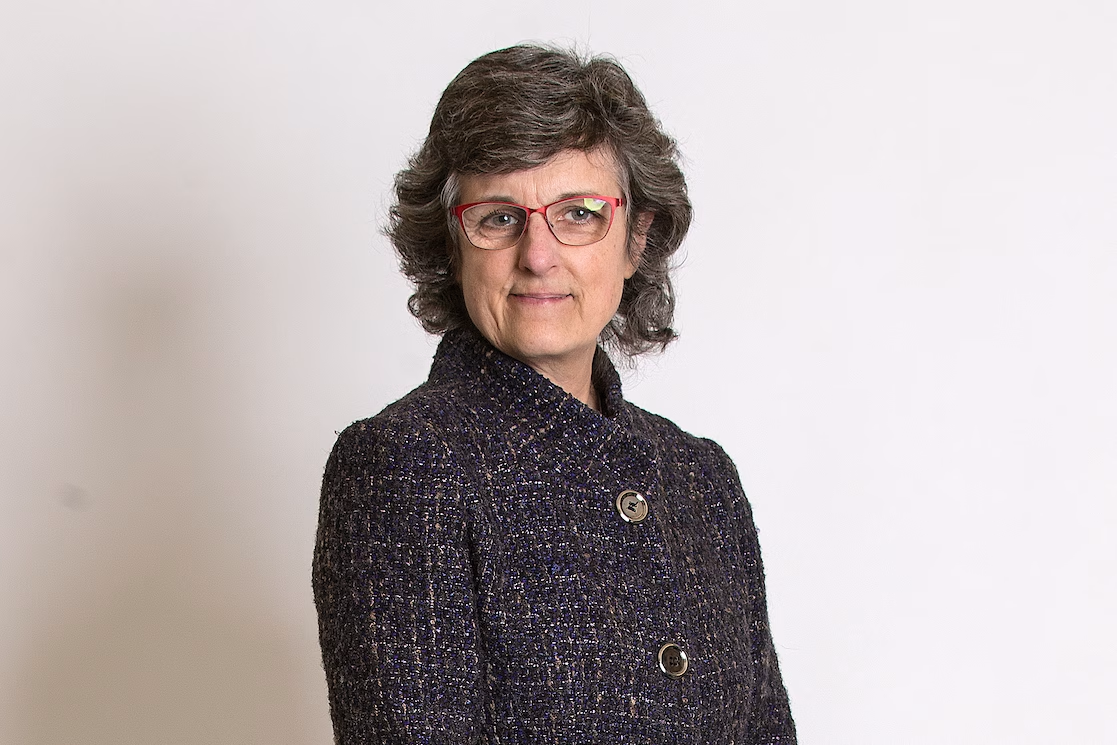
zThis is the third of three blog posts, at the end of the academic year, by Mary Triggiano, director of Marquette University Law School’s Andrew Center for Restorative Justice. These stories are also available on the Marquette Law School blog.
In many ways, restorative justice is the opposite of a shortcut.
It asks law students to slow down, sit with discomfort, listen to one another and resist the urge to immediately judge or fix. It requires presence. It requires vulnerability. And, perhaps most importantly, it requires humanity. In a time when technology, including artificial intelligence in particular, is reshaping how students learn and process information, restorative justice has become one of the most profound human experiences in my classroom at Marquette Law School, through the work of the Andrew Center for Restorative Justice.
Like many educators, I have watched students turn to technology for answers, for summaries, for efficiency. And I understand the appeal. The law is complex. The reading is dense. The days are long. But restorative justice has taught me that much important learning in a law school classroom is not found in the quickest answer, the perfect outline, or a polished response generated in seconds. It is found in the pause before speaking. In the courage to share a personal story. In the humility to listen.
Restorative justice does not translate well into an algorithm.
When students sit in a circle, there is no back row, nor is there a front of the room. No raised hand to compete for a professor’s attention. No performative answers given for a grade. Instead, there is a talking piece, a shared set of values, and an invitation to be fully seen and heard. It is in that space that something extraordinary happens. Students are better able to recognize one another not just as classmates, but as fellow human beings shaped by family, trauma, faith, identity, fear, hope and love. These circles, whether on campus, in the community or inside correctional institutions, are at the heart of the Andrew Center’s work.
As Justice Janine Geske, who inaugurated the restorative justice initiative at Marquette Law School, often says, “Restorative justice offers all of us the opportunity to speak our truth and be truly heard.” Her decades of guiding circles, victim–offender dialogues and student learning experiences continue to shape how we teach and practice justice at Marquette Law School.
I’ve watched future lawyers, who are trained to argue and to analyze, sit in silence as they listen to the story of a father who lost his child to violence. I have seen them wrestle with forgiveness and the reality that a person who caused harm was once a child who experienced unimaginable harm himself. I have seen the shift in posture, in voice and in perspective. These are not lessons that come from textbooks or chatbots. They come from presence.
One student captured the impact of restorative justice in a powerful reflection at the end of the semester:
“The lessons learned during our circle have fundamentally shaped my vision of what it means to be an attorney who fights for justice. It has not only enriched my legal education but has also instilled in me a deep commitment to promoting healing and reconciliation within our communities.”
That sense of purpose will benefit from the process of outlining cases and mastering doctrine. But it grew out of sitting in circles, listening to stories of harm and resilience, and witnessing the possibility of repair. In that space, students come to understand that being a lawyer is not only about argument and analysis; it is also about responsibility, compassion and the courage to engage in healing, even when it is uncomfortable.
In a world that often rewards detachment, restorative justice dares students to care. In a culture that increasingly values speed, it teaches us to slow down and reflect. In a system that is built around rules and consequences, it makes space for empathy, accountability and repair.
Restorative justice has reshaped not only how students speak and listen, but also how many of them begin to understand advocacy itself. They become more attentive to harm, responsibility and the human impact of decisions. Their writing reflects greater empathy and curiosity, and their advocacy becomes more grounded in dignity, lived experience and understanding alongside rigorous legal analysis.
Restorative justice does not diminish analytical rigor; it deepens it. Students who learn to sit with complexity and contradiction often approach legal problems differently. They negotiate differently. They question power differently. And they begin to enter their future roles as lawyers, judges, policymakers and community leaders with refined emotional intelligence and a broader understanding of what justice can be.
In that way, restorative justice has reshaped my classroom by keeping our shared humanity at the center.
The tools around us will continue to evolve. Artificial intelligence will continue to grow more sophisticated. The law will continue to change. But there is no replacement for sitting in a circle, looking someone in the eye, hearing their story and realizing that justice is not just something we argue about. It is something we practice together.
In this moment, teaching restorative justice at Marquette Law School feels less like a course and more like an act of quiet resistance. A reminder that even in the age of machines, it is still the human voice, the human heart and the human story that have the power to transform.
Research & Innovation, Stories at MU, University Initiatives
Faculty Focus: Dr. Patrick Johnson investigates animus toward LGBTQ+ representation in news
Campus Life, Stories at MU
News you can use: Protein popularity — Why we’re all obsessed with the macronutrient
Stories at MU
Bringing an international film festival to life
© 2026 Marquette Today. All rights reserved.