
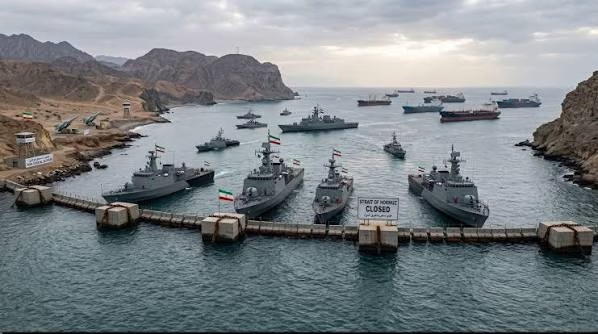
IndiaPrime International Desk The Islamic Revolutionary Guard Corps (IRGC) has announced the closure of the Strait of Hormuz “until further notice,” marking a major escalation in the ongoing confrontation between Iran and the United States. The announcement followed an incident in which Iranian forces said they fired warning shots at a commercial vessel allegedly using an unauthorized shipping route before halting the ship.
The action reportedly took place during the early hours of 12 July 2026 (IST), with international news agencies carrying live updates shortly afterward. The Strait of Hormuz is one of the world’s most strategically important maritime chokepoints, carrying a significant share of global crude oil and LNG exports. (Reuters)
Iran’s Position
According to the IRGC Navy, several vessels attempted to transit the waterway through an “unauthorized route” despite repeated warnings. Iranian authorities claimed one vessel had switched off its tracking systems, posing a threat to maritime security, and was subsequently stopped.
The IRGC stated that:
- The Strait of Hormuz will remain closed until further notice.
- No commercial vessel will be permitted to transit the waterway.
- The restriction will remain in place until what Tehran describes as the end of U.S. interference in the region.
- Iran warned that any retaliation would receive a “severe response.” (Internazionale)
US and CENTCOM Response
The U.S. Central Command (CENTCOM) said Iran’s actions endangered civilian shipping and violated previous understandings intended to keep the strategic waterway open.
Following the incident, the United States launched another round of military strikes against Iranian targets. According to U.S. officials, the objective is to protect commercial shipping, preserve freedom of navigation, and deter further attacks on merchant vessels.
President Donald Trump has demanded that Iran publicly guarantee safe passage for international shipping through the Strait of Hormuz and cease attacks on commercial vessels. (Financial Times)
Regional Response
Oman, which borders the Strait of Hormuz, is continuing diplomatic and technical discussions with Iran and regional stakeholders to reduce tensions.
Regional officials are reportedly exploring alternative navigation arrangements and confidence-building measures aimed at preventing further disruption to commercial shipping in the Gulf.
Why the Strait of Hormuz Matters
The Strait of Hormuz connects the Persian Gulf with the Gulf of Oman and the Arabian Sea.
Key facts:
- Roughly one-fifth of global oil trade passes through the Strait.
- It is also a critical route for global LNG exports, particularly from Qatar.
- Any prolonged disruption can significantly affect international energy prices, shipping insurance costs, and global supply chains.
IndiaPrimeTV Analysis
The latest confrontation represents one of the most serious threats to global maritime trade in recent years. While Iran has declared the Strait closed, the practical impact will depend on whether it can enforce that declaration in the face of the U.S. naval presence and allied maritime operations.
For India, which imports a substantial share of its crude oil from Gulf producers, any sustained disruption in the Strait of Hormuz could increase crude oil prices, raise freight and insurance costs, and put renewed pressure on domestic fuel prices and inflation. Markets will closely watch whether diplomatic efforts succeed in preventing a wider regional conflict.
Keywords
Iran, Strait of Hormuz, IRGC, CENTCOM, Donald Trump, US Iran Conflict, Gulf Crisis, Oil Prices, Global Shipping, Maritime Security, Hormuz Closure, Middle East News