

Updated | Tuesday, July 14, 2026 | 11:50 AM IST India Prime Global Desk | Recent social media posts and some media reports have claimed that Saudi Arabia threatened to suspend financial assistance to Pakistan unless Islamabad fulfilled commitments under a bilateral defense agreement. However, there is no official evidence supporting these claims.
According to available official information, a high-level meeting between Saudi Defense Minister Prince Khalid bin Salman and Pakistan’s Chief of Army Staff (now Field Marshal) Asim Munir took place in Riyadh on March 6–7, 2026. The discussions focused on strengthening strategic defense cooperation amid growing regional security challenges.
Why the Meeting Was Held
The meeting came against the backdrop of heightened geopolitical tensions in West Asia, particularly following drone and missile attacks targeting Saudi Arabia’s critical energy infrastructure, including facilities linked to Saudi Aramco.
Officials from both countries described the discussions as part of ongoing efforts to enhance bilateral security coordination and implement their existing Strategic Mutual Defense Agreement.
No Official Mention of Aid Suspension
Following the meeting, neither the Saudi government nor the Pakistani military issued any statement mentioning:
- Suspension of Saudi financial assistance
- Military sanctions or restrictions
- An ultimatum directed at Pakistan
- Any warning linked to economic support
Instead, official statements characterized the talks as constructive and reaffirmed the longstanding strategic partnership between Riyadh and Islamabad.
Background: Saudi Arabia–Pakistan Defense Cooperation
Saudi Arabia and Pakistan maintain one of the Middle East’s closest military relationships. Their defense cooperation includes:
- Military training and joint exercises
- Intelligence sharing
- Counterterrorism cooperation
- Strategic security consultations
- Defense coordination during regional crises
The two countries have maintained defense ties for decades, with Pakistan providing military expertise and Saudi Arabia remaining an important economic partner.
Why the Rumors Emerged
The speculation appears to stem largely from:
- Social media posts
- Commentary by political analysts
- Assumptions based on Pakistan’s economic dependence on Saudi financial support
Saudi Arabia has previously provided Pakistan with financial packages, deposits, and oil credit facilities during periods of economic stress. Because of this dependence, some analysts speculate that Riyadh possesses significant leverage over Islamabad.
However, analytical speculation should not be confused with confirmed government policy.
Current Status
Based on official statements available after the March 2026 meetings:
- The defense talks focused on regional security cooperation.
- No official Saudi or Pakistani document mentions a threat to halt financial assistance.
- Claims regarding an aid cutoff remain unverified and primarily circulate through social media and unofficial commentary.
Unless either government releases new official information, reports suggesting Saudi Arabia threatened Pakistan with financial sanctions should be treated as unconfirmed rather than established fact.

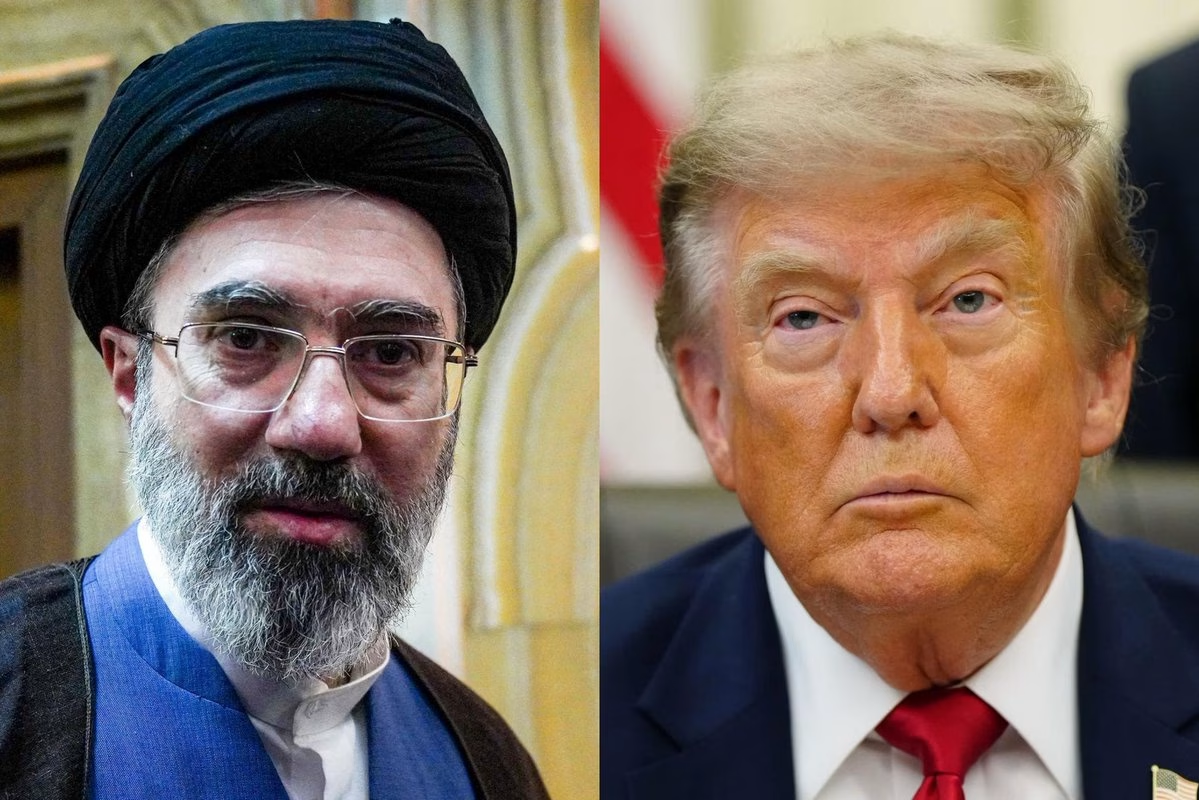
- Escalating US-Iran Tensions: Conflict intensifies as US President Donald Trump proposes strict sanctions on Iran and a transit fee on ships passing through the critical Strait of Hormuz, souring global risk appetite.
- Surging Crude Oil Prices: Geopolitical friction has pushed global Brent crude prices past $84–$85 per barrel, posing massive fiscal and inflation risks for India as a major oil importer.
- Sticky Domestic Inflation: India’s June retail inflation (CPI) climbed to 4.38%, overshooting the RBI’s 4% target and raising fears of imported inflation from rising oil costs.
- Weak Global Cues: Overnight losses in major US indices (Dow Jones, S&P 500, Nasdaq) spilled into early Asian trade, dragging down regional peers like Japan’s Nikkei and South Korea’s Kospi.
- Nifty 50 Outlook: After closing Monday at 24,211, Nifty is expected to open below the psychological 24,000 mark.
- Immediate Support Zone: 24,000 – 23,930
- Immediate Resistance Zone: 24,280 – 24,320
- Q1FY27 Earnings: Stock-specific volatility is expected today as major companies like Tata Elxsi, L&T Technology Services, Anand Rathi, and Aditya Birla Money report their first-quarter financial results.
- Institutional Flows: FIIs remained net sellers on July 13, offloading equities worth approximately ₹3,062 crore, while DIIs provided cushion via counter-buying.
- No-Fly Zone: Commercial airlines have completely shut down all transit routes operating over Iranian airspace and the strategic Strait of Hormuz.
- Flight Diversions: Flights operating from India to Europe, the United States, and various Gulf destinations (including Dubai, Abu Dhabi, and Qatar) are being rerouted. Aircraft are now forced to take much longer paths via the safer corridors of Central Asia or the Southern Arabian Sea.
- The Impact: These new, extended routes have increased total flight times by anywhere from 45 minutes to 2 hours. Furthermore, the combination of soaring Aviation Turbine Fuel (ATF) consumption and surging war-risk insurance premiums is expected to trigger a steep rise in international airfares.
- The Targets: The UAE Ministry of Defence confirmed that the commercial oil tankers Mombasa and Al Bahiyah were struck by Iranian cruise missiles. The incident took place in Omani territorial waters as the vessels were navigating the southern transit routes of the strait.
- Casualties & Injuries: One Indian national on board the Mombasa was killed instantly. Eight other crew members sustained injuries, including six Indian nationals and two Ukrainians. Four of the injured remain in critical condition.
- Vessel Condition: Both tankers suffered significant structural damage and caught fire following the impacts. However, the remaining crews successfully brought the blazes under control, preventing catastrophic oil spills or the sinking of the ships.
- Iran’s Position: The Islamic Revolutionary Guard Corps (IRGC) claimed responsibility for the interception, alleging that both vessels ignored repeated naval warnings, turned off their transponders, and intentionally steered into a sensitive military zone.
- The UAE’s Stance: The UAE government has vehemently denied these claims, labeling the missile strikes a “brazen assault” and a clear violation of international maritime law. Abu Dhabi stated it reserves the right to respond to protect its citizens and commercial interests.
- US Military Engagement: In direct response to the attack and ongoing threats, the US military (via CENTCOM) launched a third consecutive night of heavy air assaults against Iranian coastal missile batteries, targeting hubs in Bandar Abbas, Qeshm Island, and Bushehr.
India Prime International Desk US-Iran Conflict Live Updates
Timeline of Today’s Military Strikes
02:30 AM (IST): U.S. Central Command (CENTCOM) confirmed a third consecutive night of heavy airstrikes on Iranian coastal military installations, authorized by President Donald Trump.
04:15 AM (IST): Massive explosions were reported across Bandar Abbas, Kish Island, and Qeshm Island. U.S. strikes primarily targeted Iranian radar systems, drone hangars, and missile launch platforms.
06:00 AM (IST): The Pentagon released a statement confirming that these operations are essential to neutralizing Iran’s “aggressive military capabilities.”
07:30 AM (IST): The Islamic Revolutionary Guard Corps (IRGC) initiated an “Eye for an Eye” operation, launching retaliatory missile strikes on U.S. military bases in Kuwait and Bahrain. The situation remains highly volatile.
Global Economic Impact (Oil Prices)
The ongoing military escalation has triggered severe instability in global energy markets:
Surge in Crude Oil: Brent Crude prices have jumped by over 9% today, marking the sharpest increase recorded in 2026.
Supply Chain Threats: With approximately 20% of the world’s oil passing through the Strait of Hormuz, the insecurity of this maritime route has sparked fears of prolonged fuel price hikes worldwide.
Market Volatility: Financial markets are experiencing significant uncertainty, leading investors to move toward safe-haven assets like gold. Analysts warn that if the conflict persists, the global economy could face a deeper downturn.
What happened in the Strait of Hormuz?
The Strait of Hormuz has become the epicenter of this conflict:
Tanker Attacks: Late Monday, Iran targeted two UAE-owned supertankers, the Al-Bahiyah and the Mombasa, with cruise missiles while they were in Omani waters.
Humanitarian Toll: The missile strikes ignited massive fires on both vessels. Tragically, one Indian crew member was killed in the attack on the Mombasa, and eight others were left critically injured.
Maritime Blockade: President Trump has officially declared a full “maritime blockade” of the Strait of Hormuz. Under this mandate, all commercial vessels transiting through the region are now subject to U.S. naval surveillance, imposing strict new controls on international trade.
As the sun sets on July 14, 2026, the situation remains dangerously fluid. With the U.S. enforcing a strict maritime blockade in the Strait of Hormuz and Iran intensifying its retaliatory strikes across the Gulf, the region stands at a critical juncture. The international community is bracing for the potential of a wider, more protracted conflict that threatens both regional stability and global economic security.
While military actions currently dominate the landscape, all eyes are now on the diplomatic corridors in Washington and Tehran. Whether these developments lead to a total cessation of hostilities or further escalation in the coming days remains uncertain. For now, the world watches and waits, as the energy markets react with volatility and geopolitical tensions continue to hit historic highs
US Iran war live updates, Breaking news US Iran conflict today, Strait of Hormuz tension, US strikes on Iran, Middle East crisis 2026, Oil prices surge today, Donald Trump Iran policy.