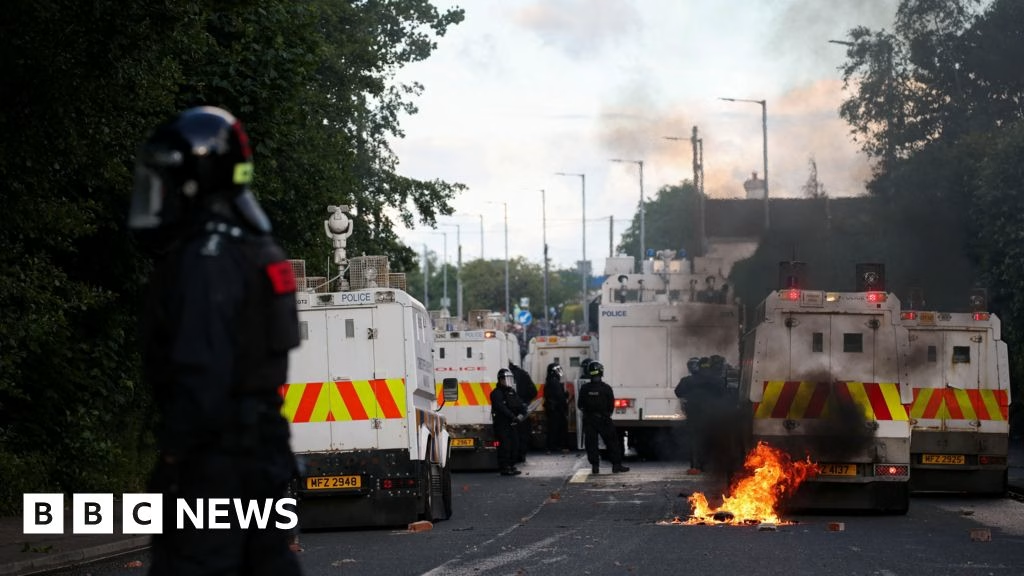
Water cannons have been used to disperse protesters who have returned to the streets of Northern Ireland for a second night.
Additional police officers were drafted in after violence erupted on Tuesday night following a knife attack in Belfast.
At least 200 people gathered at a roundabout in County Antrim – they set a large vehicle on fire and hurled bricks at the police.
Public transport shut down across Northern Ireland and some schools closed early on Wednesday ahead of any disruption. Belfast city centre is deserted after many businesses shut up shop by lunchtime.
The cannons were deployed at the Sandyknowes roundabout, about eight miles (13km) north-west of Belfast city centre.
People could be seen firing objects at police before retreating. Aerial footage captured what appears to be the group building up a pile of bricks.
In east Belfast, where there was major trouble on Tuesday, about 200 people gathered amid a large police presence.
More than 100 people gathered at row of houses near the Ulster University campus in Coleraine, County Londonderry.
Some of the crowd remonstrated with police about the houses of multiple occupation (HMOs) and those living in them before before finishing up.
In Derry, police advised motorists to avoid the Ardmore Road at the Church Brae junction due to items on fire.
About 140 protesters had gathered at the Stormont estate in Belfast, however they have largely dispersed.
Hadi Alodid, a 30-year-old originally from Sudan, appeared in court on Wednesday charged with attempted murder over a knife attack in north Belfast on Monday that caused serious injuries to the victim, Stephen Ogilvie.
Ogilvie, who is in his 40s, has lost his left eye and has damage to his right eye, along with injuries to his neck and back.
Reaction to the attack, and the alleged attacker's ethnicity, prompted calls for protests on Tuesday evening in many parts of Northern Ireland.
Groups of masked men set fire to houses, a bus and cars, mostly in the capital, forcing a number of families to flee their homes. Petrol bombs were also thrown at police in a number of locations.
The victim's family has appealed for "peaceful protest as the only way forward" and said there were "many migrants who make a deeply valuable contribution to our society".
In other developments:
Public transport operator Translink suspended bus services at 17:00 and trains at 18:00.
Some schools in Belfast and the surrounding areas closed early but the Department of Education said there was no blanket decision to close all schools.
There was "some anecdotal evidence of a decrease of pupil attendance" following the overnight disturbances in Northern Ireland, Stormont's education minister has said, although A-level and GCSE exams were "continuing as normal".
Paul Givan told the Northern Ireland Assembly's education committee that the fall in attendance was "particularly among newcomer population" – those pupils for whom English or Irish is not their first language.
The Royal College of Nursing said some staff had been "stopped by masked men" when trying to get into work on Tuesday night.
RCN director Rita Devlin said: "They have been asked to show their credentials to masked men. They have been unable to get into work."
She said some of these nurses were from overseas and were "absolutely petrified".
Devlin called for all essential workers to be allowed safe passage to work.
"We simply could not run our services without them. If all our internationally educated nurses left tomorrow, our system would grind to a halt," she added.
Many of the protests on Tuesday, in areas such as Ballymena, Londonderry and Antrim, saw people peacefully block roads.
However, scenes of violence emerged at protests in Belfast, Newtownabbey, Portadown and Kilkeel.
Some of the worst scenes were in Belfast, particularly in the Newtownards Road, where a Translink Glider bus was set on fire, and Crumlin Road areas.
At one stage a masked group of about 100 people made their way down the Newtownards Road attacking houses and setting fire to vehicles – including a bus.
One man, whose home of 13 years was destroyed by fire, said watching it burn down was "a feeling I'll never get over".
The fire service said it was called to 62 incidents on Tuesday night, most of them in the Belfast area.
Prime Minister Sir Keir Starmer said people were rightly sickened by the horrific attack on Monday night in north Belfast.
"But let me be clear, the acts of violence and arson that followed are totally unjustified," he added.
The prime minister said he had spoken to Northern Ireland's first and deputy first ministers, and the PSNI chief constable.
"We are united in calling for calm and determined to restore order, support the police and all those on the front line, and ensure that justice is done," he added.
Conservative leader Kemi Badenoch said the scenes were "deeply disturbing", adding that people had a "right to be angry" and the right to "expect politicians to secure our borders".
"But no-one has a right to burn families out of their homes or to burn public property and attack the police," she added.
Northern Ireland Secretary Hilary Benn said it was now down to people who participated in disorder to decide whether they want to continue to "leave children absolutely terrified as they're taken out into the dark with flames and screaming around them".
Northern Ireland First Minister Michelle O'Neill described Tuesday's violence as "disgusting cowardice" and "thuggery", while Deputy First Minister Emma Little-Pengelly said it was "absolutely unacceptable".
PSNI Chief Constable Jon Boutcher called on people to not get "carried away with a tide" of views online and be "persuaded by people who know nothing about Northern Ireland".
"Stop listening to these idiots," he said. We will be going after them for the incitement they will be doing."
Last week, he said he had "real concerns" about the prospect of unrest over the summer, following "really difficult, major disturbances in the last two years".
He told the Northern Ireland Policing Board he was worried about the influence of "bad actors spreading extreme and hateful disinformation on social media".
BBC Verify mapped some of the violent disorder that took place in Belfast and elsewhere in Northern Ireland.
The 14-year-old mixed race schoolboy disappeared and died in north Belfast almost six years ago.
Houses, vehicles and a bus were set on fire during violent protests on Tuesday night after a knife attack in Belfast.
Belfast police say a refugee charged with the attempted murder of a man on Monday initially entered the country from the Republic of Ireland.
Houses across the city have been set on fire following a knife attack earlier this week.
Copyright 2026 BBC. All rights reserved. The BBC is not responsible for the content of external sites. Read about our approach to external linking.