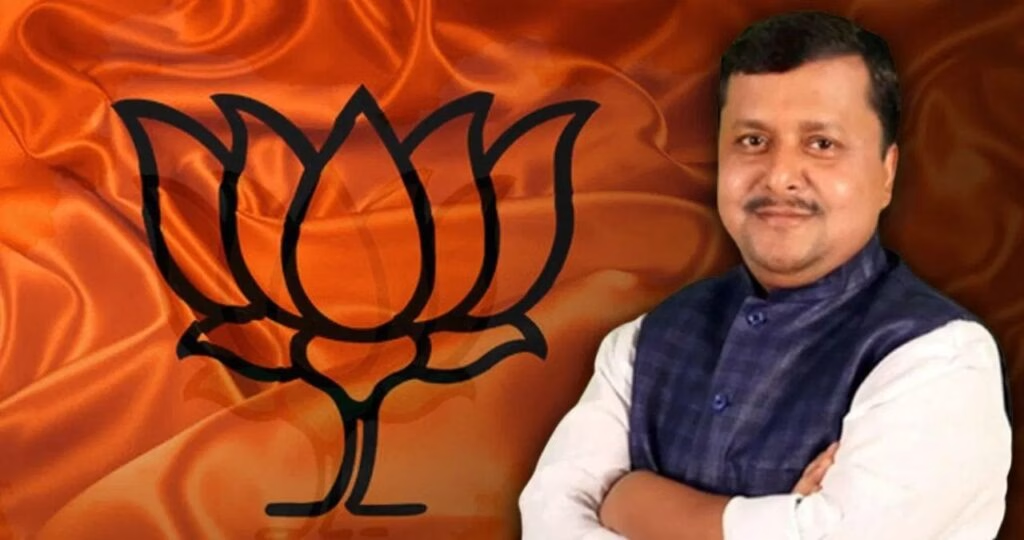
India Prime Political Desk | New Delhi/Srinagar “The Bharatiya Janata Party will form the government in Jammu & Kashmir. It is only a matter of time.” This statement by BJP National President Nitin Naveen has triggered intense political debate. Political observers believe the remarks are being assessed in the context of the BJP’s past political strategies, including developments involving regional parties in West Bengal and Punjab, as well as the party’s long-term expansion plans.
Nitin Naveen visited Kashmir during the celebrations marking the 125th birth anniversary of Dr. Syama Prasad Mookerjee. His visit has drawn attention because Dr. Mookerjee, the founder of the Bharatiya Jana Sangh, remains closely associated with the BJP’s long-standing ideological position on Jammu & Kashmir. The BJP has repeatedly highlighted the slogan of “One Nation, One Constitution, One Flag and One Head”, making Naveen’s statement politically significant. Regional parties in Kashmir are now trying to understand the message behind his remarks.
At present, the National Conference (NC)-Congress alliance is in power in Jammu & Kashmir, with Chief Minister Omar Abdullah leading the government. This has raised questions about whether the BJP is preparing for a long-term political strategy in the Union Territory. Omar Abdullah and other regional parties have questioned how the BJP expects to form a government despite the current Assembly numbers.
Omar Abdullah’s Biggest Challenge: Growing Differences Within His Own Party
Within months of forming the government, signs of internal dissatisfaction have emerged inside the National Conference. The differences are not limited to cabinet positions but also involve ideological, organizational and political issues.
1. Article 370 and Statehood: The Biggest Ideological Dispute
Senior National Conference leader and Srinagar MP Aga Ruhullah Mehdi has openly questioned the party leadership. He argues that the promises made during the Assembly elections regarding the restoration of Article 370 and full statehood have not been pursued aggressively after coming to power.
On several occasions, Ruhullah has publicly criticized Chief Minister Omar Abdullah’s approach. Political analysts see these remarks as evidence of an emerging ideological divide within the party.
2. Dissatisfaction Over Cabinet Expansion
Several MLAs are reportedly unhappy over the limited size of the cabinet and the distribution of ministerial portfolios. Many legislators expected greater representation in the government after the election.
The delay in cabinet expansion has further increased dissatisfaction, and the opposition has repeatedly raised the issue.
3. The Role of Independent MLAs
Several Independent MLAs supported the National Conference during government formation. Political circles continue to discuss the possibility that these legislators could become important if political circumstances change in the future.
However, as of now, there has been no official indication that any Independent MLA plans to withdraw support from the government.
4. Challenges Within the NC-Congress Alliance
Although the government is functioning as an alliance, questions have occasionally been raised about coordination between the National Conference and the Congress.
Some Congress leaders have publicly expressed dissatisfaction over the alliance. Discussions regarding Congress’ participation in certain political meetings have also fueled speculation about differences within the coalition.
What Is BJP’s Strategy?
Political observers believe the BJP’s strategy is not to immediately topple the government but to gradually strengthen its political position over the coming years.
The party is simultaneously focusing on monitoring internal differences within the ruling alliance, expanding its organization in the Kashmir Valley, promoting a development-oriented political narrative, and preparing for the 2029 Assembly elections.
The BJP does not appear to be in a hurry to bring down the present government. Instead, its focus remains on long-term political expansion.
Expanding the Organization in Kashmir Valley
The BJP wants to move beyond its traditional support base in the Jammu region. It is working to strengthen booth-level organization in the Valley, recruit new workers, and develop local leadership.
Development-Centred Political Narrative
The BJP continues to project development, infrastructure, tourism, investment, roads, railways and employment as the key issues that will shape the future politics of Jammu & Kashmir.
As part of this strategy, the party is trying to build direct outreach among beneficiaries of various Central Government welfare schemes.
Building Local Leadership
The BJP is also attempting to strengthen its social and political base through Panchayati Raj institutions, local bodies and young leaders.
BJP’s Possible Roadmap for 2029
Political analysts believe the 2029 Assembly election could be crucial for the BJP.
The party’s possible strategy includes:
- Increasing its presence in the Kashmir Valley.
- Retaining its existing support base in the Jammu region.
- Making development and good governance the central election issues.
- Promoting local leadership.
- Taking political advantage of internal dissatisfaction within opposition parties.
- Expanding direct outreach to beneficiaries of Central Government schemes.
Is the Government Under Immediate Threat?
Based on the current Assembly numbers, the National Conference-Congress alliance enjoys a working majority. Therefore, there is no immediate indication that the government is in danger.
However, politics can change quickly. If internal dissatisfaction within the ruling alliance, among Independent MLAs, or inside the National Conference grows in the future, political equations could also change. At present, drawing any definite conclusion would be premature.
The Political Picture
The BJP’s current objective appears to be broader than simply replacing the government. It is trying to gradually expand its political acceptance in the Kashmir Valley.
At the same time, Chief Minister Omar Abdullah’s biggest challenge is to keep his party united, maintain coordination within the alliance, balance public expectations regarding the restoration of statehood, and deliver effective governance.
For this reason, the 2029 Assembly election is expected to be more than a contest for power. It could shape the future political direction of Jammu & Kashmir.
India Prime Analysis
The BJP’s present strategy appears to focus less on bringing down the current government and more on preparing the political ground for the future.
For the National Conference, the bigger challenge may not come from the opposition but from managing internal differences and maintaining unity within the alliance.
If Omar Abdullah succeeds in addressing these challenges, the 2029 electoral contest could become highly competitive. On the other hand, if internal divisions deepen, the BJP may find greater opportunities to expand its political influence.
Ultimately, the political outcome will depend on voters, electoral issues and the political circumstances prevailing at the time of the election.