
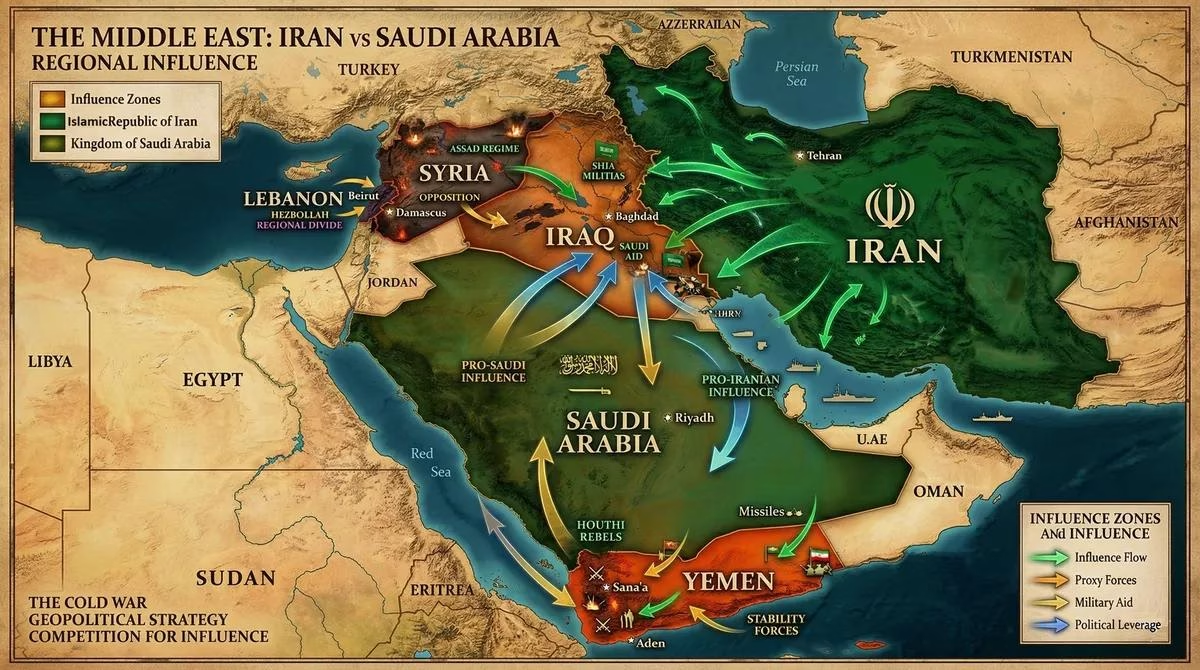
Anita Chauhan / IndiaPrimeTV International Analysis | Special Geopolitical Report Trump–Saudi Nuclear Deal: The reported US-Saudi nuclear agreement should not be viewed simply as a deal to provide Saudi Arabia with civilian nuclear energy. Its real significance extends far beyond electricity generation. At its core, the agreement is linked to the changing balance of power in the Middle East, Iran’s nuclear ambitions, Saudi Arabia’s security concerns, Israel’s strategic calculations, America’s competition with China, and the future of nuclear non-proliferation.
An Important Fact Check
The reported agreement should not be described as the United States giving Saudi Arabia permission to build nuclear weapons.
The central issue is a proposed long-term civilian nuclear cooperation framework that could potentially allow Saudi Arabia to develop domestic uranium enrichment capabilities. This is highly sensitive because the same technology used for peaceful nuclear energy can, under different circumstances, be used to produce highly enriched uranium.
The key questions are therefore not only about nuclear power plants, but also about safeguards, inspections, uranium enrichment and the possibility of future military applications.
According to reports, the proposed agreement could face scrutiny in the US Congress, while concerns remain over whether it contains sufficiently strict non-proliferation safeguards comparable to the so-called “Gold Standard” arrangements.
Why Does the US Need This Deal With Saudi Arabia?
The answer can be understood through three words:
Iran. Energy. Strategic Partnership.
Saudi Arabia has traditionally been one of America’s most important partners in the Arab world. However, the regional security architecture has changed dramatically in recent years.
Iran’s nuclear programme, growing tensions between Iran and Israel, conflicts across the Middle East, and China’s expanding economic and diplomatic influence in the Gulf have forced Washington to reconsider its long-term strategy At the same time, Saudi Arabia no longer wants to remain dependent on oil alone.
Under Crown Prince Mohammed bin Salman, Riyadh is attempting to transform the Saudi economy through technology, industrial development, infrastructure, defence, renewable energy and nuclear power.This is where the nuclear agreement becomes strategically important.
For Saudi Arabia, nuclear energy is about electricity and economic diversification.For the United States, it could also become a mechanism to deepen its strategic relationship with Riyadh.
1. Is This Deal Really Designed to Counter Iran?
In my assessment, Iran is one of the most important reasons behind the agreement—but not the only one.
Saudi Arabia and Iran are two of the Middle East’s most influential regional powers.
For decades, their rivalry has involved politics, security, regional influence and competing alliances.
If Iran moves closer to becoming a nuclear threshold state, Saudi Arabia may fear that the regional balance of power could shift decisively in Tehran’s favour.
This creates a strategic chain reaction:
Iran develops greater nuclear capability → Saudi Arabia feels increasingly vulnerable → Riyadh seeks stronger US security guarantees → Washington provides strategic and nuclear cooperation → Saudi Arabia becomes more deeply integrated into the US security architecture.
In this sense, nuclear technology becomes more than an energy issue.
It becomes a component of strategic power and regional deterrence.
2. Is America Making Saudi Arabia Stronger Against Iran?
Potentially, yes—but it is important not to confuse civilian nuclear cooperation with a nuclear weapons programme.
The key concern is uranium enrichment.
A country with enrichment capability can use it for peaceful nuclear fuel production. However, the same technical infrastructure can theoretically be adapted for producing highly enriched uranium.
That is why international non-proliferation experts focus heavily on safeguards and inspections.
The central debate is therefore:
How much nuclear capability should Saudi Arabia be allowed to develop, and what safeguards will prevent that capability from being diverted toward military purposes?
According to reporting, concerns have emerged over whether the proposed agreement includes the strongest possible non-proliferation provisions. Critics have specifically questioned the absence of some safeguards associated with the UAE’s “Gold Standard” agreement and the role of enhanced IAEA inspections.

3. Why Would the US Take This Risk?
There are at least five strategic reasons.
First: Iran
Washington wants to prevent Iran from becoming the only dominant nuclear-capable power in the Middle East.
A stronger Saudi Arabia could provide Washington with additional strategic leverage.
Second: Keeping Saudi Arabia Close to the US
Saudi Arabia has expanded its relations with China in recent years.
By offering cooperation in nuclear energy, defence and technology, Washington can reinforce its position as Riyadh’s principal strategic partner.
Third: The American Nuclear Industry
The agreement also has an economic dimension.
A large Saudi civilian nuclear programme could generate significant long-term opportunities for American companies involved in reactor technology, engineering, fuel supply and infrastructure.
This means the deal could serve both American geopolitical interests and American commercial interests.
Fourth: Saudi Security Guarantees
Riyadh has long sought stronger US security commitments.
A nuclear cooperation agreement could become part of a much broader US-Saudi strategic framework involving defence, investment, technology and regional security.
Fifth: Maintaining American Influence in the Middle East
Washington’s challenge is no longer limited to Iran.
China’s growing economic and diplomatic presence in the Gulf is also a major strategic concern.
The US therefore has an incentive to ensure that Saudi Arabia’s long-term security and technological needs remain closely tied to American partnerships.
4. Could the Deal Backfire?
This is perhaps the biggest strategic risk.
If Saudi Arabia develops domestic enrichment capabilities while Iran continues to expand its nuclear programme, the Middle East could enter a new phase of nuclear competition.
The possible strategic equation could look like this:
Iran → Maintains or expands nuclear capabilities
Saudi Arabia → Develops domestic enrichment capabilities
Israel → Maintains its policy of nuclear ambiguity
Other regional powers → Begin reassessing their own strategic options
Such a scenario could create a regional security dilemma.
One country’s attempt to increase security could make neighbouring countries feel less secure—and encourage them to develop their own capabilities.
That is the classic mechanism behind an arms race.
5. Why Will Israel’s Reaction Matter?
Israel’s position will be critical.
A central principle of Israeli security policy has traditionally been to prevent hostile regional powers from acquiring nuclear weapons.
This creates an obvious question:
If uranium enrichment is considered dangerous in Iran, why should the same capability be acceptable for Saudi Arabia?
The answer from Washington would likely be that Saudi Arabia is a US partner and that its programme would operate under international safeguards.
But Israel may still be concerned about the long-term implications.
If Saudi Arabia acquires enrichment capability, Israel could face a fundamentally different strategic environment.
This is why the nuclear agreement may ultimately become connected to the wider US effort to reshape relations between Saudi Arabia and Israel.
6. What Could Iran Do Next?
Iran’s response could become one of the most important consequences of the agreement.
Tehran has several possible options.
Option 1: Diplomatic Pressure
Iran could argue that Washington is applying double standards—restricting Iran’s nuclear programme while allowing Saudi Arabia greater nuclear flexibility.
Option 2: Strengthening Its Nuclear Programme
Iran could conclude that it must retain or expand its own nuclear capabilities to maintain strategic balance.
This could increase tensions with the United States and Israel.
Option 3: Expanding Strategic Partnerships
Iran could deepen its economic and security cooperation with China and Russia.
This could further divide the Middle East into competing strategic blocs.
The result could be a broader geopolitical competition involving:
US + Saudi Arabia + Israel
versus
Iran + China + Russia
This would not necessarily represent a formal military alliance, but it could reflect increasingly competing strategic interests.
7. Why Could Pakistan Become Important?
Pakistan is another factor that strategic analysts will closely monitor.
Saudi Arabia and Pakistan have longstanding defence and security ties. Any future Saudi move toward greater nuclear capability will therefore inevitably raise questions about the nature of their strategic relationship.
However, it would be incorrect to conclude that Saudi Arabia is preparing to build nuclear weapons.
The distinction between a civilian nuclear programme and a weapons programme remains crucial.
The concern is that domestic enrichment capability could provide Saudi Arabia with a wider range of future strategic options.
That possibility alone could alter regional calculations.
8. What Is the Biggest Challenge for Trump?
The Trump administration faces two competing objectives.
Objective One: Keep Saudi Arabia firmly within the American strategic camp and strengthen the regional balance against Iran.
Objective Two: Prevent the weakening of the global nuclear non-proliferation system.
If Washington gives Riyadh too much nuclear flexibility, Iran could argue that it deserves the same rights.
If Washington imposes extremely strict conditions, Saudi Arabia could potentially seek deeper cooperation with China or other partners.
This is why the agreement is more than a nuclear energy deal.
It is a test of American Middle East strategy.

9. What Happens Next?
The next major step will be the US political and congressional review process.
If the agreement moves forward, several scenarios are possible.
Scenario One: Approval
The deal is accepted, allowing American companies to participate more deeply in Saudi Arabia’s nuclear energy programme.
Scenario Two: Stronger Safeguards
Congress demands additional non-proliferation provisions, inspections or restrictions on enrichment.
Scenario Three: Political Opposition
The agreement faces prolonged political resistance or legal challenges.
Scenario Four: Regional Nuclear Competition
Iran and other regional states respond by reassessing their own nuclear and security policies.
This fourth scenario would be the most dangerous.
10. What Does This Mean for India?
India has major strategic, economic and energy interests in the Gulf.
Millions of Indians live and work across the region, while India maintains strong economic and diplomatic relations with Saudi Arabia, the UAE, Iran and other Gulf states.
Any major deterioration in regional security could affect:
- crude oil prices
- shipping and maritime security
- India’s energy security
- remittances
- Indian expatriate workers
- trade routes
At the same time, if Saudi Arabia develops a stable civilian nuclear energy sector, India could potentially see opportunities for cooperation in energy, technology and investment.
India’s biggest challenge will be maintaining its strategic autonomy while balancing relations with the United States, Saudi Arabia, Iran and Israel.
Conclusion: Is This America’s New Strategy Against Iran?
The more accurate interpretation is that Washington may be seeking to strengthen Saudi Arabia as a strategic partner against Iran without directly giving Riyadh nuclear weapons.
However, the potential issue of uranium enrichment makes the agreement extremely sensitive.
If strict international safeguards are maintained, the deal could help Saudi Arabia develop a civilian nuclear energy sector while strengthening its relationship with Washington.
But if safeguards are weakened and regional tensions continue to rise, the same agreement could contribute to a new nuclear competition in the Middle East.
The biggest question is therefore not simply whether Saudi Arabia will develop nuclear power.
The real question is:
Will the United States allow Saudi Arabia to acquire enough nuclear technology and infrastructure to preserve a future option for developing a military nuclear capability—and if so, how will Iran, Israel and the wider Middle East respond?
That is the real geopolitical centre of the Trump-Saudi nuclear agreement.
IndiaPrimeTV Investigative Angle
For IndiaPrimeTV, the strongest follow-up investigation would be:
“Saudi Nuclear Deal: Is America Taking the Risk of Creating a New Nuclear Power Centre to Counter Iran?”
The investigation should examine four critical questions:
- What exactly does the US-Saudi nuclear agreement permit?
- Will Saudi Arabia be allowed to enrich uranium domestically?
- Why are some US lawmakers concerned about the absence of the strongest non-proliferation safeguards?
- Could the deal trigger a wider nuclear race involving Iran, Saudi Arabia and potentially other Middle Eastern powers?
The most important evidence will be found in the final agreement text, US Congressional review documents, IAEA safeguards arrangements, and official statements from Washington, Riyadh, Tehran and Jerusalem.
The story should therefore be presented carefully: this is not yet a story about Saudi Arabia receiving nuclear weapons. It is a story about whether the United States is willing to expand Saudi Arabia’s civilian nuclear capabilities in a way that could potentially reshape the strategic balance of the Middle East.


