
LIVE UPDATE – July 2026. 08:09 PM IST India Prime International Desk World Breaking: A magnitude 4.8 earthquake struck 53 km (33 miles) northeast of Port-Olry, Sanma Province, Vanuatu, on Monday, July 20, 2026, at 11:53 PM local time.
The seismic event was recorded by monitoring agencies including the European-Mediterranean Seismological Centre (EMSC).Quick Facts About the EventThe Epicenter: Located roughly 51 to 53 kilometres northeast of Port-Olry, a major coastal town on Espiritu Santo island.Tsunami Threat: No tsunami warnings, watches, or threats have been issued following this moderate quake.
Potential for Damage: Due to its moderate 4.8 magnitude, it is highly unlikely to cause any significant structural damage or casualties, though residents in northern Sanma Province and nearby islands may have felt light shaking.Regional ContextVanuatu sits directly on the Pacific Ring of Fire, a highly active tectonic zone where earthquakes and volcanic activity are frequent occurrences. The region experiences regular seismic shifts as the Australian plate subducts beneath the Pacific plate. This specific northern area near Port-Olry has seen multiple moderate tremors over the last few weeks, including a 5.1 magnitude quake on July 9 and a 4.6 magnitude quake on July 12.
US Launches Heaviest Bombing Campaign Yet Against Iran
LIVE UPDATE – July 20, 10:40 AM IST India Prime International Desk World Breaking:
US Launches Heaviest Bombing Campaign Yet Against Iran for Ninth Consecutive Night .The United States has carried out its most intense bombing campaign yet against Iran for the ninth consecutive night, significantly escalating tensions across the Gulf region and raising fears of a wider conflict.
According to a statement released by the U.S. Central Command (CENTCOM), the latest wave of strikes is aimed at completely dismantling Iran’s military capability to target commercial shipping in the Strait of Hormuz, one of the world’s most critical maritime trade routes.
Tabriz Targeted for the First Time
In a major expansion of its military campaign, the United States reportedly targeted Tabriz, a key city in northwestern Iran, for the first time. Local reports indicate that at least three powerful explosions were heard across the city.
Strikes Hit Strategic Coastal Cities
Overnight bombardments were also reported in several strategically important port cities along Iran’s southern and southwestern coastline, including:
- Chabahar
- Bushehr
- Bandar Mahshahr
- Bandar Imam Khomeini
These locations are considered vital to Iran’s maritime and energy infrastructure.
Iranian Air Defenses Activated
Iran’s air defense systems were activated in the southeastern province of Sistan and Baluchestan, particularly in the cities of Konarak and Chabahar, following the reported attacks.
Heavy bombardment was also reported in Sirik and Jask in Hormozgan Province, according to local reports.
Fires and Tensions in the Strait of Hormuz
Iran’s Islamic Revolutionary Guard Corps (IRGC) claimed that two oil tankers exploded and became inoperable after traveling along what it described as a route influenced by U.S. actions.
Iran warned that as long as what it calls U.S. “aggression” continues, not a single drop of oil or natural gas will be allowed to pass through the Strait of Hormuz, a waterway through which a significant portion of the world’s energy supplies is transported.
Bahrain and Gulf Region on High Alert
Following the recent deaths of U.S. service members in incidents reported in Jordan and Iraq, security tensions across the Gulf have intensified.
Security alerts have been raised at the U.S. Navy’s Fifth Fleet headquarters in Bahrain as well as at other American military installations across the region.
Iran Claims Retaliatory Missile Strikes
According to Iranian media reports, Iran’s military launched multiple missiles from Lorestan Province, targeting U.S. military positions in what it described as a retaliatory response to the American attacks.
Global Oil Prices Surge
The escalating confrontation has already had a significant impact on global energy markets.
Brent crude oil prices climbed more than 3%, rising above $90 per barrel, as investors reacted to growing concerns over potential disruptions to energy supplies through the Strait of Hormuz.
…………………………………………………………………………………………………………………………………………………………………………………………….
50 Malian Army soldiers dead in clash with Rebel Groups Near Anéfis
LIVE UPDATE – July 20, 12:10 AM IST India Prime International Desk World Breaking:
Fierce Clash Between Malian Army and Rebel Groups Near Anéfis. A deadly attack on the Malian Armed Forces near Anéfis in northern Mali is being described as one of the most severe assaults on the country’s military in recent years.
1. When, Where, and How Did the Attack Happen?
When Did It Occur?
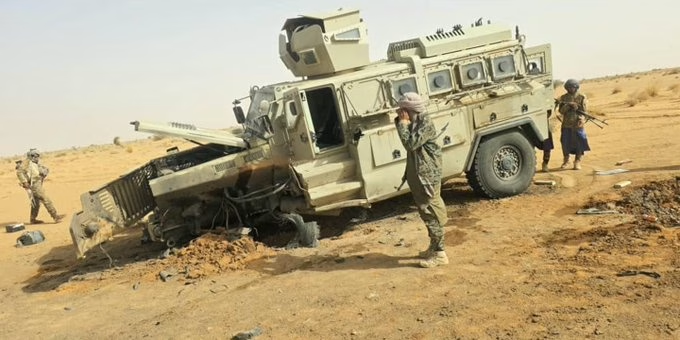
The attack took place on Saturday morning (July 18, 2026) along the strategic desert route between Anéfis and Tabankort in northern Mali. A large Malian military convoy was traveling from Anéfis toward the city of Gao when it came under attack.
How Did the Attack Unfold?
According to available reports, fighters from Jama’at Nasr al-Islam wal-Muslimin (JNIM), an al-Qaeda-linked militant group, and the Azawad Liberation Front (FLA) jointly launched a coordinated ambush on the convoy.
The attackers, reportedly equipped with heavy weapons, surrounded the convoy from multiple directions and opened intense fire, destroying several military vehicles and armored carriers.
Videos circulating on social media, which have not been independently verified, appear to show soldiers being captured. Some reports also claim that a number of surrendered soldiers were killed, although these claims remain unverified by independent sources.
Casualties
According to preliminary reports:
- At least 50 Malian soldiers were killed.
- More than 24 soldiers were reportedly taken prisoner by the attackers.
Reports indicate that Russian Africa Corps personnel, formerly associated with the Wagner Group, had already reached Gao before the convoy was attacked and were therefore not part of the incident.
2. Who Are These Rebel Groups?
Origins of the Conflict
The conflict in northern Mali dates back to 2012, when Tuareg separatist groups launched an armed rebellion seeking an independent state known as Azawad.
Rise of Jihadist Groups
Following the uprising, extremist organizations linked to al-Qaeda and the Islamic State (IS) expanded their presence in northern Mali, exploiting the instability and, in some areas, taking control of territory.
New Alliance in 2026
Although Tuareg separatists and jihadist groups have often fought one another in the past, reports indicate that since April 2026, factions of the FLA and JNIM have coordinated operations against Malian government forces and Russian military personnel, significantly escalating the security situation in the region.
3. Military Losses Over the Years
Mali has experienced continuous armed conflict since 2012, resulting in thousands of military casualties over the past 14 years.
The country’s military governments, which came to power following coups in 2020 and 2021, cited deteriorating security conditions as a key reason for taking control.
Major Reported Losses in Recent Years
- Reports from April 2026 claimed that Mali’s Defence Minister, Lt. Gen. Sadio Camara, was killed during attacks. However, such claims should be treated with caution unless officially confirmed.
- In June 2025, around 60 soldiers were reportedly killed near the Burkina Faso border.
- In July 2025, another major attack reportedly resulted in the deaths of 47 Malian soldiers and 84 Wagner Group fighters, according to various media reports.
4. Impact on Mali’s Economy
Mali is among Africa’s poorest countries, and years of armed conflict have placed enormous pressure on its economy.
Disrupted Supply Chains
Armed groups have repeatedly targeted or blocked key transport routes connecting Bamako with northern Mali, disrupting trade and causing shortages of fuel, food, and essential supplies in affected areas.
Agriculture and Food Inflation
Mali’s economy relies heavily on agriculture.
Years of insecurity, combined with adverse weather conditions including floods and droughts, have reduced agricultural production and contributed to rising food prices.
Humanitarian agencies estimate that millions of people require food assistance across the country.
Pressure on Gold Mining
Mali is one of Africa’s leading gold producers.
Security concerns, regulatory disputes, and operational challenges have affected parts of the mining sector, reducing government revenue and impacting foreign exchange earnings.
Declining Foreign Investment
Persistent insecurity has discouraged foreign investment.
At the same time, a growing share of government expenditure has been directed toward defense and security operations rather than infrastructure, healthcare, and education.
Russian Military Presence in Mali
Russian military personnel operating under the Africa Corps, which succeeded the Wagner Group’s operations in Mali, continue to support the Malian military in counterinsurgency efforts.
Keywords
Mali News, Mali Army Attack, Anéfis Conflict, JNIM, Azawad Liberation Front, Mali Breaking News, Africa Corps, Wagner Group, Mali Security Crisis, Gao, Tabankort, Sahel Conflict, World Breaking News, Mali Military, Northern Mali Violence.


